Automating Enterprise Product Data: Syncing Oracle PIM to HubSpot HubDB

A $200M+ building products manufacturer had massive SKU volume: more than 10,000 product variations stored in an Oracle Product Information Management system, each needing to be accessible, searchable, and localized on the web in real time. Enterprise data architecture commonly breaks at exactly this point, where an ERP's rigid schemas have to meet the performance requirements of a modern CMS at the point of customer interaction.
Executive Summary

Context
A high-volume manufacturer of doors, doorglass, and accessories runs three regional web instances: US English, Canada English, and Canada French. Replicating technical product specifications across all three by hand carried heavy overhead and a real error rate. The objective was to eliminate both. HubSpot would serve as a high-velocity data mirror for the master PIM, beyond its role as a content engine.

What We Built
A stateful data pipeline built on Syncari maps Oracle PIM data into a relational HubDB schema. It supports dynamic page generation for doors, doorglass, and accessories across three regional table sets.

Tech Stack
- HubSpot CMS Enterprise
- HubDB
- Syncari
- Oracle PIM
Not a fit if your product catalog is static, or small enough to manage directly in native HubSpot CRM objects without external PIM dependencies.

The Challenge
Technical specs created constant friction, drifting between internal records and the public site: caming colors, privacy ratings, insulated glass dimensions. A manual web catalog at this volume is an operational liability. A single update to a product line meant manual entry across multiple HubDB tables and language variations, a process that was slow, error-prone, and impossible to scale alongside a growing inventory of doorglass and door accessories. The risk was concrete: a data mismatch could send builders ordering incorrect specifications from outdated web information.

Our Approach
Oracle PIM remained the sole source of truth. Syncari acts as the logic layer that flattens and routes data, which set a clear dependency order and protected data integrity. Multi-regional routing was the hard call. A logic gate inside Syncari checks the catalogName attribute from Oracle: a US catalog value routes the record to the US HubDB tables, and the Canadian English or Quebec catalog values populate the corresponding Canadian English or French tables. Regional product availability is hard-coded into the sync logic rather than managed by hand. French display labels ride alongside English internal names, so front-end localization never breaks API-based filtering.
This engagement is part of our systems integration work for manufacturing & industrial organisations.

Impact

Thousands of Model Configurations, Populated Programmatically
The pipeline populates thousands of model configurations automatically, across product families including doors, doorglass, and blinds. Manual entry across parallel tables and language variations is gone.
Regional Accuracy Enforced by the Sync
Products route automatically into three distinct regional table sets (US-EN, CA-EN, CA-FR) based on ERP catalog markers. Regional availability on the web therefore matches the source system by construction. No one has to police it.
Localization Without Forked Data
French language labels serve the front end. English internal names stay consistent for API-based filtering and developer-side data management. One dataset carries both, so localization never becomes a second catalog to maintain.
API Limits and the Firewall Both Respected
Syncari batches updates to respect HubSpot API limits. Only customer-facing attributes sync, which keeps sensitive PIM data behind the corporate firewall.
HubDB is not natively a relational database. This architecture treats it as one. A two-table structure per product listing, linked by a Model Number column, lets the dynamic page template query every configuration for a product without bloating the main index.
Syncari acts as the stateful data authority. It transforms nested JSON from Oracle, like checking whether a category name contains an impact rating, into simple boolean flags or localized labels in HubDB. No brittle custom code lives in the CMS.
A conditional gate reads the Oracle catalogName on every record. US catalog values populate US tables, and Canadian and Quebec values populate the Canadian English and French tables. Regional governance lives in the pipeline itself rather than on a manual checklist.
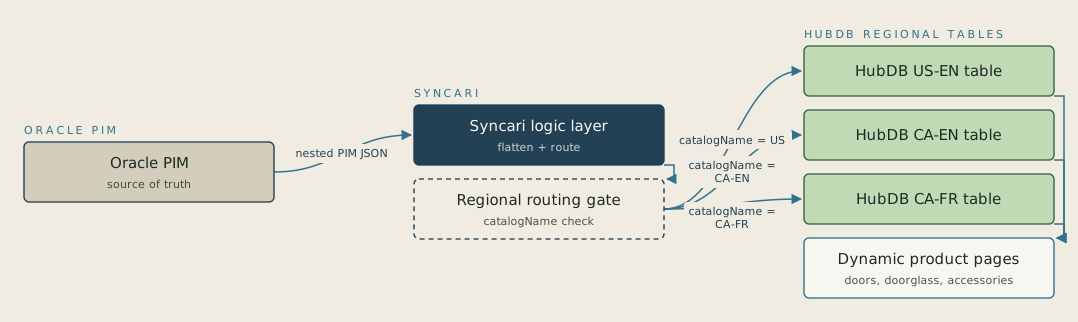
Technical specs such as caming colors, privacy ratings and glass dimensions drifted between internal records and the public site. Each update also meant manual entry across several HubDB tables and languages. Now Oracle PIM is the only source of truth, and a logic gate in Syncari checks the "catalogName" attribute. A US value routes the record to the US HubDB tables, and a Canadian English or Quebec value routes it to the Canadian English or French tables. French display labels sit alongside English internal names, so localization never breaks API-based filtering.

FAQ
It separates unique page metadata from the thousands of SKU-level variations. The template never processes excessive rows on a single page load. Site speed stays fast while complex SKU filtering still works.
Syncari provides a stateful data authority layer. It transforms nested JSON responses from Oracle, like parsing a deeply nested glass-height attribute or checking a category name, into simple typed fields in HubDB. A direct integration would push that transformation logic into custom CMS code. That is exactly the brittle layer this architecture avoids.