

HubSpot implementation for a frozen-dough manufacturer entering independent bakeries
An Australian frozen-dough manufacturer expanding into the independent bakery channel had no digital presence built for that buyer: its site ran on WordPress with no HubDB, and its only marketing support was an SEO-only retainer. We built its HubSpot portal from a blank account, embedding tracking and forms into the existing site, and shipped a three-stage gated offer set on a dedicated subdomain for the new segment.
Executive Summary

Context
The client is an Australian frozen-dough manufacturer selling into wholesale and foodservice channels through a Singapore-based parent, entering the independent bakery segment as a new line of business with no marketing infrastructure built around it.

What We Built
We built the client's HubSpot portal from a blank account, embedding tracking and lead-capture forms into its WordPress site and shipping a three-stage gated offer set on a dedicated subdomain for the independent bakery segment.

Tech Stack
- HubSpot Marketing Hub Professional, HubSpot Sales Hub Professional, WordPress, Databox, Flowmapp, Trello
Not a fit if you need a full site rebuild rather than a bridge into an existing non-HubSpot CMS: this build embeds tracking and forms into a live WordPress site. It also assumes you can coordinate around an already-running SEO-only retainer, and that someone keeps working the pipelines once the campaign ends.

The Challenge
Before this build, the manufacturer had no way to capture or qualify interest from independent bakeries: its WordPress site carried no CRM-wired forms, no tracking script, and no record of who visited before calling or emailing. Marketing support was limited to an SEO-only retainer, so nobody watched on-page behaviour or built anything a sales team could work from.

Our Approach
Rebuilding the site natively in HubSpot's CMS was ruled out: it ran on WordPress with no HubDB, and an SEO-only retainer was scoped around that site staying in place. Instead, the team pointed DNS at a new HubSpot instance, embedded HubSpot's tracking script into the WordPress theme, and added a heat-mapping script, giving the marketing team visitor data on a site it had run blind. Ad-account pixels went in per paid channel for attribution. The assets formed a three-stage offer set, a top-of-funnel education piece, a middle-of-funnel calculator, and a bottom-of-funnel assessment tool with a book-a-visit and a request-a-sample path, hosted on a subdomain decoupled from the retainer's site.

Impact

A working inbound funnel where none existed
The build gave the manufacturer a working inbound channel on its existing site, so a bakery owner reading the gated content left a trackable trail instead of vanishing after a page view. Forms fed straight into HubSpot, so a lead could be worked without re-typing details from an inbox.
A dedicated acquisition path for a new buyer segment
The three-stage offer set was built around the independent bakery buyer, separate from the manufacturer's wholesale and foodservice channels, so a prospect saw content addressed to their own decision. Hosting it on its own subdomain let the funnel launch and change independently of the retainer's site.
Visibility into a site the team had never measured
Tracking script and heat-mapping installed with the offer set gave the team its first record of how visitors moved through the site, since no client-side instrumentation existed before this build. Ad-account pixels tied behaviour back to the paid channel that sent it, so spend could be judged against engagement rather than clicks alone.
Infrastructure built to carry the campaign's own targets
The build was scoped to the campaign's own business case: a nine-month push with a media budget of $40,000 to $50,000, aimed at 20 marketing-qualified leads and 5 new customer accounts a month. Landing pages, forms and pixels were in place before that spend began, so the campaign launched measurable from day one.
HubSpot's tracking script was added into the WordPress theme rather than requiring a platform migration, with lead-capture forms wired to submit into HubSpot. The client kept its existing site and domain authority while gaining CRM-connected forms and page-level tracking.
Pixels for Facebook and Instagram, LinkedIn and Google were installed against the offer pages, with a heat-mapping script running alongside HubSpot's own tracking. Together they gave the team attribution by channel and a visual record of where visitors dropped off.
The funnel moved a visitor through a top-of-funnel education piece, a middle-of-funnel calculator, and a bottom-of-funnel assessment tool, closing with a book-a-visit and a request-a-sample path. Each stage had its own landing page, thank-you page and email template for an independent-bakery buyer.
The gated funnel was hosted on its own subdomain rather than built into the client's main WordPress pages, so the campaign could ship and change on its own schedule, clear of the work the SEO-only retainer was managing on the primary site.
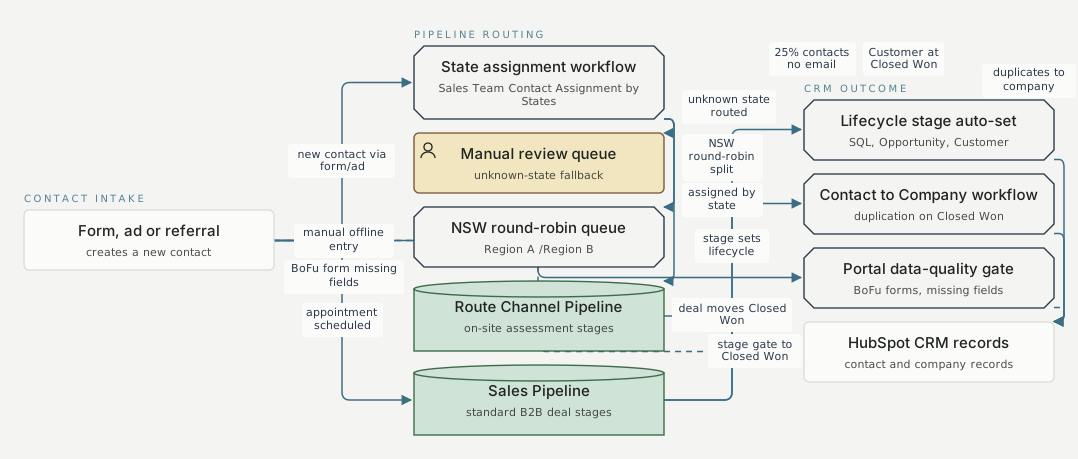
Contact intake Pipeline routing CRM outcome Form, ad or referral creates a new contact State assignment workflow Sales Team Contact Assignment by States Manual review queue unknown-state fallback NSW round-robin queue Region A / Region B Route Channel Pipeline on-site assessment stages Sales Pipeline standard B2B deal stages Lifecycle stage auto-set SQL, Opportunity, Customer Contact to Company workflow duplication on Closed Won Portal data-quality gate BoFu forms, missing fields HubSpot CRM records contact and company records new contact via form/ad mechanism 1 assigned by state mechanism 1 unknown state routed mechanism 1 NSW round-robin split mechanism 1 stage gate to Closed Won mechanism 1 appointment scheduled mechanism 2 stage sets lifecycle mechanism 2 Customer at Closed Won mechanism 2 deal moves Closed Won mechanism 3 duplicates to company mechanism 3 manual offline entry mechanism 3 BoFu form missing fields mechanism 4 25% contacts no email mechanism 4
FAQ
You embed HubSpot's tracking script and connect its forms into the existing site's theme rather than migrating the site. That's what happened here on a WordPress site with no HubDB: the client kept its domain and pages, and gained CRM-connected forms, tracking and heat-mapping.
A blank HubSpot account needs DNS pointed at it, a tracking script installed, ad pixels per paid channel, and templates for the campaign; here that meant landing pages, thank-you pages and emails for a three-stage gated offer set for a new buyer segment, none of which existed before the build.


