

An Investor-Status Expiry Gate for a Corporate Advisory Firm

A sophisticated-investor approval under Section 708 carried no expiry date on the contact record that held it, so a status confirmed years earlier still read as current. No record anywhere tied a signed non-disclosure agreement to the counterparty who signed it. We defined a contact property that auto-expires two years after approval, reinstated only after compliance review, and a ten-stage counterparty pipeline giving every NDA its own requested, sent and signed dates linked to the filed copy in Microsoft Teams.
Executive Summary

Context
An Australian corporate advisory firm running M&A, equity capital markets and corporate broking mandates held sophisticated-investor status as a static fact nobody revisited, with nothing marking when a Section 708 approval lapsed. A requirements document, annotated by the client, set out how HubSpot would hold and gate it going forward.

What We Built
We defined a Section 708 status property that auto-expires two years after approval and reinstates only through compliance-coordinator review. A ten-stage counterparty pipeline gives every NDA its own requested, sent and signed dates, linked to the filed copy in Microsoft Teams.

Tech Stack
- HubSpot Sales Hub Enterprise, HubSpot Data Hub, PandaDoc, Microsoft Teams
Not a fit if the firm has no one who can own an ongoing compliance-review responsibility, or expects the counterparty pipeline to advance on its own. Reinstating an expired status depends on the compliance coordinator reviewing new documentation, not on an automatic renewal. And the pipeline moves contacts by hand, because the client didn't ask for automation on that leg. A firm wanting either piece to run unattended needs a different design.

The Challenge
A Section 708 approval carried no expiry date. So a status confirmed years earlier looked identical to one confirmed last week, and nothing prompted a check. Non-disclosure agreements were tracked even less well: the firm recorded client-side NDAs on a single checkbox, and no deal-specific NDA record existed anywhere. A signed NDA therefore had nothing tying it to its mandate.
Investors responding through the firm's investor-facing web portal arrived as a plain contact with no stage attached. A coordinator couldn't tell who had been sent an NDA or who was already in due diligence. A requirements document put both problems in front of the client, and the client's feedback fixed the sequence: a ten-step counterparty stage list, and an exportable, point-in-time audit record for the screening evidence already required on every memorandum.

Our Approach
The requirements document first treated Section 708 status as a single confirmed-or-not flag, matching how the compliance database already stored it. That flag couldn't carry the fact that the certification expires under the Corporations Act. So the status became a contact property with three values: Not Assessed, Confirmed and Expired.
The property is tied to an approval date, which HubSpot uses to clear the status automatically two years out, with a reminder ahead of time. Reinstatement depends on the compliance coordinator's review, and nothing re-approves it automatically. At Gate 1 the status is stamped onto the counterparty record as a point-in-time snapshot.
The counterparty side had no prior system at all. We gave it a ten-stage list running Unqualified through Completed, with NDA properties linked to the filed copy in Microsoft Teams. The client didn't ask for automation between stages, so contacts move by hand.

Impact

Investor status that expires instead of just existing
A Section 708 approval now carries its own two-year clock, so one nobody has revisited in years reads as Expired rather than quietly valid. The compliance coordinator gets a reminder before that clock runs out, and reinstatement always requires reviewing updated documentation first.
A signed NDA the firm can actually point to
A counterparty's non-disclosure agreement now has its own requested, sent and signed dates, linked to the filed copy in Microsoft Teams, because no deal-specific NDA record existed anywhere before. A compliance review can trace a signature to a mandate instead of a single checkbox.
One pipeline for everyone a mandate reaches
Every investor responding to a mandate now moves through the same ten stages, from Unqualified to Completed, so a coordinator can tell who was sent an NDA and who is already in due diligence. Nobody could tell that when a counterparty arrived as a plain contact.
A screening record the memorandum can stand behind
The Section 708 status and its date now stamp onto the counterparty record at Gate 1, alongside the AML/CTF and ASIC Search attachments the memorandum already required. That gives the fee estimate a point-in-time snapshot instead of a status that could have changed since.
The property holds three values, Not Assessed, Confirmed and Expired, tied to a Section 708 approval date. HubSpot clears it to Expired two years on and sends a reminder ahead of the deadline, so the record carries the clock.
An expired status returns to Confirmed only after the compliance coordinator reviews updated documentation, and no workflow reinstates it automatically. At Gate 1, the status and its date are stamped onto the counterparty record as a point-in-time audit trail.
A counterparty responding through the firm's investor portal moves through Unqualified, Qualified, Contacted, No Interest or Withdrew, NDA Sent, NDA Signed, Materials Sent, Offer Received, Due Diligence and Completed, replacing what had been no record at all.
Each counterparty carries NDA requested, sent and signed properties with dates, linked to the filed copy in Microsoft Teams. A separate single checkbox still records client-side NDAs, kept apart from the counterparty-specific record.
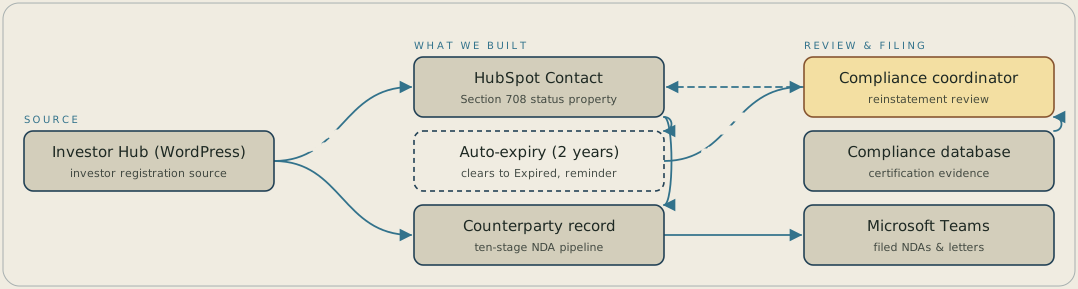
An investor who registers through the firm's WordPress investor portal becomes a HubSpot contact, and a respondent to a mandate becomes a counterparty record. The contact's Section 708 status clears to Expired two years after approval, and only the compliance coordinator can reinstate it, after reviewing the documentation in the compliance database. The status is stamped onto the counterparty record at the gate, and each NDA on that record links to the filed copy in Microsoft Teams.
FAQ
Because Section 708 status is a point-in-time certification, not a permanent one, and a flag with no expiry gives nobody a reason to check it again. Building the expiry into the property, with reinstatement gated to a person's review, keeps the record honest.
Properties already on the counterparty record covered it, with requested, sent and signed dates linked to the filed copy in Microsoft Teams, once a deal-specific NDA record existed at all. No record existed before this build; the object type was never the missing piece.


