

Consolidating calculator fields into one property for an offshore BPO

A lead-capture calculator on the client's site collects nine separate job-role fields, and none of them could be reported on as a single property. A dataset, a custom-coded merge and workflow field formatting each failed to consolidate the nine values into one column anyone could filter on. A Breeze Data Agent did it in fifteen minutes.
Executive Summary

Context
Leadership approved this fix as one step in a wider, phased AI adoption programme: a feature audit, a small pilot, and a validation step before anything touched a live contact. A Breeze Data Agent closed the calculator's reporting gap. A second agent took on a narrower, gated job: personalising the reply a qualified enquiry gets before a person opens the ticket.

What We Built
We built a master job-role smart property with a Breeze Data Agent, consolidating nine single-line fields into one value the team can filter and report on. Alongside it sit a Country property and a Likely Spam property that the verified-lead process now checks. A second agent drafts a personalised reply to each qualified enquiry, and we tested it in a sandbox first.

Tech Stack
- Breeze Data Agent
- HubSpot smart properties
- Team Builder Calculator
- sandbox environment for AI-generated replies
Not a fit if a form collects only two or three fields a native multi-select already reports on cleanly. The reply agent assumes a team willing to review AI-drafted output before production. Where nobody owns that review, hold the agent at the pilot stage instead.

The Challenge
Every prospect who used the Team Builder Calculator answered nine job-role questions, and each answer landed in its own single-line text field. So reporting on hiring intent meant opening nine columns to see one thing.
We tried a dataset, custom code and workflow field formatting, and each broke on the same problem: none could merge nine free-text values into one reportable property. Doing the same merge by hand was estimated at eight to twelve hours, and the result would need upkeep every time an option was added.

Our Approach
Rather than keep patching the merge by hand, we pointed a Breeze Data Agent at the nine fields to build the combined property the other three approaches couldn't. The agent matched the values to a job-role taxonomy and wrote the result to one master property in fifteen minutes, against the eight-to-twelve-hour estimate. The same pattern filled a Country property to ninety-eight percent and built a Likely Spam flag that the verified-lead process now uses.
A second agent took on a different job. When a qualified Contact Us enquiry comes in, it gets a reply personalised from CRM and external context. We run that reply through a sandbox first so every prompt is reviewable.
Leadership signed off on a phased Pilot, Validate, Scale roadmap before either agent touched production data.

Impact

One property where there used to be nine
A Breeze Data Agent now writes the job-role data once split across nine fields into a single smart property, so the reporting team can filter and report on hiring intent without opening nine columns. The same pattern now covers a Country field and a spam flag, both built the same way.
A reply before the team gets to it
A qualified enquiry now gets a reply personalised from its own CRM record and external company context before a person on the team opens the ticket, with 1,626 unique contacts reached across 1,659 enrolments in H1 2026. Every prompt clears a sandbox review first.
A rollout leadership signed off before go-live
Five agents across the vendor's AI suite were mapped into a single Pilot, Validate, Scale roadmap, and leadership approved the framework before any of them touched a live record. Feedback from the team's own sessions on the new agents came back overwhelmingly positive.
An early signal, not a result to bank on yet
Of the contacts the Data Agent enriched, 729 became qualified leads and 102 are tied to a closed-won deal, drawing on 18,380 of the vendor's AI credits in H1 2026. The programme's own reporting states plainly that this is not yet evidence of incremental commercial uplift, only that enriched data reaches the pipeline it was built to feed.
A Breeze Data Agent reads all nine of the calculator's job-role fields and writes one consolidated value to a new smart property. The dataset, custom-code and workflow-formatting attempts couldn't do the same merge. The build took fifteen minutes against an estimated eight to twelve hours by hand.
The same pattern filled a Country property to a ninety-eight percent fill rate and built a Likely Spam property the verified-lead process checks before a record counts as qualified. Staff Required, a third enrichment target, reached a lower twenty-one percent fill.
A qualified Contact Us submission triggers a second agent that drafts a reply from the contact's CRM record and external company context. Every prompt runs in a sandbox and is reviewable before it reaches a live contact, enrolling 1,659 times across 1,626 unique people in H1 2026.
Five HubSpot AI agents, including a Customer Agent still awaiting approval, were mapped into one phased roadmap before any reached production. Leadership signed off on the phase gate itself, so a new agent joins the same review before it goes live.
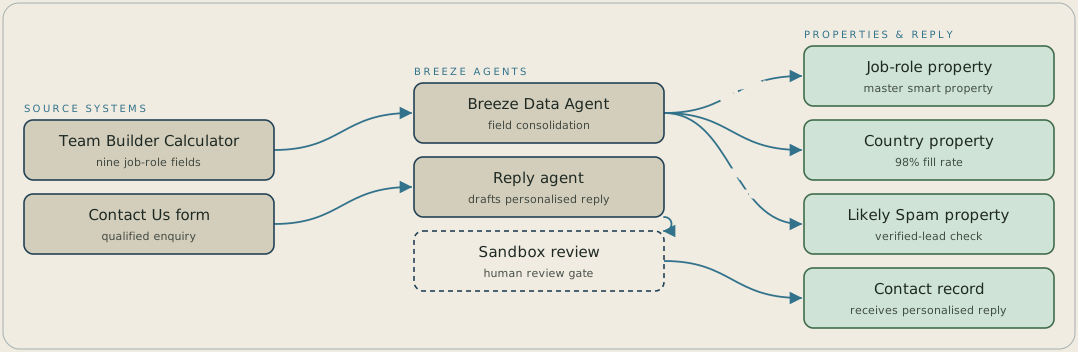
Nine job-role fields from the Team Builder Calculator go to a Breeze Data Agent, which writes one master job-role property, fills the Country property and flags Likely Spam. Separately, a qualified Contact Us enquiry goes to a reply agent that drafts a personalised reply. A sandbox review sits between the draft and the contact record, so the reply reaches the contact only after it has been reviewed.
FAQ
Three native paths were tried first: a dataset, custom code, and workflow field formatting. None could merge the nine single-line text fields into one reportable property, and the manual equivalent was estimated at eight to twelve hours. The Data Agent did the same merge in fifteen minutes.
Not yet, by the programme's own account. Of the contacts the Data Agent enriched, 729 became qualified leads and 102 are tied to a closed-won deal, but the H1 2026 reporting states plainly that incremental commercial uplift is not yet proven. What it has shown is that enriched data reaches the pipeline reliably, not that it moves revenue beyond what would have happened anyway.


