

A Field-Mapped Document Build for a Corporate Advisory Firm

Every New Business Memorandum and Engagement Letter came from a Word template a coordinator retyped by hand, with no link back to the deal and no way to confirm which scope or fee terms a memorandum carried. We mapped a nine-value Transaction Type property and a multi-select Fee Type property to the clauses PandaDoc assembles into the memorandum, and fixed the firm's payment terms as constants across every document. The client's own review then scoped the Engagement Letter back to a single tick-box property.
Executive Summary

Context
An Australian corporate advisory firm running M&A, equity capital markets and corporate broking mandates produced its New Business Memorandum and Engagement Letter from Word templates with no property mapping behind them and no record of which scope or fee terms a mandate carried.

What We Built
We mapped Transaction Type and Fee Type deal properties to PandaDoc's scope and fee clauses, replacing a hand-typed memorandum with one PandaDoc assembles from the deal record, and fixed the firm's payment terms as constants so every document carries the same terms regardless of who drafts it.

Tech Stack
- HubSpot Sales Hub Enterprise, HubSpot Data Hub, PandaDoc, Microsoft Teams
Not a fit if legal counsel has not yet finalised the clause language for each transaction type and fee type, since the mapping only works once those variants are stable; the firm keeps ownership of that wording while the build owns the mapping. It also assumes someone can name which fee-type combinations advisers actually sell, rather than leaving that judgement to whoever drafts the next letter.

The Challenge
A New Business Memorandum and an Engagement Letter both started from a Word template that a coordinator filled in by hand. The coordinator chose the scope clause and the fee clauses from the template's own boilerplate, not from a record on the deal. Nothing tied a finished memorandum back to the scope or fee language it carried, so confirming what had been sent to a counterparty meant reopening the document itself.
The firm's standing terms sat in that same boilerplate: an expenses cap, 14-day payment terms, and 2% over the 180-day Bank Bill Rate on overdue amounts. Changing any of them meant editing every future document. Discovery treated both documents as one field-mapping problem.

Our Approach
We gave Transaction Type nine values, including Strategic Review, Corporate Broking, Acquisition, Divestment and Dual Track Exit Strategy, and each value selects its own scope clause. Fee Type became a multi-select property instead, because a mandate can bill on more than one basis at once. A retainer alongside a success fee pulls both fee clause blocks into the same document.
We fixed the standing terms as constants rather than variables, because none of the discovery material showed them changing by transaction. A further checklist of properties carries what the merge fields still needed. S2 owns the mapping, and the firm keeps the legal wording.
The client reviewed that specification and scoped the Engagement Letter back to a single tick-box property. Conditional generation stays only for the memorandum.

Impact

A scope clause the deal record chooses, not a person drafting one
The Transaction Type property decides which scope clause enters the memorandum, one of nine values matched to how the firm categorises a mandate. A coordinator no longer drafts scope language from memory, because the clause comes from a property already set on the deal.
A fee schedule that reads what a mandate actually bills
Fee Type is a multi-select property, so a mandate billing a retainer alongside a success fee pulls both fee clause blocks into the same letter rather than forcing a single choice. The combination comes from the property the deal already carries, matching what the firm agreed to charge.
The same payment terms on every document, not whatever the last draft used
An expenses cap, 14-day payment terms and 2% over the 180-day Bank Bill Rate on overdue amounts are now fixed constants on every memorandum and letter, rather than boilerplate retyped by hand. Changing one of those terms is a single edit to the document logic, not a rewrite of every future document.
A document build the client could scope down, not one it had to accept whole
After reviewing the specification, the client chose to scope Engagement Letter generation back to a single tick-box property, rather than build the same conditional generation PandaDoc runs for the memorandum. The mapping still gave them that choice, because the two driver properties were built to be adopted piece by piece.
Transaction Type is a single-select Deal property with nine values, Strategic Review, Corporate Broking, Capital Raise, Acquisition, Divestment, Debt Refinance, Financial Model, Performance Improvement and Dual Track Exit Strategy, each mapped to its own scope clause. PandaDoc reads whichever value is set on the deal and drops the matching clause into the document.
Fee Type is a multi-select Deal property covering retainer fee, fixed fee, hourly rates, success fee and post-listing retainer, each with its own sub-fields, with combinations allowed. PandaDoc assembles the fee clause for every value selected, so a mandate billed on more than one basis gets every clause it needs in one document.
An expenses cap, 14-day payment terms and 2% over the 180-day Bank Bill Rate on overdue amounts sit in the document logic as constants rather than deal properties, applied the same way regardless of transaction type or fee structure. None of the discovery material showed the firm varying these terms by mandate.
Beyond the two driver properties, the build added MD Sponsor, Introducer, Capital Raise Type, Fee Splits, Staff Conflict of Interest, Competing Client or Dual Advisory Role, Marketing Publish Permission, Investor Hub Publish Permission, Legal Entity Name, Short Name, Engagement Term, Engagement Effective Date and Co-signing MD, the checklist PandaDoc's Deal, Company and Contact merge fields actually read.
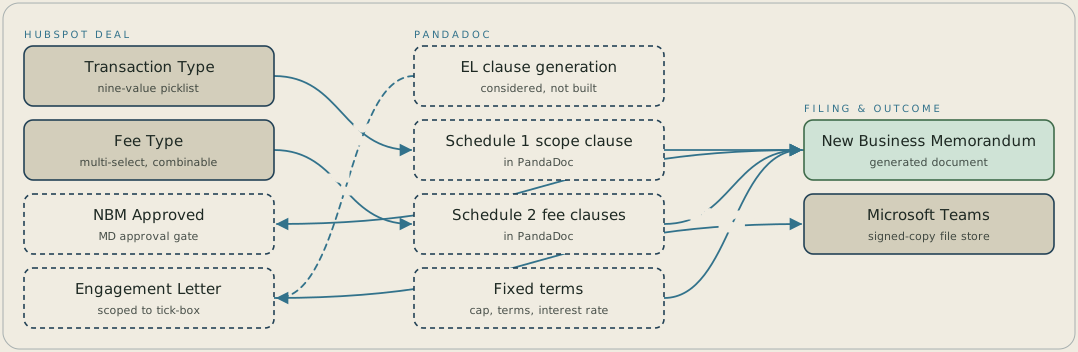
Two Deal properties drive the New Business Memorandum in PandaDoc. Transaction Type, a nine-value picklist, selects the scope clause, and Fee Type, a multi-select, selects the fee clauses, while the fixed terms (the expenses cap, payment terms and overdue interest rate) go into every memorandum. The assembled memorandum is submitted for MD approval through the NBM Approved gate. Generating the Engagement Letter's clauses was considered and scoped down to a tick-box, and the signed copy is filed in Microsoft Teams.
FAQ
The two documents share Deal, Company and Contact merge fields but read different driver properties: Transaction Type decides the scope clause, and Fee Type decides the fee clauses with combinations allowed. Fixed terms sit outside that logic as constants applied to both documents the same way.
Because the client reviewed the specification and chose to. The memorandum's mapping stayed as built, and the Engagement Letter became a single property that moves the deal into Mandated once signed, rather than a second generated document with its own conditional logic to maintain.


