

A Benchmarked Readiness Score HubSpot Could Not Generate
The client's brief doubted that HubSpot could generate a report that changed by respondent and carried an industry benchmark. We built the scoring engine on a separate platform instead and wired only a single contact property back into HubSpot. A market research and FMCG product innovation consultancy used the result as a mid-funnel asset benchmarked against an Australian FMCG average.
Executive Summary

Context
A market research and FMCG product innovation consultancy targeted roughly 150 Australian manufacturers and retailers with $500M+ revenue. Its sales team needed a mid-funnel asset that could grade a prospect's organisation against an industry benchmark before a rep spoke with them.

What We Built
We built a self-assessment on a separate calculator platform that scores a respondent's organisation across four readiness areas against an Australian FMCG benchmark. Only the final score reaches a HubSpot contact property, because native reporting couldn't produce the report.

Tech Stack
- HubSpot Marketing Hub
- HubSpot CMS
- external calculator platform
- HubSpot contact property token
Not a fit if your addressable market is too narrow to carry assessment volume. A target list near 150 accounts produced only a handful of completions, which limited how much pipeline signal one score could generate. It also underserves a niche B2B consultancy that wants a strategy spanning more than a HubSpot-first programme, because an assessment tool alone can't deliver that.

The Challenge
The client's brief called for a report that varied by respondent, benchmarked their organisation against an Australian FMCG average, and routed them to a sales contact by result. The brief also doubted that HubSpot could produce it. Its native reporting couldn't generate a document whose bands changed for each respondent.
Workflows would have meant branches for four sub-scores plus the overall score, and there was no renderer to draw a personalised report from. The assessment also had to be live ahead of a mid-May 2022 conference. We had no time to wait on an upgrade that might not have closed the gap anyway.

Our Approach
We first looked at what HubSpot's Marketing Hub could do. It routes contacts and stores a single property well, but it couldn't run the assessment's own logic: 36 five-star statements across five blocks plus two ten-point allocation questions, rolling up to a score out of 165. No HubSpot surface could render a report whose bands changed for each respondent, so we built the scoring engine on a separate platform instead.
That platform gated the headline at average plus or minus 3 percent, showed a detail page for a readiness area only when it scored more than 3 percent under average, and matched one of seven videos to the result band.
Only the final score wrote back to a contact property, through a token that also triggered a meeting-booking call. The trade-off is visibility. HubSpot saw the click and the score, but nothing of how a respondent moved through the assessment, so drop-off stayed undiagnosed.

Impact

A benchmarked score reaches HubSpot without a platform rebuild
The assessment ran entirely outside HubSpot, so the build needed no hub tier upgrade or new native reporting, and only the final score crossed into HubSpot. That kept the asset live ahead of the May 2022 conference target it was built for.
Follow-up content matches the respondent's actual result
Seven videos map to the overall result band and separately to a low score in any readiness area, so a respondent weak on pipeline generation sees a different follow-up than one weak on post-launch monitoring. That branching ran from the same platform that scored the assessment.
A completed assessment reaches a sales contact without a manual handoff
The thank-you page printed the score through a contact property token and routed every completer towards a meeting-booking call, so a completed assessment reached the sales team without a manual handoff. Twenty-one clicks and seven completions moved through that path by the twelve-month review.
A known visibility limit for the next assessment build
Because the assessment lived outside HubSpot, the team saw a click and a score but nothing of how a respondent moved through it, so drop-off stayed invisible even as two to three completers progressed towards a deal. The next version's design now accounts for that gap.
The questionnaire, its scoring logic and its report renderer were all hosted on a platform outside HubSpot. Only the final score crossed into HubSpot, written to a single contact property through a token.
The report's headline switched between three states at average plus or minus 3 percent. A detail page for any readiness area showed only when that area scored more than 3 percent below benchmark, so a strong respondent never saw pages meant for a weak result.
Video content mapped to the overall result, above, average or below benchmark, and separately to a low score in any readiness area. The same seven videos covered every outcome the assessment could produce, rather than a new video per respondent.
A single token rendered the respondent's score on the HubSpot thank-you page and populated a matching contact property. A sales rep used that property to find completers and route them towards a meeting-booking call.
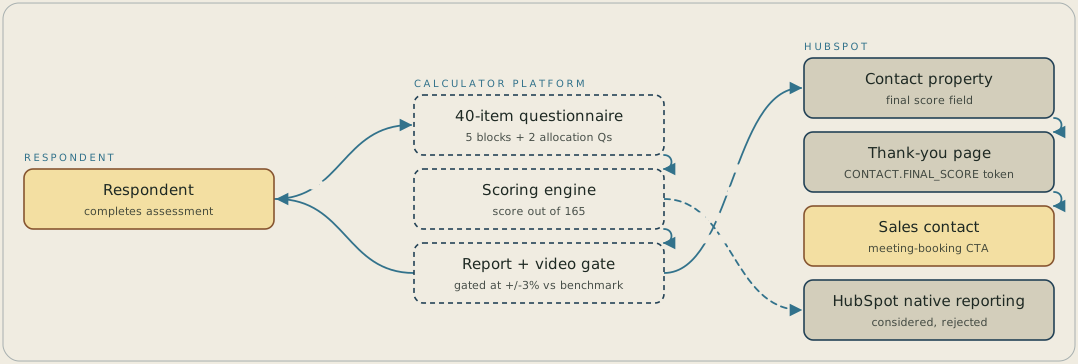
A respondent completes the 36-statement questionnaire and two allocation questions on an external calculator platform, which scores the answers out of 165. A gate compares the result with the Australian FMCG benchmark at plus or minus 3 percent and shows the respondent a report and a matching video. Only the final score is written to a HubSpot contact property, and a token displays it on the thank-you page beside a meeting-booking call to a sales contact. HubSpot's native reporting was considered and ruled out because it couldn't render the per-respondent report.
FAQ
HubSpot's native reporting couldn't render a report whose bands changed for each respondent, and the brief doubted the platform could produce one. Building the scoring engine on a separate platform let the report and its video branch by result, at the cost of visibility into how a respondent moved through it.
HubSpot receives a single contact property carrying the final score, written through a token the thank-you page also displays. Everything else, including which readiness areas a respondent scored well or poorly on, stays on the platform that ran the questionnaire.


