

Correcting a HubSpot Lifecycle-Stage Default for an RPO Firm

Every new contact in this firm's HubSpot portal defaulted to lifecycle stage Lead, so 4,099 contacts sat in a stage meant for active buying interest against only 150 correctly staged as Subscriber. The team reset the backlog to Subscriber, excepted anyone already tied to an open or closed-won deal, and locked the subscribe form and a new opt-in workflow so new contacts start in the correct stage.
Executive Summary

Context
An Australian recruitment process outsourcing and talent-advisory firm had run its HubSpot portal for some time before this engagement, its lifecycle-stage configuration never audited. Every new contact record defaulted to Lead regardless of how it entered the portal, so the stage meant to flag active buying interest carried most of the database instead.

What We Built
We reset the mis-staged backlog to Subscriber, excluded anyone already attached to a deal, and replaced the broken default with a forced subscribe-form setting and an opt-in workflow that keep new contacts starting in the correct stage.

Tech Stack
- HubSpot Marketing Hub, HubSpot Sales Hub, HubSpot CMS Hub, HubSpot workflows, Google Analytics, Salesforce
Not a fit if your lifecycle-stage defaults have already been audited and work correctly, since the value here is finding a default nobody had checked. It also assumes deal records are reliable enough to protect automatically during a bulk reset, and is scoped as a bounded fix, not an ongoing retainer.

The Challenge
This firm's HubSpot portal predated the engagement, and nobody had ever audited its lifecycle-stage configuration. Every new contact defaulted to Lead regardless of how it entered the portal, even though Lead is the stage meant to flag active buying interest. That put 4,099 contacts at Lead against only 150 correctly staged as Subscriber, so a database of mostly newsletter sign-ups and casual visitors looked, on paper, full of active leads.
Reporting built on lifecycle stage would have counted nearly all of that volume as leads worth working. That would have happened before any nurture or scoring could run against a clean population.

Our Approach
We didn't want to reset every Lead-stage contact to Subscriber in one pass, because that risked knocking active deals back to a stage that undercounts real pipeline activity. So we keyed the correction on lifecycle stage and deal status together. Only contacts at Lead with no attached deal moved to Subscriber, and the deal-based automation the portal already ran left anyone on an open deal at Opportunity and anyone closed-won at Customer untouched.
That exclusion rule let the reset run in bulk, 4,099 contacts, without touching a record that sales already had in motion. A one-time reset alone would have drifted back, so we changed the subscribe form's Options to force Subscriber on every completion. We also added a new opt-in workflow that marks those completions as marketing contacts on submission.
The trade-off was scope. The correction fixes the stage a contact starts in, and it leaves the nurture, scoring and qualification builds to run on top of it.

Impact

Lifecycle-stage reporting that reflects real buying intent
Every new contact's stage now starts at Subscriber unless a form or workflow explicitly sets it to Lead, so stage counts describe actual engagement rather than an accident of the portal's default settings. Nurture and scoring builds that key off lifecycle stage inherit a population that means what the stage name says.
Deal records protected during a bulk correction
The reset excluded any contact already tied to a deal, using the automation the portal already ran, so 4,099 contacts moved stage without a single active deal's record being reclassified underneath the sales team. That rule made a correction at this scale safe to run in one operation.
A default that will not drift back
Forcing the subscribe form's Options to Subscriber, paired with an opt-in workflow that marks completions as marketing contacts on submission, means the fix doesn't depend on someone re-running the reset. New contacts entering through that form start correctly staged going forward.
A clean base for the funnel work built on top of it
The nurture sequences, the lead-scoring model, and the SQL workflow all key off lifecycle stage as their entry condition, so each starts from a population that reflects genuine engagement rather than a misconfiguration. The correction did not build those programs; it gave them a stage they could trust.
Before the reset ran, the team keyed off the deal-based lifecycle automation already in place, so a contact tied to an open deal stayed at Opportunity and a closed-won contact stayed at Customer instead of being swept into the reset. That property became the exclusion filter.
The correction targeted every contact at lifecycle stage Lead with no attached deal, moving 4,099 of them to Subscriber in one operation against the 150 already correctly staged, matching the portal's stage distribution to its actual engagement level.
The subscribe form's Options were changed to force lifecycle stage to Subscriber on every completion, closing the path that had silently defaulted new contacts to Lead regardless of how casually they had engaged.
A new workflow enrols every subscribe-form completion and marks the contact as a marketing contact on submission, so opt-in status and lifecycle stage are set by the same event. Eleven contacts enrolled in its first run.
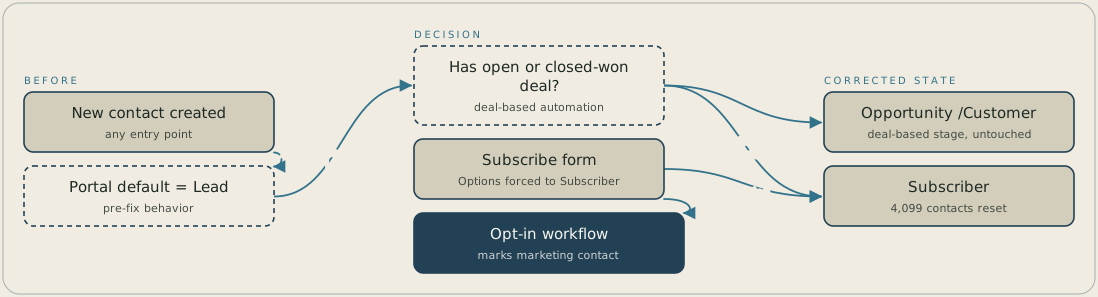
A new contact used to get the portal default of Lead, however it was created. The reset checks each Lead-stage contact against deal status: a contact with an open or closed-won deal is left at Opportunity or Customer, and a contact with no deal moves to Subscriber, 4,099 contacts in all. For new contacts, the subscribe form now forces Subscriber on every completion and enrols the contact in an opt-in workflow that marks them as a marketing contact.
FAQ
The portal's default lifecycle stage for a new contact was set to Lead, so every contact picked up that stage regardless of how they engaged, whether a casual sign-up or a genuine buying inquiry. That put 4,099 contacts at Lead against only 150 correctly staged, and nobody had audited the default because the portal predated this engagement.
You key the reset on lifecycle stage and deal status together, not stage alone. The correction excluded any contact already tied to an open or closed-won deal, relying on automation the portal already used, so the bulk reset moved thousands of records to Subscriber without reclassifying one sales already had in motion.


