

Migrating a Nonprofit Lab Incubator's Website From WordPress to HubSpot CMS
A nonprofit biotech and medtech wet-lab incubator ran its site on WordPress with a HubSpot Marketing Hub account that a portal audit scored 51 out of 100, with no personas, no lifecycle stages, and no lead nurturing anywhere. We migrated the site to HubSpot CMS, replaced the theme with 30-plus reusable modules, and mapped every legacy URL through a redirect layer first.
Executive Summary

Context
The organization leases wet-lab space to resident biotech and medtech companies. A 2020 audit found its WordPress site and underused HubSpot account scoring 51 out of 100 for the portal and 66 out of 100 for the website.

What We Built
We rebuilt the incubator's site on HubSpot CMS, replacing WordPress with more than 30 reusable modules and a redirect layer mapping every legacy URL ahead of cutover.

Tech Stack
- HubSpot CMS
- HubSpot Marketing Hub
- Google Search Console
- SEMRush
- Moz PageSpeed
Not a fit if your marketing team can't commit ongoing time to run what a platform migration surfaces. This engagement's own audit produced a roadmap that outpaced the client's execution capacity, and a planned follow-up review of the new content hub was never acted on after launch. A migration only pays off when someone owns the resulting build.

The Challenge
The incubator's site ran on WordPress, with a HubSpot Marketing Hub account attached but barely used: a few blog posts, a handful of landing pages, no buyer personas, no lifecycle stages, and no lead nurturing configured anywhere. An April 2020 audit scored the setup 51 out of 100 for the portal and 66 out of 100 for the website.
The audit cited a 7.9-second load time against a 3-second target, and traffic concentrated on two older posts. Content lived in WordPress while the marketing tooling sat in HubSpot, so a form or a lifecycle stage had nowhere consistent to attach.

Our Approach
We treated the April 2020 audit as the build brief: its findings on missing personas, lifecycle stages and forms set what the new site had to support natively. A straight lift of the WordPress templates would have carried the same fixed-theme limits forward, so we rebuilt the front end as a library of 30-plus named HubSpot modules instead. They cover forms, hero banners, testimonials, headers, blog CTAs, and donation and metric blocks the theme had no equivalent for.
We mapped every legacy URL into a 301 redirect layer ahead of cutover, so that the domain's modest organic traffic held. On top of the migrated CMS, a Resource Center hub went live on 30 October 2020. It pulls featured articles through a tag-selection mechanism, and it launched after a Creative, Dev and CS sign-off gate.
The migration gave the team a platform, but it also surfaced a larger roadmap than the client could execute at once.

Impact

The site kept the search visibility it already had
The redirect layer mapped every legacy WordPress URL before the HubSpot CMS site went live, so the domain's existing rankings and the two blog posts already carrying its organic traffic didn't reset on launch day.
The marketing team can build pages without a developer
The site runs on a library of 30-plus named HubSpot modules, covering forms, hero banners, testimonials, headers, and blog CTAs, in place of a fixed WordPress theme. New pages assemble from that library, so the marketing team ships one without a developer ticket first.
A lead-nurturing destination the portal audit found missing
The April 2020 audit found no lead nurturing, no lifecycle stages, and no dedicated content destination anywhere on the account. The Resource Center hub that launched on the migrated CMS in October 2020 closed that gap, pulling featured articles through a tag-selection mechanism on a homepage the WordPress site never had.
A documented baseline the retainer could plan against
Scoring the portal 51 out of 100 and the website 66 out of 100 gave the migration a specific target rather than a general sense the site needed work. That baseline, plus the domain and page authority the SEO audit measured separately, anchored the retainer's later roadmap decisions.
The April 2020 audit set the requirements for the new CMS build directly: missing personas, absent lifecycle stages, and sparse form usage became scope items rather than a report shelved after review. The 51-out-of-100 portal grade and 66-out-of-100 website grade anchored what counted as done.
More than 30 named modules replaced the WordPress theme's fixed templates: forms, hero banners, testimonials, footers, two header versions, blog CTAs, logo carousels, and donation and metric blocks. Each module is a standalone, reusable component the marketing team assembles into new pages.
Every legacy URL was mapped to its HubSpot CMS destination through 301 redirects ahead of launch, and a post-launch checklist tracked the 404s and redirect gaps that turned up once the site went live. That checklist closed those gaps before they could cost the domain its existing search visibility.
A homepage with featured-article and event sliders pulls content through a tag-selection mechanism rather than manual curation, launched on the migrated CMS on 30 October 2020. The build passed through a Creative, Dev, and CS sign-off gate before go-live, the same review structure the migration went through.
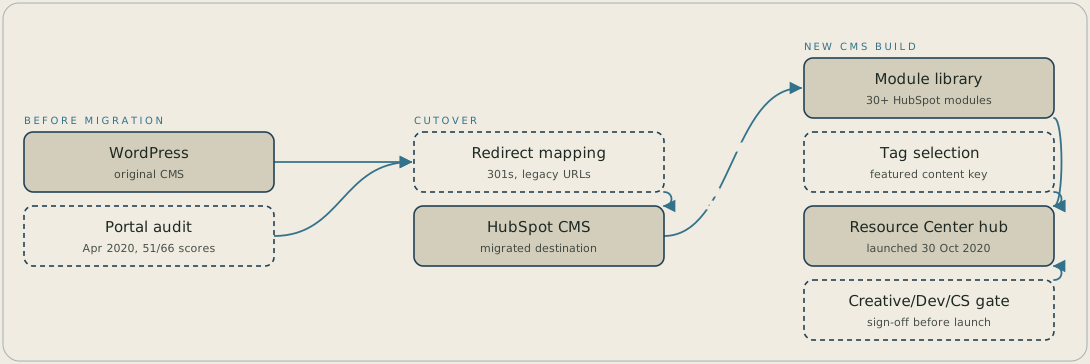
The April 2020 audit set the scope for the move from WordPress to HubSpot CMS. Every legacy WordPress URL was mapped to a 301 redirect, and those redirects went live at cutover so the domain kept its search visibility. Once on HubSpot CMS, the theme was replaced by a library of more than 30 modules. The Resource Center hub was assembled from those modules, pulled featured articles through a tag selection, and launched on 30 October 2020 after a Creative, Dev and CS sign-off.
FAQ
Because the site and the marketing platform were split: HubSpot Marketing Hub held the forms and CTAs, while the content sat in WordPress with no route to attach lifecycle stages or nurturing to a page. Moving the site into HubSpot CMS put content and tooling on one platform, so a workflow could reach the page itself.
Only if the URLs aren't mapped before launch. Every legacy URL was mapped into a redirect layer ahead of the cutover here, and a post-launch checklist tracked the gaps that appeared afterward before they cost organic traffic.


