A Requirements-Driven CRM Selection and HubSpot Architecture for a No-Code App Platform

A no-code app platform had four teams running four disconnected toolsets: marketing couldn't hand warm leads to sales cleanly, account managers couldn't see nurture status, and support tracked issues somewhere else entirely. Before any implementation, we ran the CRM decision as an engineering exercise: a weighted requirements matrix across platforms, then a HubSpot architecture and onboarding built to satisfy the priority-one rows.
Executive Summary

Context
A SaaS platform for building enterprise apps without code, operating across marketing, new-business sales, account management, and customer support. The company was weighing CRM platforms including HubSpot, Salesforce, Microsoft Dynamics, and marketing-automation point tools. Each function brought its own requirements to the table.

What We Built
A requirements-driven platform selection followed by HubSpot architecture and onboarding: behavioural segmentation modelled in properties and lists, lead scoring for the marketing-to-sales handoff, separated pipelines for new business and account management, sequence exit rules, shared template governance, and multi-currency configuration.

Tech Stack
- HubSpot Marketing Hub
- Sales Hub
- Service Hub
- Lead Scoring
- Multi-Pipeline Configuration
- Multi-Currency
- Requirements benchmarking vs Salesforce
- Microsoft Dynamics
- marketing-automation point tools
Not a fit if only one function, marketing, sales, or service, will run on the platform while the others stay on separate systems. This architecture exists to unify multiple functions with competing requirements, such as lead scoring, multi-pipeline forecasting, and multi-currency, onto one CRM through a weighted evaluation. Without more than one function sharing the same platform, there is no cross-functional requirements conflict here to resolve.

The Challenge
The requirements matrix ran to dozens of rows because four functions were buying one platform. Marketing needed behavioural intent tracking across the website, community, and product studio, plus conditional email content and A/B testing with winner-send logic. Sales needed multiple pipelines, weighted forecasting, multi-currency with controlled exchange rates, and shared email templates with edit permissions. Account management needed its own deal stages, touchpoint scheduling, and client health dashboards. Support needed email ticketing and an issue-tracking integration. Several rows carried a competing tool's name in the margin, and no single platform obviously won. An unexamined default choice would have failed at least one team.

Our Approach
We turned the evaluation into a weighted matrix. Each requirement was graded by priority and mapped against candidate platforms, including HubSpot, Salesforce, Microsoft Dynamics, and marketing-automation point tools, with the native mechanism named for every row rather than a checkbox. That discipline is what determined the architecture that followed. Tag-style behavioural segmentation, a pattern carried over from the incumbent tooling, was rebuilt as HubSpot properties and active lists so automations and reporting could key off structured data. Lead scoring formalized the marketing-to-sales handoff that had previously been a judgement call. New business and account management got separate pipelines with their own stages. Sequences auto-unenroll on reply and notify the owner. Shared templates carry edit permissions, so brand-controlled assets stay controlled. Onboarding took each team through the mechanisms built for its own priority-one rows.
This engagement is part of our implementation + onboarding work for marketing & advertising organisations.

Impact

One Platform Serving Four Functions
A Defensible, Documented Platform Decision
The weighted requirements matrix documents the platform choice against criteria rather than preference. When anyone asks why a capability works the way it does, the answer traces to a requirement row, not a vendor demo.
A Formalized Marketing-to-Sales Handoff
Automation Guardrails from Day One
Sequence exit rules stop automated sends the moment a prospect replies, and goal criteria pull contacts out of nurture when they convert. Both guardrails were in place before launch.
Every functional requirement, from conditional email content to weighted forecasting to Jira and Xero integration, was graded by priority and mapped to the native mechanism in each candidate platform. Rows where a competitor led were recorded as such, so the final choice could be defended against them.
The incumbent tooling used free-form tags for behavioural intent, like naming a downloaded lead magnet. HubSpot has no tags, so the pattern was rebuilt structurally: custom properties for durable attributes, active lists for behavioural segments, and workflow enrolment keyed to both. Structured data replaced string matching.
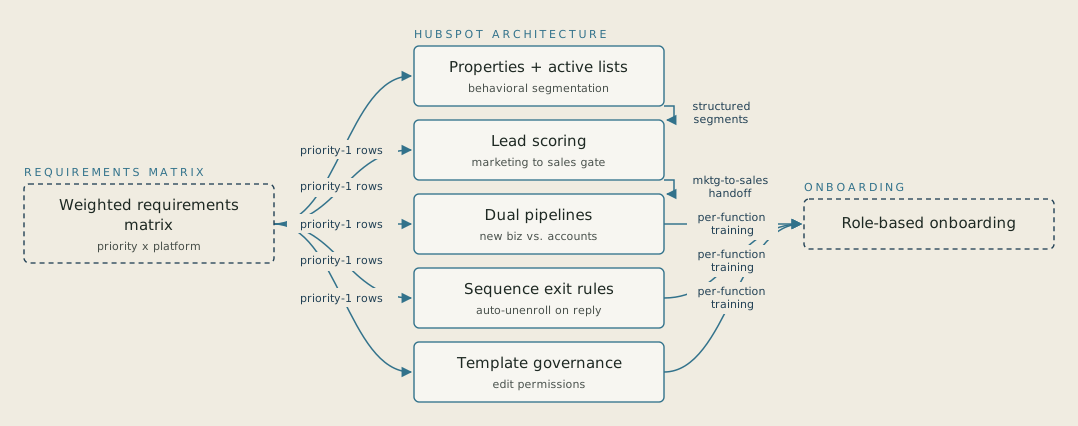
Four functions were buying one platform, and an unexamined default choice would have failed at least one of them. So we graded every requirement by priority in a weighted matrix and named the native mechanism for each row. That matrix decided the architecture. Behavioural segmentation became properties and active lists, and lead scoring now sets the handoff to sales. New business and account management have separate pipelines.

FAQ
Split what tags were doing into HubSpot's structured equivalents. Durable facts about a contact become custom properties. Behavioural segments, like everyone who downloaded a specific asset, become active lists driven by form submissions and page views. Automation triggers enrol from those lists and properties. The result is more maintainable than tags because segments update themselves instead of relying on consistent manual labelling.