

Warranty Claim Sync and Case Migration for a Residential Appliance Manufacturer
A residential kitchen and refrigeration appliance manufacturer needed its service reps to create warranty claims without leaving HubSpot, but its vendor's claim-creation API never returned a customer or internal ID, closing off the obvious round-trip handshake. We built a two-directional Global Warranty integration inside HubSpot Service Hub: a rep-triggered claim-creation flow, a status-sync path on dedicated per-event webhooks with ID-based dedupe and ordering guards, and a full case, history, claim, servicer, and asset migration ahead of cutover.
Executive Summary

Context
The manufacturer sells its appliance lines through an independent dealer network and adjudicates warranty claims in a separate claims platform, so every open case has to exist correctly in both systems at once. Its service team already runs ticketing in HubSpot Service Hub, but a rep still had to bridge claim creation and status updates by hand between the two systems.

What We Built
We built a two-directional claim integration that lets a rep create a Global Warranty claim from a HubSpot ticket and receive status updates back on that ticket, replacing a workflow where reps logged into the warranty platform directly.

Tech Stack
- HubSpot Service Hub, Global Warranty, GoTo Connect (Contact Center Complete), SysPro ERP, Infor ERP, Power BI
Not a fit if your warranty vendor can't commit to shipping its own webhook release on a fixed date: the reverse status sync depends on it, and a vendor that treats its API as a moving target will stall a build the same way this one stalled. It also assumes a service team already running ticketing in HubSpot.

The Challenge
Service reps needed to create warranty claims without leaving HubSpot. So the first design assumed that the vendor's claim-creation response would return a customer or internal ID that HubSpot could match against later. Live testing showed the API never returns that ID, even for a record it had just created, which closed off that handshake.
The reverse direction failed differently. A webhook-trigger token locks its field schema to the shape of whatever payload it first samples, and one shared token that received mixed payload shapes became corrupted for mapping. HubSpot's webhook trigger also caps at fifty mapped fields, which is short of the vendor's full claim payload.

Our Approach
With no return ID available, we used serial-number lookup as the only automatic way to match a claim to a customer record, and kept a small manual queue for cases it can't resolve.
For the reverse sync, we replaced the corrupted shared receiver with one dedicated webhook-trigger URL per event type, so that no token samples more than one payload shape. Because the vendor's payload still exceeds HubSpot's fifty-field mapping ceiling, the receiver is custom-coded. It writes updates onto the Asset and GW Claim custom objects by matching on several keys: the vendor's claim identifier first, then its claim number and an internal sequence key as fallbacks.
An EventID check that skips events already processed, together with an event-sequence ordering check, stops the vendor's retry behavior from overwriting a newer status with a stale one. The vendor retries up to six times across a two-minute window. The same identifier logic carries into the cutover migration as orphaned-record reconciliation, which flags any case with no matching HubSpot owner into a visible queue. The trade-off is that the receiver is custom code rather than native HubSpot mapping.

Impact

Reps create warranty claims without leaving HubSpot
A rep opens a Global Warranty claim from a HubSpot ticket, and the flow stamps a match key at creation and writes the claim number back onto that ticket, so the record stays in HubSpot. Enrollment criteria block a duplicate claim on the same ticket, and a cutover guard skips records already carrying a migrated case ID.
Cases with no matching owner surface instead of disappearing
Every case carried into HubSpot is checked against a HubSpot user, and any case with no match is flagged into a visible queue rather than migrated ownerless. Per-object count reconciliation stops the load on any mismatch, so a data gap becomes a queue to work through, not a case that goes missing.
A webhook design that survives the vendor's own payload changes
Because each event type has its own dedicated webhook-trigger URL, no single token has to interpret more than one payload shape, so a future payload change cannot silently corrupt the mapping again. The EventID dedupe guard and the ordering check keep a delayed or repeated delivery from overwriting a newer status with a stale one.
A migration path for records the vendor's API cannot fully expose
Case Status, Equipment Status, and claim mood fields exist nowhere in the vendor's API, so the plan uses a manual CSV export pulled immediately before cutover, alongside a recursive date-windowed extraction that works around the platform's row ceilings. That gives the migration a path for records the API cannot deliver completely.
A button on the ticket calls the warranty platform's claim-creation endpoint, stamps a HubSpot-generated match key on the request, and writes the claim number onto the ticket and a new claim custom object. Enrollment criteria block a second claim on a ticket that already has one.
Instead of one shared endpoint branching on the vendor's EventType field, each event type posts to its own webhook-trigger URL, so no token's field schema ever represents more than one payload shape. A custom-coded receiver behind each URL parses the full claim payload, since HubSpot's native mapping caps at fifty fields.
Every inbound status event carries an EventID the receiver checks against records already processed, and an ordering check compares each event's sequence number and timestamp against the last status written. Together they stop a delayed duplicate from overwriting a newer status.
Cases, history notes, claims, servicers, assets, and contacts migrate keyed on the vendor's own identifiers: case and servicer ID, serial number for assets, claim number for claims, email then phone for contacts. Per-object count reconciliation halts the load on a mismatch, and unmatched-owner cases are flagged into a visible queue.
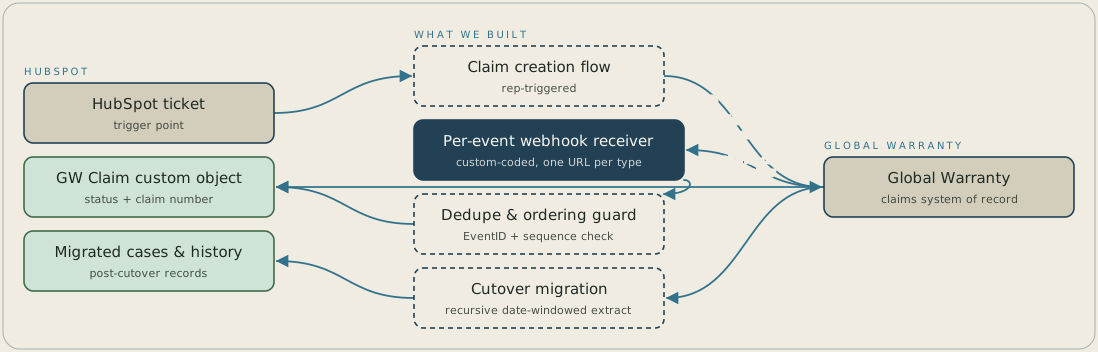
A rep clicks Create Claim on a HubSpot ticket, and the claim creation flow sends Global Warranty a HubSpot-generated match key. Global Warranty returns a claim number, which lands on the GW Claim custom object. In the other direction, Global Warranty sends claim status webhooks to a custom-coded receiver, one URL per event type, and an EventID and sequence check decides whether each update gets written to the claim. At cutover, a date-windowed extract moves cases and history from Global Warranty into HubSpot, with a count reconciliation on each object.
FAQ
You can't rely on the claim-creation response for a customer or internal ID if the vendor's API never sends one back. The workaround was serial-number lookup as the primary automatic match, with a small manual queue for cases it can't resolve.
A webhook-trigger token locks its field schema to whatever payload shape it samples first, so a later, differently shaped payload makes it unusable for mapping. We gave each event type its own dedicated URL instead of routing them all through one token.


