

Diagnosing a Region-Assignment Workflow's Silent Enrolment Gap

A region-assignment workflow inside the client's HubSpot instance wouldn't enrol a record until two contact properties, an IP-derived country and a user-entered country, both held a value. Only a small share of a roughly 180,000-contact database ever cleared that bar. We traced the enrolment logic field by field and found that the workflow's own failure notification pointed at a deactivated user account. The review recommended replacing the two-property gate with the single, better-covered field.
Executive Summary

Context
A global print-management software vendor sold through a multi-tier authorised-partner and reseller channel ran a HubSpot workflow meant to assign each of its contacts to a region, but the rule behind it quietly excluded most of a roughly 180,000-contact database from ever enrolling.

What We Built
We delivered a documented diagnosis of why the region-assignment workflow under-enrolled contacts, a coverage comparison between its two candidate identity properties, and a recommendation for correcting the enrolment condition and the failure-notification routing.

Tech Stack
- HubSpot
- Zendesk
- SendGrid
- in-house system of record
Not a fit if your contact database already carries one reliably complete identity field for a region or territory rule, rather than two partially known properties stacked as a single condition. It's also not a fit if your team already audits where a workflow's failure notifications route whenever an owner leaves. The value here is catching a coverage gap and a routing gap that neither shows up until someone traces the logic directly.

The Challenge
A workflow in the client's HubSpot Marketing Hub instance assigned each contact to a region so the rest of the marketing programme could route correctly. Only a small share of a roughly 180,000-contact database ever enrolled, and nobody on the team could say why.
That left the client unable to decide safely whether to keep the workflow running, rebuild it or retire it. Keeping a rule that silently excluded most contacts had a cost. So did abandoning region assignment, because the fraction that did work still provided some routing value.

Our Approach
We started by reading the workflow's own enrolment criteria rather than its outputs. They required two properties, an IP-derived country and a user-entered country, to both hold a value before a record could proceed.
We then counted how many contacts carried each property: roughly 102,000 for the user-entered field against roughly 48,000 for the IP-derived one. The IP-derived property also misreads the country of a travelling or VPN-connected contact. With narrower coverage and lower accuracy, we recommended dropping it.
We also traced the workflow's failure path and found it led to a deactivated user account, a second fault alongside the enrolment logic. The review recommended the single, better-covered field, which trades a small amount of self-reported inaccuracy for enrolling most of the excluded database.

Impact

The exact rule that blocked enrolment has a name
The review traced the workflow's enrolment criteria field by field rather than treating low participation as an unexplained platform quirk, and found that enrolment required both the IP-derived country property and the user-entered country property to carry a value. With the condition written down rather than assumed, the client can check any similar two-property gate before it ships.
A better-covered field replaces the one causing the gap
The user-entered country property held a value for roughly 102,000 contacts against roughly 48,000 for the IP-derived property, which is itself unreliable for a travelling or VPN-connected contact, so the recommendation drops the weaker property rather than trying to improve it. Rebuilding enrolment around the better-covered field recovers most of the database the old rule excluded.
A failure notification reaches a person who can act on it
The workflow's own error notification was configured to alert a user account that had since been deactivated, so a failing enrolment produced no signal anyone would see. Flagging that routing gives the team a concrete reason to check who a workflow notifies whenever ownership changes.
Re-enabling the workflow rests on evidence, not a guess
Because the workflow had already been switched off before the review began, the client faced a real decision about whether reviving it was worth the effort. The recommendation gives that decision an evidenced basis, running it on the single field with far larger known coverage rather than leaving the old two-condition gate switched off indefinitely.
Before any contact record is assigned a region, the workflow's enrolment step checks two properties, an IP-derived country and a user-entered country, and only proceeds when both already hold a value. Stacking two partially populated properties as a single condition kept most of a roughly 180,000-contact database from ever enrolling.
The review counted how many contact records actually held a value in each property, roughly 102,000 for the user-entered country field against roughly 48,000 for the IP-derived one, which is also prone to error for a travelling or VPN-connected contact. Comparing the two counts directly, rather than assuming IP detection was the more trustworthy source, justified dropping it from the gate.
The review didn't stop at the enrolment logic. It also traced where the workflow sent its own failure notification and found that the recipient account had been deactivated, so the workflow could keep failing with its alert reaching nobody. Checking notification ownership became as much a part of the review as the enrolment condition itself.
The review recommends the single user-entered country field in place of the two-property gate, accepting that a contact's self-reported country can occasionally be wrong in exchange for enrolling the much larger share of the database the old condition excluded. It trades a small, known inaccuracy for coverage, rather than trying to make the IP-derived property more accurate.
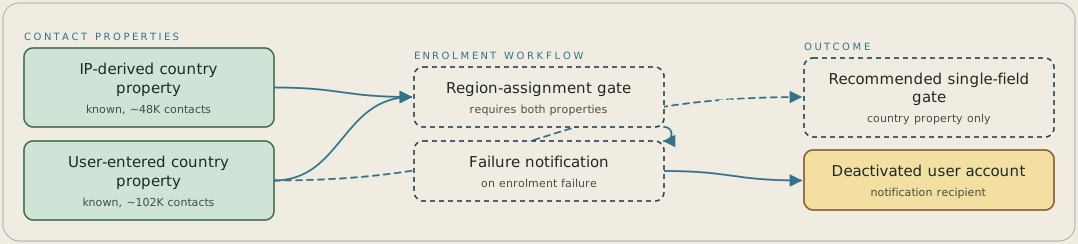
Two contact properties, an IP-derived country covering about 48,000 contacts and a user-entered country covering about 102,000, both have to hold a value before the region-assignment gate in the HubSpot workflow enrols a contact. Most contacts are missing one of them, so most of the database stops at the gate. When the workflow fails, its notification goes to a deactivated user account, so nobody sees the failure. The recommended fix is a gate on the user-entered country alone.
FAQ
Because its enrolment condition required two properties, an IP-derived country and a user-entered country, to both already hold a value. Any contact missing either one, which was most of a roughly 180,000-contact database, never enrolled, and nothing in the workflow signalled that the gate itself was the cause.
You trace where its own failure notification is configured to go, not just whether it is enrolling records. Here, that notification pointed at a deactivated user account, so a failing workflow had been producing no alert anyone would see.


