

HubSpot lead scoring and industry data standardization for a B2B SaaS platform
The client's HubSpot instance carried a Deal Industry property with more than seventy raw free-text values, because reps and imports had typed in whatever fit for years. There was also no scoring layer to separate a real buyer from a one-time form fill. Segmentation and reporting barely worked, because near-duplicate spellings rolled up to nothing. We built a weighted lead-scoring model with a hard exclusion gate, and we remapped Deal Industry to a fixed picklist cross-referenced to ANZSIC codes.
Executive Summary

Context
An Australian expense-management SaaS platform ran its sales and marketing on HubSpot at Enterprise tier, with a small team split between business development reps and account executives. Its CRM's industry classification had never been governed, carrying whatever text a rep or importer typed in.

What We Built
We built a composite lead-scoring model layering profile fit, firmographic fit, and engagement signals into one score, gated by a hard exclusion rule that zeroes out non-Australian, competitor, and internal test contacts before 100 points. We also remapped Deal Industry to a fixed picklist cross-referenced to ANZSIC codes.

Tech Stack
- HubSpot Sales Hub, HubSpot Marketing Hub, Clay
Not a fit if your CRM licence doesn't support custom scoring properties and workflow-based exclusion logic, since the score and its exclusion gate need capacity above entry-tier licensing. Also not a fit if nobody will own picklist governance once the remap ships, since a fixed list stays clean only when new values are triaged against it rather than typed back in as free text.

The Challenge
The Deal Industry property had accumulated more than seventy free-text values over two years, because reps and imports typed in whatever fit. A report filtered to Construction or Education therefore undercounted every deal filed under a near-duplicate spelling.
Marketing's lead flow had the opposite problem. Any contact who filled out a form was treated the same regardless of fit, so sales worked genuine buyers and one-time e-book downloads at equal priority. A new workflow on top of the existing property couldn't fix either problem, because the property carried no structure to score or filter against. The client needed a scoring layer that separated a qualified prospect from noise, and a picklist that a report could actually group by.

Our Approach
We worked from the property itself and didn't layer a workaround on top of it. That meant walking the seventy-plus raw industry values and mapping the ones that mattered to a fixed picklist cross-referenced to ANZSIC Division and Group codes. We folded anything irrelevant into a single Other value. The rollout ran in phases, with Construction, NDIS and Education live first.
For lead scoring, the trigger was any tracked property change or engagement event. It fed a composite score built from Profile fit, Bad Fit and tiered Engagement signal groups. A record located outside Australia, matching a named competitor, or flagged as internal or test took a negative one-thousand-point exclusion that overrode the score. A clean record that crossed one hundred points hit the MQL threshold that handed it to sales.

Impact

reps stop chasing contacts that were never going to convert
The hard exclusion gate zeroes out non-Australian companies, named competitors and internal or test contacts before they reach the 100-point MQL threshold, so a rep never sees a record that the model has already ruled out. That let sales work a shorter, better-qualified queue.
campaigns can target by industry instead of guessing from free text
With Deal Industry remapped to a picklist cross-referenced to ANZSIC codes, a report can group deals by Construction, NDIS, or Education without missing records buried under a near-duplicate spelling. That gave marketing a governed field for the three planned industry campaigns.
sales sees a ranked queue instead of an undifferentiated inbound feed
The composite score weights Profile fit, Bad Fit and Engagement signals into one number, so a contact that matches the ideal profile and is actively engaging ranks above one who only filled in a form. That gives sales a queue ordered by fit.
the industry field is now something a dashboard can group by
Values marked for removal fold into a single Other category instead of piling up as stray text, so a dashboard built against the picklist stays accurate as new deals come in. That leaves the field ready for the reporting and attribution work still queued behind it.
The score combines Profile fit, Bad Fit and tiered Engagement signal groups into one property, and it's evaluated on any tracked property change or engagement event. A negative one-thousand-point exclusion overrides it for a company outside Australia, a named competitor or an internal test contact. A clean record that reaches 100 points is promoted to MQL.
We replaced the legacy free-text Deal Industry property field by field with a picklist cross-referenced to ANZSIC Division and Group codes. It rolled out in phases, starting with the client's priority segments. Values we didn't map were marked REMOVE and folded into a single Other option.
Clay enriches company records with an industry signal that feeds the picklist mapping. That gives the remap a second source beyond whatever a rep typed into the deal, so the team could validate a deal's mapped industry against the company's own profile.
Core categories, including Construction, NDIS and Education, went live first, because those were the segments that the next campaigns needed. The Other fallback keeps every record classifiable during the rollout, so a report never silently drops a deal whose industry hasn't been mapped yet.
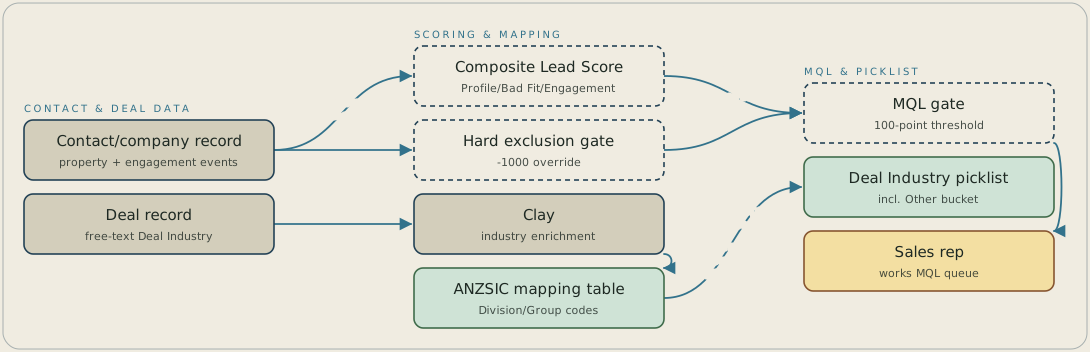
A tracked property change or engagement event feeds a composite lead score built from profile fit, bad fit and engagement signals. A hard exclusion gate overrides the score with a negative one thousand for records outside Australia, named competitors and internal test records, and a clean record that reaches 100 points goes to sales as an MQL. Separately, each deal's free-text industry value goes through Clay enrichment and an ANZSIC mapping table into a fixed Deal Industry picklist, with an Other value for anything unmapped.
FAQ
The exclusion rule only fires on hard, checkable facts: the company's country field, a match against a named competitor list, or an internal or test flag. It doesn't touch behavioural scoring, so a genuine prospect can still clear 100 points on profile fit alone.
It gets mapped to the single Other value, and it doesn't stay as free text or get forced into a category that doesn't fit. That keeps every deal reportable during the rollout, and the Other bucket doubles as a review queue for a future category.


