

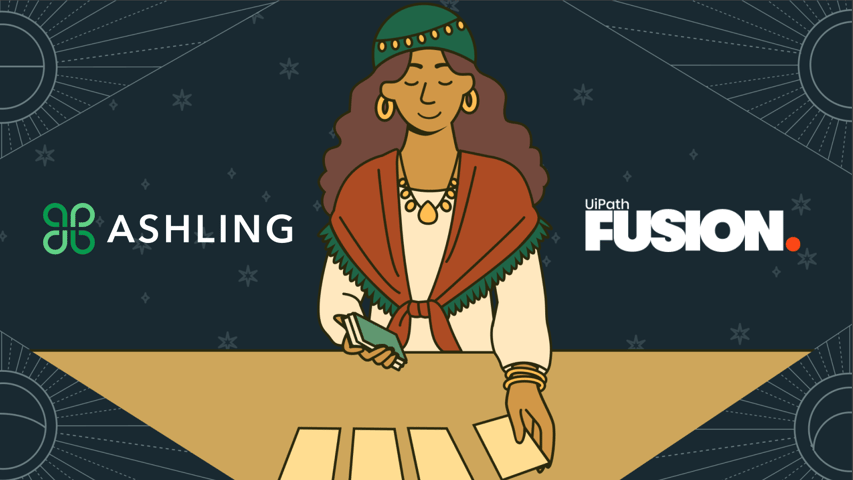

There are client briefs that arrive fully formed, and there are ones that arrive as a spark. When the team at Ashling came to us ahead of UiPath's Fusion 25 conference, they had a compelling asset — a custom deck of tarot-inspired cards, each one riffing on the real pain points facing automation and AI teams today — and a clear ambition: make it mean something at the show.
What they wanted was a partnership that went from ideas to outcomes. That meant developing a creative concept, producing the assets required to bring it to life, and architecting the digital strategy, workflows, and automations to make sure it was as functional as it was cool. That's the kind of problem we're built for.
Turning a Swag Item Into a Campaign
The cards themselves were already good. Sharp, funny, rooted in genuine industry insight — the kind of thing that earns a second look on a conference table. They'd been well-received at previous events. But a deck of cards at a booth is a conversation starter, not a campaign.
Our job was to build the concept that would transform them into one.

The idea we developed was the Ashling Oracle: a fortune-teller style interactive web application where conference attendees could select three cards representing their current automation challenges, then receive a personalized interpretation powered by AI. It was playful on the surface and substantive underneath — which made it a natural fit for a client whose core message is that intelligent automation, in the right hands, can do remarkable things.
The concept did exactly what good event creative should do: it gave people a reason to engage, a reason to stay, and something worth telling the person at the next table about.
Building the World Around the Cards
Once the concept was set, we got to work on everything required to make it real. That meant designing a cohesive visual world that extended the aesthetic of the cards across every touchpoint in the campaign: landing pages, organic social content, email templates, and the in-app screens for the Oracle application itself.
Consistency across that many surfaces doesn't happen by accident. Every asset had to feel like it belonged to the same world — and that world had to feel considered, not assembled. When attendees moved from a social post to a landing page to the app at the booth to a follow-up email in their inbox the next morning, the experience needed to hold together.

We also contributed our UX experience to the application build itself. Small details matter in an experience like this. One example: During testing, we realized that the brief "The Oracle is Thinking" pause screen needed to stick around a bit longer than we initially planned before delivering each reading, to build a moment of anticipation that made the payoff land better. It's a minor touch, but it reflects how we approach this work — we're not just producing assets, we're thinking about how people actually move through an experience.
Strategy and Execution: Connecting the Pieces
Creative without strategy is decoration. Our work on the Ashling Oracle extended well beyond asset production into the full digital marketing architecture that made the campaign function.
That meant designing the funnel from the ground up: pre-event awareness content to build anticipation, on-site engagement through the Oracle app, and a post-event nurture sequence to extend the experience past the show floor.

The Oracle application itself was built by the Ashling Team on Microsoft Power Platform using frontend designs and UX notes provided by S2, and connected to a custom-configured GPT via the OpenAI Responses API. We handled the HubSpot side — building the automation workflows that triggered a personalized HTML email to each attendee after their reading, delivering their unique fortune and keeping the Ashling brand alive in their inbox after they'd left Las Vegas.
Pulling all of that together — the creative, the martech, the strategy — under one roof is what made the execution efficient and reliable. There were no handoffs between a creative agency, a strategy team, and a tech vendor. It was one team, one vision, end to end.
One Team, One Dream
The Ashling Oracle is a good example of what Salted Stone actually does, stripped of the jargon. A client had a great idea and the raw material to support it. We provided the creative concept, the design and production work, the strategic framework, and the technical execution to turn it into something that performed in the real world.
That integration — creative, strategy, and technology working as a single discipline rather than three separate ones — is what we bring to every engagement. It's why clients come to us when the brief is a spark, and why they keep coming back when it isn't.
If you're working on something that could benefit from that kind of thinking, we'd like to hear about it - so drop us a line!


