

Paid media account restructure by service line and location for a dental practice group

A multi-location dental practice group's Google and Meta accounts ran unsegmented Smart, Search and Dynamic campaigns side by side, leaking spend through broad match while one campaign climbed to a creative frequency of 46. We rebuilt the account by service line and clinic location, added shared conversion tracking through Google Tag Manager, and set a cost-per-acquisition target for each line that decides when a campaign gets refreshed or cut.
Executive Summary

Context
The client runs several dental clinics across Tasmania, spanning general dental care, cosmetic work and same-day emergency appointments. Its paid media account had grown without a segmentation plan, so every service line and location drew from the same undifferentiated campaigns and budget.

What We Built
We rebuilt a leaking, unsegmented Google and Meta account into campaigns split by service line and clinic location, each governed by its own cost-per-acquisition target and a frequency-based creative refresh rule.

Tech Stack
- HubSpot Marketing Hub, Google Ads, Meta Ads, Google Tag Manager
Not a fit if nobody on the client side can approve a campaign launch or a budget shift above 20 percent within days, since the CPA kill criteria only works with a fast sign-off. Also not a fit if the ad accounts carry no spend history to audit, since the restructure starts from diagnosing an existing account rather than building one from nothing.

The Challenge
The prior account mixed Smart, Search and Dynamic campaigns without separating them by service line or clinic location, so a same-day emergency search shared a budget pool with a full-arch implant case worth a very different amount per lead. Broad match pulled in clicks nobody could filter, and no one could tell which service line was paying for its own leads. One Meta campaign ran long enough without a creative change that its frequency reached 46, well past the point where a repeat viewer stops responding to an ad.

Our Approach
The rebuild began with an audit of the existing account rather than a wholesale relaunch, since the leaking spend had to be diagnosed first. Segmenting by service line meant sorting emergency, wisdom teeth, all-on-4 implant and brand-search intent into their own campaigns, crossed with clinic location. Google Tag Manager carried the conversion event for both platforms, so a lead from Google and a lead from Meta rolled up to one tracked action. Each service line got its own cost-per-acquisition band, tight for a same-day emergency lead and wide for a full-arch implant case, reflecting what a closed case is worth. That target sets the kill criteria for an underperforming campaign and triggers a creative refresh once frequency crosses eight to ten, the range the prior 46-frequency campaign had blown past.

Impact

a campaign that stops converting gets cut before it drains the budget
Each service line's cost-per-acquisition band now works as a kill criterion, so a campaign drifting past it gets paused instead of spending on momentum alone. That replaces one blended account-wide budget with a rule tied to what each line's lead is worth.
a clinic's own performance is visible instead of blended into the account
Crossing service line with clinic location lets a report isolate how one clinic's campaigns are actually performing rather than reading a single account-wide number. That shows whether a slow line is a service problem or a location problem before anyone reacts.
a fatigued ad gets refreshed before it repeats the frequency problem
The creative-refresh rule fires once a campaign's frequency crosses eight to ten, catching the pattern earlier than the account's prior campaign, which had already reached a frequency of 46 before anyone noticed. That turns a problem the team used to catch late into one the account flags on its own.
a lead from either platform counts as the same tracked conversion
Google Tag Manager unifies the conversion event across Google and Meta, so a lead counts once against one definition regardless of platform. That gives the cost-per-acquisition targets a single consistent number to measure against.
Campaigns split first by service line, emergency, wisdom teeth, all-on-4 implant and brand, then cross with clinic location, so each combination runs and reports as its own unit rather than one account-wide campaign.
Each service line carries its own CPA band, tight for a same-day emergency lead and wide for a full-arch implant case, set against what a closed case in that line is worth. A weekly negative-keyword review and a monthly performance report keep a campaign that crosses its band from continuing to run unnoticed.
Once a campaign's frequency crosses eight to ten, a creative refresh triggers rather than waiting for performance to decline. The account's prior Meta campaign ran to a frequency of 46 before anyone acted, which is the gap this rule is built to close.
Google Tag Manager captures the conversion event for both Google and Meta campaigns and reports it back as one tracked action. That gives the CPA targets and kill criteria a single consistent number instead of two platforms each reporting their own count.
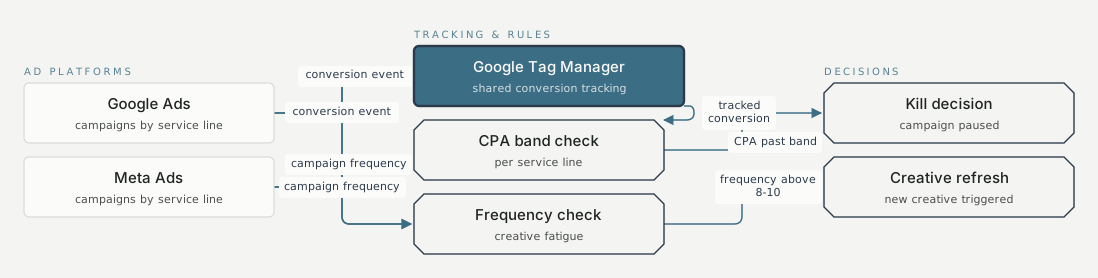
Ad platforms Tracking & rules Decisions Google Ads campaigns by service line Meta Ads campaigns by service line Google Tag Manager shared conversion tracking CPA band check per service line Frequency check creative fatigue Kill decision campaign paused Creative refresh new creative triggered conversion event Campaign launch by service line and location conversion event Campaign launch by service line and location tracked conversion Service vertical crossed with location campaign frequency creative refresh once frequency exceeds 8 to 10 campaign frequency creative refresh once frequency exceeds 8 to 10 CPA past band CPA target per service line drives kill criteria frequency above 8-10 creative refresh once frequency exceeds 8 to 10
FAQ
Each service line has its own cost-per-acquisition band, so a campaign spending past its band without converting gets paused rather than adjusted indefinitely. A campaign performing inside its band keeps running even if another line is doing better, since the two are not measured against each other.
The account ran Smart, Search and Dynamic campaigns without separating them by service line or location, so broad match pulled in clicks nobody could filter and a same-day search shared a budget pool with a much higher-value implant case.


