

Recurring Technical SEO Audits and Keyword Rank Recovery for a Commercial Design Firm

A commercial design firm's website carried a recurring SEO audit every few months from June 2022 through November 2024, run against the main site and a dedicated Life Sciences vertical. Each cycle checked Core Web Vitals, page weight, and backlink toxicity, then fed a keyword research pass that set which pages got rewritten next. A tracked term, "commercial interior design services," climbed from rank 41 to rank 4 over that cadence.
Executive Summary

Context
A commercial interior design and workplace-strategy firm ran a recurring technical and content SEO audit across its main site and its Life Sciences vertical from June 2022 through November 2024, checking Core Web Vitals, page weight, and backlink health at every cycle. Keyword research from each cycle set the revision list, carrying a tracked term from rank 41 to rank 4.

What We Built
We ran a recurring technical and content SEO audit against the firm's main site and its Life Sciences vertical, checking Core Web Vitals, page weight, and backlink toxicity at every cycle, and paired each finding with keyword research that set the on-page revision list for that period.

Tech Stack
- Google PageSpeed Insights
- HubSpot Website Grader
- SEMrush
- Google Search Console
- Google Analytics (GA4)
- Google Tag Manager
- HubSpot CMS Hub Enterprise
Not a fit for a single SEO audit with no return visit, since the value came from comparing each cycle against the last. Also not a fit without someone to act on keyword research between cycles, since the rank movement depended on pages actually getting revised.

The Challenge
By the November 2024 audit, the firm's desktop Core Web Vitals score read 64 out of 100, low enough to cost a page ranking position regardless of its copy. The same audit counted 476 toxic links inside a backlink profile of roughly 378,000 total links across 3,200 referring domains, and measured an average page weight of 15.2MB across a design-heavy portfolio built around project imagery.
Page weight like that does not arrive once and stay; a new project gallery adds it back between audits, so one review would have caught a snapshot and missed the pattern underneath it.

Our Approach
We ran the same audit toolset, Google PageSpeed, HubSpot's Website Grader, and SEMrush, on a recurring schedule from June 2022 through November 2024, so each cycle measured the site against the last one. Findings on Core Web Vitals, page weight, and backlink toxicity fed a keyword research pass every cycle that set which pages got rewritten next.
A term that lost ground in one period became a page slated for revision in the next. Over the full cadence, that loop carried "commercial interior design services" from rank 41 to rank 4 and "corporate interior design" from rank 11 to rank 8, both reaching page one.

Impact

A tracked keyword climbed from rank 41 to rank 4
"Commercial interior design services," tracked across the full audit cadence, moved from rank 41 to rank 4, reaching page one alongside "corporate interior design," which moved from rank 11 to rank 8. Neither term moved in one jump; each rose as a cycle's keyword research pointed at a specific page to rewrite.
The site's technical baseline became a number, not a guess
The November 2024 audit gave the firm a desktop Core Web Vitals score of 64 out of 100 and an average page weight of 15.2MB, figures the cadence could compare against every prior cycle. A design-heavy site built around project imagery gains page weight back with every new gallery, so a repeatable measurement mattered.
Backlink toxicity got a specific count attached to it
The same audit counted 476 toxic links inside a backlink profile of roughly 378,000 total links across 3,200 referring domains, turning a general sense that inbound links might be hurting rankings into a specific count.
Keyword research and on-page revision stayed one loop, not two calendars
Because the same cadence measured Core Web Vitals and backlink health and fed the keyword research, a page's technical problems and its ranking problems surfaced together, and revisions followed from one finding rather than two separate workstreams.
Google PageSpeed, HubSpot's Website Grader, and SEMrush ran at every cycle from June 2022 through November 2024, so a score in one period compared directly against the same tool's prior reading rather than losing the baseline to a tool change.
The November 2024 cycle measured a desktop Core Web Vitals score of 64 out of 100 against an average page weight of 15.2MB, the two figures the cadence tracked as the site's technical baseline between reviews.
The same cycle counted 476 toxic links inside a backlink profile of roughly 378,000 total links across 3,200 referring domains, a specific count rather than a general toxicity warning.
Every cycle's findings fed a keyword research pass that set which pages got rewritten next, tying revision directly to the most recent technical and ranking data rather than a fixed content calendar.
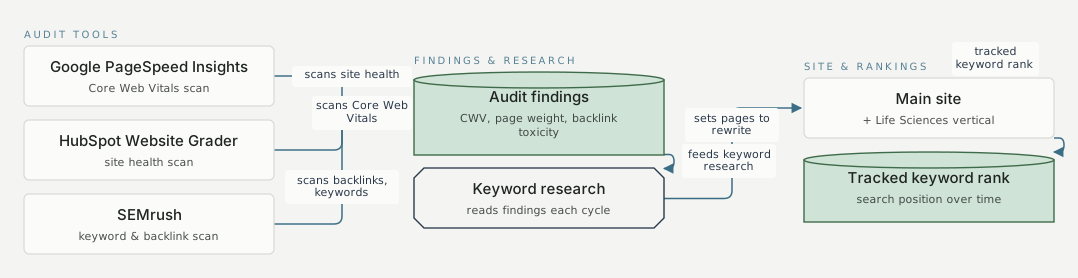
Audit tools Findings & research Site & rankings Google PageSpeed Insights Core Web Vitals scan HubSpot Website Grader site health scan SEMrush keyword & backlink scan Audit findings CWV, page weight, backlink toxicity Keyword research reads findings each cycle Main site + Life Sciences vertical Tracked keyword rank search position over time scans Core Web Vitals recurring technical and content SEO audit cadence scans site health recurring technical and content SEO audit cadence scans backlinks, keywords recurring technical and content SEO audit cadence feeds keyword research keyword research drove on-page revisions sets pages to rewrite on-page revisions across main site and Life Sciences vertical tracked keyword rank commercial interior design services 41 to 4
FAQ
"Commercial interior design services" rose because each cycle's keyword research pointed at a specific page to revise before the next cycle measured the site again. The climb from rank 41 to rank 4 happened across the full run from June 2022 to November 2024.
A single review gives one Core Web Vitals score and one page-weight figure with nothing to compare against. The cadence caught that page weight and backlink toxicity, 15.2MB average and 476 toxic links of roughly 378,000 by November 2024, could drift between cycles, and fed that drift into the next round of keyword research.


