Merging Two Mature HubSpot Portals After Acquisitions for a Building Products Manufacturer

Two mature HubSpot portals held the data of a $200M+ building products manufacturer, each with its own legacy property types, conflicting product-interest values, and inconsistent regional data. The acquisitions had left fragmented data and redundant software spend. Both portals had to reconcile into a single unified source of truth without disrupting active lead flows.
Executive Summary

Context
Acquisitions had left the manufacturer with regional brand sites and a second mature HubSpot instance running alongside the parent portal. The objective was to dissolve the operational silos by merging the two portals into one. A phased migration put data hygiene first and normalized thousands of records before anything moved.

What We Built
A property reconciliation layer that resolves type conflicts between portals. Normalization logic corrects corrupted regional data. A source-portal identity property preserves brand-level segmentation, and a full 301-redirect map covers every legacy domain URL.

Tech Stack
- HubSpot CMS Enterprise
- HubSpot CRM
- Screaming Frog
- Google Tag Manager
Not a fit when the two business units operate entirely different sales motions with no overlap in customer segments or reporting requirements.

The Challenge
Leads were tracked entirely differently across the two portals: one instance used a multi-select property for product interest while the other used a radio-select, a mismatch that produces fatal errors on import. Legacy region fields were riddled with values that were actually city or province names, and those values broke regional reporting and automated lead routing. That technical debt left marketing teams without a unified view of their builders and OEMs, and duplicate outreach and lost sales opportunities followed.

Our Approach
Reconciliation had to come before migration, since a simple export-and-dump was off the table. Mapping the product-interest properties was the hardest part: on a naive import, the disparate property types would have truncated or lost roughly 40 percent of the historical data. So a reconciliation layer re-mapped those property types into a new, normalized schema in the destination portal before the final import. Normalization logic corrected the regional data errors during export, and a comprehensive Screaming Frog crawl of the legacy sites mapped every URL to its equivalent on the parent domain, protecting years of accumulated SEO equity. A hard-stop date retired legacy automation, so rebuilt nurture sequences launched only after the final import had validated.
This engagement is part of our migration work for manufacturing & industrial organisations.

Impact

Two Mature Portals Became One Clean Instance
The reconciliation layer resolved the property-type mismatches that had blocked unification, so the merged database imported cleanly instead of the truncated records a naive migration would have caused.
Regional Reporting Restored by Normalization
State and regional markers were normalized during export, so marketing automation and sales-territory routing now run against clean, consistent values instead of city names left in region fields.
SEO Equity Preserved Through the Cutover
A full 301-redirect strategy covered every acquired legacy domain. Internal links and search-engine indexes stayed intact through the transition to the unified parent domain.
Brand History Kept Inside Global Reporting
A custom source-portal property stamps every migrated record with its original brand instance. Teams can segment by legacy brand while reporting globally from one database.
Every custom property in both portals was audited. Type conflicts, number versus text, radio versus multi-select, were resolved by creating new standardized destination properties instead of forcing incompatible imports.
Cleanup logic corrected regional data errors, like city names in state fields, during the export phase. Bad values never reached the destination portal in the first place.
A source-portal property in the destination instance records which legacy brand each record came from. Brand-level segmentation survives inside a unified global database.
A Screaming Frog crawl plus HubSpot's redirect tooling mapped the legacy brand domains into the consolidated sitemap, URL by URL. Redirects were treated as core migration infrastructure rather than a launch-week afterthought.
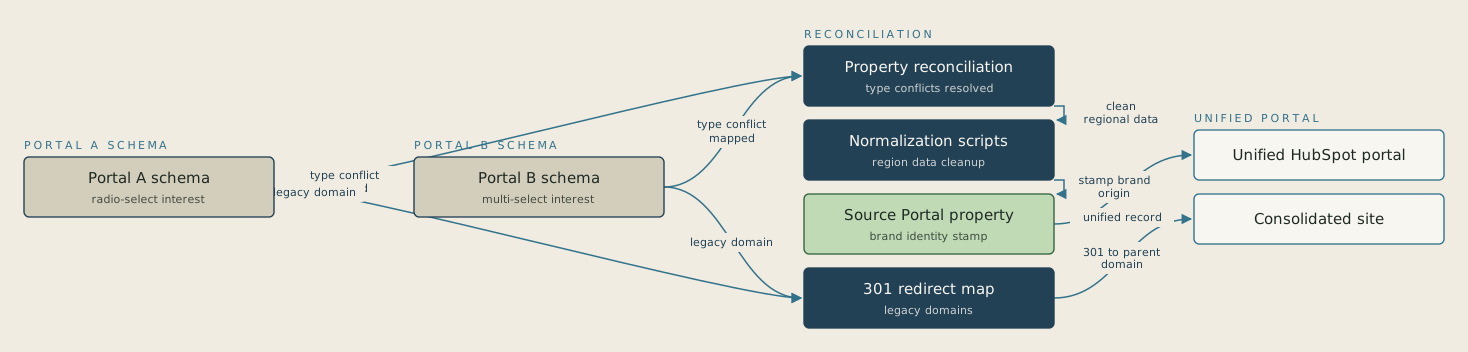
One portal stored product interest as a multi-select property and the other as a radio-select. That mismatch causes fatal errors on import, and a naive import would have truncated or lost roughly 40 percent of the historical data. The reconciliation layer re-maps those property types into a normalized schema before the final import. Each record also gets a source-portal property, so teams can still segment by legacy brand.

FAQ
Email address is the unique identifier. The final import uses HubSpot's update-existing logic. A builder who existed in both portals gets one merged record carrying the full interaction history from both brands, without creating a duplicate.
Prioritize the most flexible data type in the destination portal, usually multi-select. Then run a transformation on the source data so single-select values arrive compatible with the new destination property. The inflexible type never survives the merge.