Gong Conversation Flag Gates a Marketing Automation Build

A marketing-automation build risked enrolling a contact in a nurture track on the same day a sales rep already had them in conversation, because lead capture, deal routing, and event nurture all read from one shared HubSpot contact record. Twenty scoped automations needed sequencing so that a duplicated or in-flight record never triggered twice. Every enrolment now checks a flag sourced from Gong before it fires.
Executive Summary

Context
A B2B events and exhibitions operator running 90+ annual conferences across 35 brands was scoping a lead-to-revenue automation set for a new HubSpot build, while account records were still moving across from a legacy platform.

What We Built
We scoped and delivered twenty HubSpot automations spanning lead capture, deal routing, event nurture, and post-event follow-up, gated by a flag sourced from Gong that suspends enrolment for any contact already in an active sales conversation.

Tech Stack
- HubSpot Marketing Hub
- Clay
- Gong
- Salesforce Sales Cloud
Not a fit if you don't already have a call-intelligence tool like Gong feeding signal into your CRM, since the suppression gate depends on a live conversational flag that an automation can query. It also assumes Contact, Deal, and Project Attendance records are already associated cleanly enough to tell one object from another.

The Challenge
Two discovery calls, held nine days apart, produced a checklist of twenty automations spanning lead capture, deal routing, event nurture, badge emails, and referral links, all reading from the same HubSpot contact record. A nurture email could land in the same inbox a sales rep had open in a live call, and an unresolved duplicate could be routed into a deal before anyone confirmed it was the same person.
Two items, a CPD certificate email and a meeting-preference survey, were flagged Needs Clarification on the checklist. Building them to a guess risked shipping an automation that nobody could point to a rule for. We needed one gate that every automation could check, rather than twenty separate judgement calls made one at a time.

Our Approach
We first scoped each automation to its own triggering event: a lead-capture form firing a Clay enrichment webhook into deal creation, an email-open event starting a seven-day nurture drip, a confirmed Project Attendance firing a badge email, and a scheduled script generating the next week's campaigns.
Each automation checked only its own object before firing, so nothing stopped two of them enrolling the same person on the same day. We added one shared gate instead. Every automation now checks a flag sourced from Gong that marks an active sales conversation before it enrols a contact, and it suspends enrolment where the flag is set.
All twenty scoped automations were delivered, each checking the shared gate before it enrols anyone. That includes the CPD certificate email and the meeting-preference survey, which had been flagged Needs Clarification on the checklist.

Impact

An active sales conversation suspends marketing enrolment
A flag sourced from Gong marks when a contact is already in an active sales conversation, so every automation checks it before enrolling anyone in a nurture track, a badge email, or a deal-routing step. A rep working a live deal no longer competes with a parallel send, because the check runs before enrolment, not after.
Lead enrichment and deal routing work as a single step
A lead-capture form fires a Clay enrichment webhook that scores the contact and routes it directly into deal creation, so a rep receives a qualified deal record rather than a raw form submission to chase down by hand.
A confirmed event attendance triggers its own follow-up
An email-open event starts a seven-day engagement drip, and a confirmed Project Attendance fires a badge email on its own, matching a delegate's follow-up to what they did.
All twenty scoped automations were delivered
The checklist from the two discovery calls held twenty automations, and all twenty were delivered. That includes the CPD certificate email and the meeting-preference survey, which had been flagged Needs Clarification on the checklist.
A lead-capture form fires a webhook to Clay, which enriches and scores the contact before handing it back to HubSpot for deal creation. The Contact record carries its enrichment data into the Deal it becomes.
Before any of the twenty automations enrols a contact, it checks a flag sourced from Gong marking an active sales conversation and skips enrolment where the flag is set, across lead nurture, deal routing, and event follow-up alike.
An email-open event starts a seven-day nurture drip, and a confirmed Project Attendance record fires its own badge email. Referral links ride the same associations back to the record that generated them.
A scheduled script regenerates the next week's campaign workflows on its own timer, rather than a marketer rebuilding the same shape by hand for every new event. It reuses the Contact, Deal, and Project Attendance associations the other automations already read.
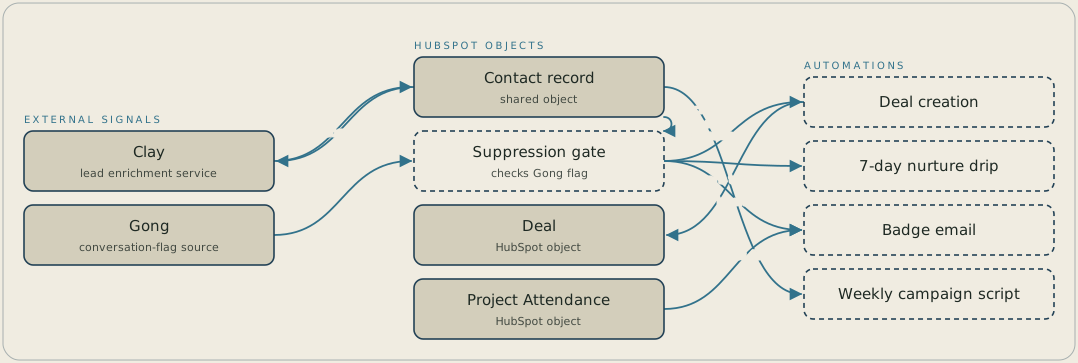
Twenty automations all read the same HubSpot contact record. A nurture email could reach a contact a rep already had in a live call. Now one shared gate sits in front of every automation. Before it enrols a contact, each automation checks the flag sourced from Gong that marks an active sales conversation. Enrolment is suspended only if that flag is set, and all twenty scoped automations were delivered with that check in place.
FAQ
Deal stage alone doesn't tell you whether a rep is mid-conversation with that contact right now. A flag sourced from Gong reflects live call activity, so an automation can suspend enrolment the moment a conversation starts. One shared flag meant we wrote the suppression logic once for all twenty automations.
Each automation originally checked only its own object before firing, so nothing stopped two of them enrolling the same person on the same day. One shared flag meant the suppression rule was written once and applied to all twenty.