

A HubSpot Leads object rebuild that stops unqualified trials from becoming deals

Every submission on an Australian workshop-management software vendor's free-trial form became a deal on landing, whether from a genuine buyer, a bot, or a fraud attempt filed under a deceased identity. We audited all eight pipelines against the client's own proposed lifecycle model and moved the qualification boundary onto the Leads object, so a deal now exists only once qualified.
Executive Summary

Context
The client had run its HubSpot portal for three years after two earlier partners failed to move it forward, and its pipeline still treated a form submission and a qualified opportunity as the same thing. Every free trial became a live deal the moment the form cleared, whether or not anyone had looked at it.

What We Built
We mapped the client's proposed lifecycle model against all eight live pipelines and moved the qualification boundary onto the Leads object, so deal creation now waits for Lead Qualified instead of firing on every submission.

Tech Stack
- Formidable (WordPress trial-signup form), HubSpot Sales Hub, HubSpot Service Hub, the HubSpot Leads object
Not a fit if your portal has no pipeline or workflow history to test a proposed model against, since this review compares a stated model to what is configured, not a blank-state design. It is also not a fit while your own lifecycle documentation disagrees with itself, since the gate needs one agreed model before the Leads workflows switch back on.

The Challenge
The client's free-trial form ran on Formidable and fed straight into HubSpot Sales Hub. A submission created a deal at Lead Received and raised a rep call task, worked to a 24-business-hour SLA. The only barrier was a copy-paste access code, with no CAPTCHA and no email verification, so bot and fraud signups walked in as live deals, including three cases filed under a deceased identity against the client's own payment product.
The portal's only lifecycle automation set a contact's stage whenever its deal reached one of four late stages. As a result, sales-qualified volume outnumbered marketing-qualified by a wide margin, and the marketing-qualified count was a single contact. A Leads object built for this earlier stage already existed, but its seven stage-transition workflows were switched off, so most of the 150 to 167 Lead records carried no stage.

Our Approach
We walked all eight pipelines against the client's proposed model instead of accepting it on paper, because its stage names didn't match what the workflows fired on. The audit isolated the boundary at Lead Qualified. The four stages before it never triggered more than a call task, so we moved them onto the Leads object, whose workflows already existed.
Deal creation now waits for the qualification call. The trade-off is that a deal's visibility starts later, in return for a pipeline reps can trust. We also recommended CAPTCHA and magic-link verification, which closes the gap that let fraud signups in as deals.
The harder call was an eight-stage model against the client's own six-stage specification. We left that for the client to settle, because the Leads workflows shouldn't go back on until one agreed model exists.

Impact

a qualification boundary the pipeline actually enforces
Every free trial used to become a deal the moment the form submitted, so reps worked bot and fraud signups as real opportunities. Moving deal creation to the qualification call means the pipeline now only holds reviewed records.
an existing Leads object with a named reactivation sequence
The portal already carried seven stage-transition workflows for the Leads object, disabled long enough that most Lead records held no stage at all. The audit gives the client a named reactivation order, not a rebuild from nothing.
a lifecycle-stage rule replaced before it fires too late
The one lifecycle automation in the portal set a contact's stage from four late pipeline stages, so sales-qualified volume heavily outnumbered marketing-qualified. Restaging those stages onto the Leads object fires a signal before a deal exists, not after.
a named decision the client still owns
The client's own documentation disagreed with itself on an eight-stage model against a six-stage model, so we flagged the contradiction rather than picking a side. The redesign works with either resolution, so the decision doesn't block the rollout.
Deal creation now triggers only when a Leads record reaches Lead Qualified, replacing the rule that created a deal on any submission. Every earlier stage, Lead Received, Ready to Sign Up, Demo Complete and Prospect Qualified, lives on the Leads object instead.
WF002 through WF008 already existed for signup validation, a failed-validation digest, and each stage transition through to disqualification capture, but had been switched off. The audit names each workflow so reactivation needs no rebuilding of logic already written.
The trial form's only barrier was a copy-paste access code, no CAPTCHA, no email verification, so signups including deceased-identity cases entered as deals. The fix adds CAPTCHA and magic-link verification at the point that now marks the qualification boundary.
Every one of the client's eight pipelines was checked against its proposed model rather than assuming it matched what was configured. That check surfaced the contradiction between the client's own eight-stage and six-stage specifications.
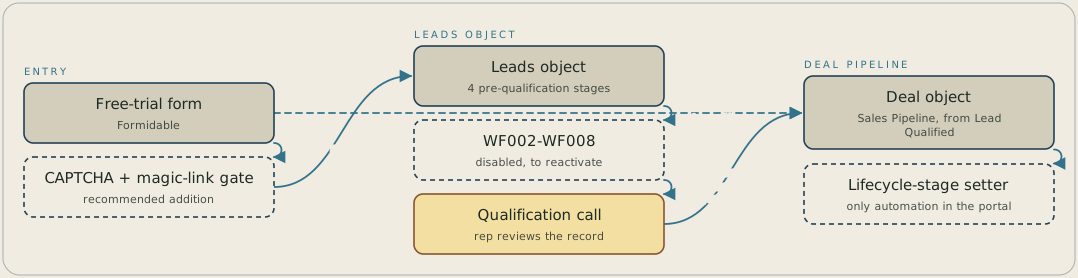
With the recommended CAPTCHA and magic-link check in place, a free-trial signup on the Formidable form goes first to the Leads object instead of straight to a deal. The four pre-qualification stages run there on the seven stage-transition workflows, WF002 to WF008, which were already built and are to be switched back on. Only when a rep confirms Lead Qualified on the qualification call does a deal form in the Sales Pipeline. Once that deal reaches a late stage, the portal's lifecycle-stage automation sets the contact's stage.
FAQ
The portal created a deal at form submission, before anyone judged whether the signup was real, so scoring that entry point wouldn't stop fraud records becoming deals. Moving the trigger to Lead Qualified means a deal exists only once a person has acted on a Leads record.
The audit named each disabled workflow and mapped what it was meant to do, from signup validation to the demo-booked handoff. Reactivating them in that order is the rollout path, not new automation from scratch.


