

Routing a single contact form into a segmented conversion path
A business process outsourcing group's website had one generic Contact Us form as its only conversion path, unable to tell a sales enquiry from a collections query, a media request or a job application. We replaced it with an intake that routes each submission by enquiry type, solution line and business unit, a qualifying discovery-call funnel that only books once a visitor answers a short questionnaire, and a three-email nurture across nine industries.
Executive Summary

Context
A multi-brand business process outsourcing and customer experience group ran its public website on one generic contact form, with every enquiry landing in the same queue regardless of intent. Industry was never captured at conversion, so no segmented follow-up existed beyond that form.

What We Built
We built a routed intake keyed on enquiry type, solution line and business unit that replaced a single generic contact form, a qualifying discovery-call funnel with round-robin calendar booking, and a three-email nurture segmented across nine industries.

Tech Stack
- HubSpot Forms
- HubSpot Workflows
- HubSpot Marketing Hub Enterprise
- HubSpot Content Hub Enterprise
- HubSpot Calendar
Not a fit if enquiry volume is too low to split across five routing queues without leaving some idle for weeks. It also assumes a business-unit or brand property is already applied consistently at intake, since routing and the nurture both key off it.

The Challenge
The client's website had a single Contact Us form as its only way to reach the business. No field distinguished a sales enquiry from a collections matter, a media request, a talent enquiry or a general question.
Every submission landed in one queue regardless of intent, so a sales rep and a collections handler read the same inbox and triaged it manually. No qualifying step came before a sales conversation, so an unready visitor could book a seller's time as easily as a ready one.
A visitor who didn't convert had nowhere to go, because no nurture existed off the form at all.

Our Approach
We replaced the single form with a structured intake keyed on an enquiry-type property, a solution-line property and the business unit a submission belonged to. That way each enquiry type goes to a different queue as soon as it's submitted.
A qualifying discovery-call funnel replaced Contact Us as the primary conversion point. A landing page invites a visitor to apply for a call, and a short questionnaire runs ahead of booking. Only a qualified visitor reaches round-robin calendar booking, and confirmation and reminder emails carry the booking through. That gate filters an unready visitor out before a seller's calendar is touched, not after.
Visitors who named an industry but didn't convert enter a three-email sequence instead of getting no follow-up at all. The trade-off is that the nurture enrols only on a selected industry, so an enquiry without one is still routed but doesn't enter it.

Impact

A routed intake instead of one shared inbox
Every enquiry now resolves to a queue by its own enquiry type, solution line and business unit at submission, so a sales rep, a collections handler and a talent contact each see only the enquiries meant for them. That removes the manual triage step in between.
A qualifying gate ahead of every sales conversation
A discovery-call funnel now asks a short set of questions before a visitor can book time with a seller, filtering an unqualified visitor out before a calendar invite goes out rather than after. Round-robin booking then distributes only the qualified sessions.
A nurture where none existed
Visitors who select an industry but don't convert immediately now enter a three-email sequence written for their industry, replacing what had been silence after that first form. Nine industries each have their own sequence.
A conversion path visible end to end
The routed intake, the funnel and the nurture now run as one connected path, so the team can report on where a visitor entered and how far they travelled. April 2026's account review found lead volume still below target. The routing fixed a structural gap, but it hadn't yet fixed volume.
A structured intake captures enquiry type, solution line and business unit, and a workflow reads those three properties to send the record to one of five queues: sales, collections, media, talent or general, before anyone opens it.
A landing page invites a visitor to apply for a discovery call, and a short questionnaire runs before any calendar slot is offered. Only a visitor who clears it reaches round-robin HubSpot Calendar booking, with automated confirmation and reminder emails carrying it through.
Selecting an industry on the intake form enrols a visitor in a three-email sequence written for that industry rather than one generic follow-up. Nine industries each have their own version, matching the sector a visitor identified.
The routed intake, the qualifying funnel and the nurture hand a visitor from one to the next, so a submission that misses the discovery-call gate still enters a nurture if it named an industry, rather than dead-ending at the form.
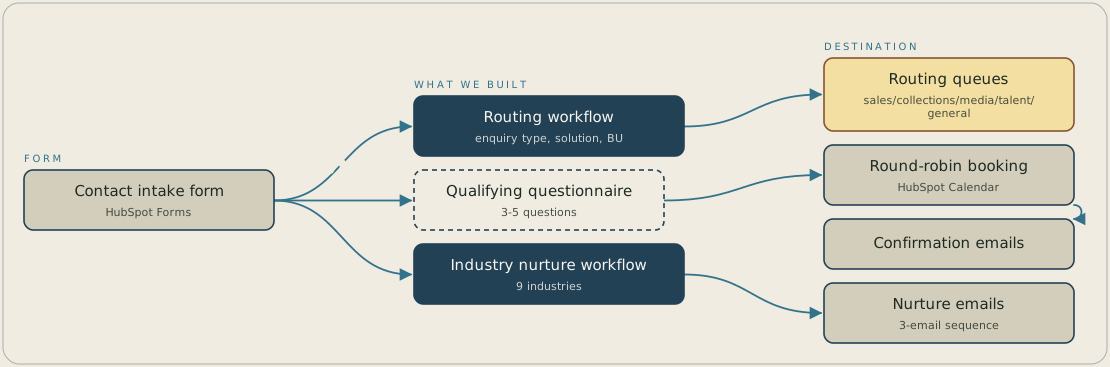
Every submission starts at the contact intake form. A routing workflow reads the enquiry type, solution line and business unit, and sends the record to one of five queues: sales, collections, media, talent or general. A visitor who applies for a discovery call answers a short questionnaire first, and only those who qualify reach round-robin HubSpot Calendar booking and a confirmation email. A visitor who selects an industry also enters a three-email nurture for that industry.
FAQ
It still routes by enquiry type and business unit, since those two properties drive the intake routing on their own. It just won't enter the industry nurture, because that sequence enrols only on the industry a visitor selected.
No. The qualifying questionnaire runs before round-robin calendar booking, so a visitor has to clear it first. That gate is what keeps an unqualified enquiry off a seller's calendar rather than letting sales disqualify it after the fact.


