

Gating lead verification before MQL for an offshore BPO

More than 80 percent of leads in this offshore BPO's HubSpot portal used to skip straight from Lead to Opportunity, with no MQL or SQL stage checking the jump. We rebuilt the lifecycle ladder with entry criteria at every stage and put a verification gate in front of MQL. A lead now counts as qualified only once Verified Lead is set to Yes or a deal has reached the Verified stage.
Executive Summary

Context
An offshore staffing and business process outsourcing provider had seven lifecycle stages in its HubSpot portal. Reps rarely set the Verified Lead or Manually Qualified property that was meant to gate movement, so most leads advanced straight from Lead to Opportunity.

What We Built
We redefined all seven lifecycle stages, Subscriber through Evangelist, with entry criteria that block a record from advancing until it meets its condition. We then added a verification gate in front of MQL that requires Verified Lead, or a Manually Qualified deal in the Verified stage.

Tech Stack
- HubSpot lifecycle-stage and deal properties, workflows
- Contact Us form and Team Builder Calculator lead capture
Not a fit if lead volume is low enough that one rep already reviews every record before it advances, since the gate replaces judgement at scale and not a step where none is needed. It also assumes reps reliably set the Verified Lead or Manually Qualified property and that deals carry a distinct Verified stage. Without that discipline, the gate blocks records because inputs are missing, not because the lead is genuinely disqualified.

The Challenge
A lead that filled out the Contact Us form or the Team Builder Calculator entered the Speed-to-Lead workflow and picked up a Lead stage. After that, nothing checked whether the record had actually been qualified. A rep could move a contact from Lead straight to Opportunity by hand, and more than 80 percent of leads did exactly that, so the MQL and SQL stages went unused.
Ninety-eight percent of contacts also had no location data, so regional segmentation had nothing to work with. The lifecycle needed a rule that stopped a record from moving, not a label a rep could apply at will.

Our Approach
We kept the same intake points. A Contact Us or Team Builder Calculator submission still sets Lead and enters the Speed-to-Lead workflow. What changed is what happens next.
A property-level gate now blocks MQL unless Verified Lead is set to Yes, or Manually Qualified is set to Yes with a deal in the Verified stage. SQL requires a First Call Booked date, which ties the stage to a call that was actually scheduled, not a status set without one occurring. A failed SQL regresses to Lead with a disqualification reason.
We put the gate downstream of intake so the fix could ship without touching the triggers the sales team depended on.

Impact

Stage-skipping no longer happens by default
A lead used to reach Opportunity on a rep's judgement alone, with no stage checking whether it had earned that jump, and more than 80 percent of leads took that path. The entry-criteria rule now blocks the jump at MQL, requiring Verified Lead or a Manually Qualified deal already open in the Verified stage.
A verified lead converts to a booked call most of the time
Once a lead clears the Verified Lead or Manually Qualified gate and reaches MQL, 87 percent of those records went on to a booked-call SQL in H1 2026. That rate shows the gate filtering for genuine intent, not blocking leads that would have converted anyway.
The true qualification rate is visible for the first time
Before the gate existed, every Lead counted as equally likely to become an Opportunity, because nothing measured the difference. With verification in place, only 3.9 percent of leads clear it to become a verified MQL, a number the old funnel never produced.
Regional segmentation has data to work with
Location-data coverage across the contact database rose from 2 percent to 98 percent alongside the lifecycle rebuild, giving the Australia, North America and United Kingdom segments an actual population to target instead of a blank field.
Subscriber, Lead, MQL, SQL, Opportunity, Customer and Evangelist each carry their own entry criteria rather than one open stage a rep sets freely. A record only advances when its condition is met, which stops the stage-skip pattern the previous model allowed.
A lead becomes an MQL only when Verified Lead is set to Yes, or Manually Qualified is set to Yes with a deal already in the Verified stage. Either path clears the bar, so a rep's manual call and an automated signal both count equally.
SQL status depends on a First Call Booked date on the record, tying the stage to a scheduled event rather than judgement alone. A failed SQL regresses to Lead with a disqualification reason, so its history stays legible instead of quietly resetting.
The two lead-capture points feeding the ladder, the Contact Us form and the Team Builder Calculator, kept their existing behaviour of setting a contact to Lead. Keeping that entry point untouched let the verification gate go live downstream without retraining the sales team.
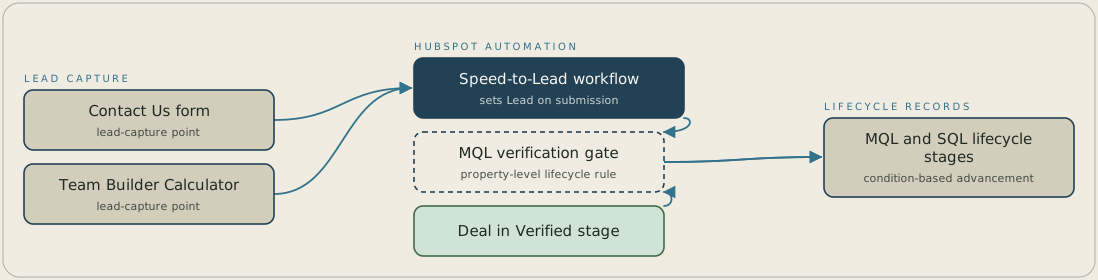
Over 80 percent of leads used to progress from Lead to Opportunity unchecked. The gate now stops that. A contact moves from Lead to MQL only if either the "Verified Lead" property is set to Yes, or it's a Manually Qualified deal in the Verified stage. When an SQL fails, it drops back to Lead with a disqualification reason.
FAQ
A lead becomes an MQL once Verified Lead is set to Yes, or Manually Qualified is set to Yes with a deal already open in the Verified stage. A lead that meets neither stays at Lead.
An SQL that doesn't hold up regresses back to Lead with a disqualification reason, rather than staying parked in a stage it no longer fits. The regression only fires after the First Call Booked bar was already cleared.


