

Escalating unqualified deals in an offshore BPO sales pipeline

Duplicate and obsolete deal stages meant a new lead entered the pipeline with no automated route to a rep. An unqualified deal could sit with its original owner indefinitely, and nobody else knew it existed. Now a qualification task fires automatically the moment a deal is created. If the deal is still unqualified after two days, an escalation goes to the BD manager and four contact owners, and a second escalation goes to the CEO five days after that. The rebuilt pipeline and a speed-to-lead dashboard gave the team one place to see where every deal stood, and within six months the business was closing 15% more deals a month at 20% higher monthly revenue.
Executive Summary

Context
An offshore staffing and business process outsourcing provider ran a HubSpot Sales Hub pipeline that had accumulated duplicate and obsolete deal stages over several configuration passes. New leads had no automated routing, and unqualified deals had no path to escalate.

What We Built
We collapsed the pipeline down to a single, consistent set of deal stages and built a two-step escalation workflow around one qualification task. A speed-to-lead dashboard backs it by tracking how long a deal has sat at its current stage.

Tech Stack
- HubSpot Sales Hub workflows and tasks
- deal pipeline stages
- sales templates and smart content
- Sales Workspace speed-to-lead dashboard
Not a fit if the sales team is small enough that one person already reviews and assigns every new deal before it can sit unqualified, or if there is no manager tier above reps to receive an escalated notification when a deal stalls. The workflow also assumes deal stages are consistent enough for one qualification task to gate every new record. Where reps create ad hoc stages for each deal, the check has nothing uniform to test.

The Challenge
Deal stages had accumulated duplicates and obsolete steps across earlier configuration passes. A new lead therefore had no single automated path into the pipeline once it arrived. A rep could create a deal and walk away, and nothing checked whether anyone had qualified the record before it aged in place.
An unqualified deal had no visible deadline and no second person looking at it. It stayed with its original owner until that person remembered to act on it.

Our Approach
We collapsed the pipeline and removed the duplicate and obsolete stages first, because a qualification rule built on an inconsistent stage set would have had nothing reliable to gate. A task named Manually Qualify New Lead is now created automatically the moment a deal enters the pipeline. Before, qualification depended on a rep noticing a new record on their own.
Two days after that task appears, a workflow checks whether the deal has been qualified. If it hasn't, an email goes to the BD manager and the four contact owners, addressed to the task's original owner. That way more than one person sees the stalled deal without it being reassigned outright. A further five-day delay repeats the check, and a deal that is still unqualified escalates directly to the CEO rather than cycling through another reminder.
That second escalation trades a lighter touch for a harder stop, because a message in the CEO's inbox signals that the earlier steps already failed. Sales templates and smart content standardised what a rep sent once a deal cleared qualification, and the speed-to-lead dashboard gave the team a single view of how long deals sat at each stage.

Impact

Unqualified deals stop waiting on memory
A deal used to sit with its original owner for as long as that person forgot about it, with no second check built into the pipeline. The qualification task now forces a decision within two days. An unqualified deal reaches the BD manager and four contact owners automatically, so the record gets a second set of eyes before it goes cold.
Escalation reaches the CEO when it needs to
A deal still unqualified five days after the first notification escalates straight to the CEO instead of repeating the same reminder. That second threshold gives the pipeline a real stopping point, one that only fires once the earlier steps have already failed.
Deals won climbed 15% a month
Once the collapsed pipeline and escalation workflow were both live, the team closed 15% more deals every month within six months of the rebuild. The stages a deal moves through now match what reps actually do with it, rather than carrying steps nobody used anymore.
Monthly revenue rose alongside deal volume
Monthly revenue grew 20% in the same six-month window, tracking the rise in deals won rather than one large deal skewing the number. The speed-to-lead dashboard let the team see that rise as it happened, instead of reconstructing it from stage history afterwards.
A task by this name is created automatically the moment a deal enters the pipeline, replacing a rep's own memory as the trigger for qualification. Its existence is what the two-day and five-day checks test against.
A workflow tests the qualification task two days after it is created. If the deal is still unqualified, it emails the BD manager and the four contact owners, addressed to the task's original owner. A second check five days later escalates a still-unqualified deal directly to the CEO.
Duplicate and obsolete stages accumulated from earlier configuration passes were removed, leaving one consistent set of stages every deal now passes through. The qualification task and its escalation checks rely on that consistency to know which deals are new.
A dashboard built on the rebuilt pipeline stages shows how long a deal has sat at its current stage, giving the team a single place to check pipeline health instead of piecing it together from individual records.
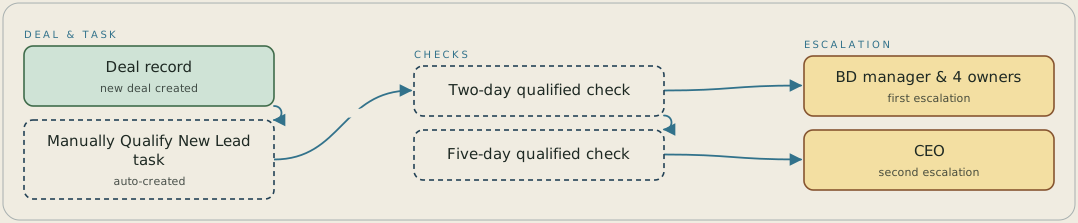
A new deal triggers the Manually Qualify New Lead task automatically. Two days later a check looks at whether the deal has been qualified, and if it hasn't, the BD manager and four contact owners are notified. Five days after that a second check runs, and a deal that is still unqualified escalates directly to the CEO.
FAQ
A workflow checks the Manually Qualify New Lead task two days after it is created, and if the deal is still unqualified it emails the BD manager and the four contact owners, addressed to the task's original owner. If the deal remains unqualified five days after that, the workflow escalates again, this time directly to the CEO.
Duplicate and obsolete stages gave reps no consistent place to leave a new deal, so an escalation rule built on that pipeline would have had no reliable signal to test. Collapsing the stages first gave the qualification task a single, current stage set to run against.


