

A lifecycle nurture built for five brands sharing one HubSpot portal
Five consumer-facing brands ran their lifecycle marketing from one HubSpot Marketing Hub Professional portal, and the shared instance surfaced conflicts that a dedicated portal wouldn't. Paired workflows fought over the same lifecycle-stage property, and enrolment logic let one brand's visitors slip into another's nurture. We rebuilt the flagship brand's subscriber-to-opportunity nurture stage by stage, replacing workflow-set stages with form-set ones and tracking each stage's conversion and open rate.
Executive Summary

Context
The group is a multi-brand aged-care and retirement-living media, directory and events business serving Australia and New Zealand. It runs consumer directory sites, an industry newsletter and a professional-development institute from brands that share a subscriber base but compete for the same reader's attention. Each brand needed its own path to a sales-ready lead, on one Marketing Hub Professional subscription built for one company, not five.

What We Built
We rebuilt the flagship brand's lifecycle nurture as a four-stage HubSpot workflow chain, from newsletter subscriber through Lead, MQL and SQL. It uses persona-branched emails and gated content, and a chatbot hands qualified visitors to the group's consumer toolkit signup.

Tech Stack
- HubSpot Marketing Hub Professional, HubSpot Forms, HubSpot Workflows, HubSpot Chatflows
Not a fit if an outside digital agency owns and hosts your brand's website and forms instead of your own team: this rebuild depended on changing tracking code and form logic directly, and a site you can't touch stalls every trigger. It also assumes you already keep contact and company data in one system, since a lifecycle stage that reads a hidden field needs that data to be reliable.

The Challenge
A single hidden contact property tracked which brand a subscriber belonged to. Paired Set Lifecycle workflows, one per stage, could both fire in the same sync window and strand a contact between them. Enrolment criteria on the newsletter form also let visitors from a sibling brand's site enrol here, which inflated the subscriber count with people who had never seen the flagship brand's content.
The final step, Sales Qualified Lead to Opportunity, didn't have a form at all. An opportunity existed only once someone created a profile in the group's consumer toolkit service, a system the nurture couldn't trigger directly. That gap let marketing report a healthy MQL count while sales saw far fewer real opportunities.

Our Approach
Each lifecycle transition relied on a paired Set Lifecycle automation. It read a hidden persona field and a contact-source property before writing the new stage, and two workflows watching that property at once caused the race that stalled contacts mid-funnel. The December 2023 review moved the assignment onto the form itself, so a stage-form submission now sets the stage the moment it fires. We retired the paired workflows instead of patching them again.
Email cadence still followed a fixed interval. Subscriber-to-Lead messages went out at three days, then six, then six again, with an instant knowledge-base email on download, and later-stage messages followed a three, seven and fourteen day rhythm after each change.
For the newsletter leak, we tightened the form's own source check instead of adding a second filter workflow downstream. That traded a more complex fix for a simpler one.

Impact

Every nurture stage now converts at a known, trackable rate
The Subscriber-to-Lead form now converts at 32.51%, Lead-to-MQL at 38.02% and MQL-to-SQL at 30.47%. The team couldn't state those numbers with confidence before the stage logic moved off two competing workflows and onto the form. A revenue team can now point at the exact stage where a cohort drops.
Email engagement stays high even four steps into the funnel
The first nurture email reached 5,971 sends with a 61.65% open rate and 19.33% click rate, and later stage emails held 70% to 91% opens with 33% to 54% clicks, so engagement didn't collapse deeper into the funnel. The same review flagged unsubscribe rates of 1.5% to 3.3%, above benchmark, as the next fix.
Cross-brand contact leakage stopped inflating the funnel
Tightening the newsletter form's source check closed the path that let a sibling brand's visitors register as flagship-brand subscribers. This funnel's lead count now reflects people who actually engaged with the flagship brand. That matters because the group runs both directory sites from one portal, where an inflated funnel would mask each brand's real performance.
A lifecycle model ready to run without the workaround workflows
Moving lifecycle-stage assignment onto the enrolment forms let the team retire the paired Set Lifecycle workflows that the December 2023 review flagged as the source of stalled contacts. Fewer, simpler rules now govern the automation than at launch.
Each contact carries a hidden persona field and a contact-source property that the lifecycle workflows read before writing a new stage. So a flagship-brand visitor and a sibling-brand visitor don't share a nurture path, even though they live in the same portal. The December 2023 fix checked this pair first to explain the cross-brand leak.
Subscriber-to-Lead emails fire at three days, then six, then six again after subscribing, with an instant knowledge-base email on a gated-asset download. Later messages follow a three, seven and fourteen day rhythm from the stage-change date instead of the subscribe date, so a contact who jumps straight to MQL still gets the right email.
The three stage-forms now set their own lifecycle stage on submission, which takes over the property-write role that the paired Set Lifecycle workflows used to hold. Retiring those workflows removed the race between two automations writing the same property at once.
The chatflow only engages a visitor who scrolls past the halfway point of the homepage or one of three state-level location pages, which matches the Jenny persona instead of every anonymous session. It asks only for a signup to the consumer toolkit service, and otherwise falls back to stage-appropriate content.
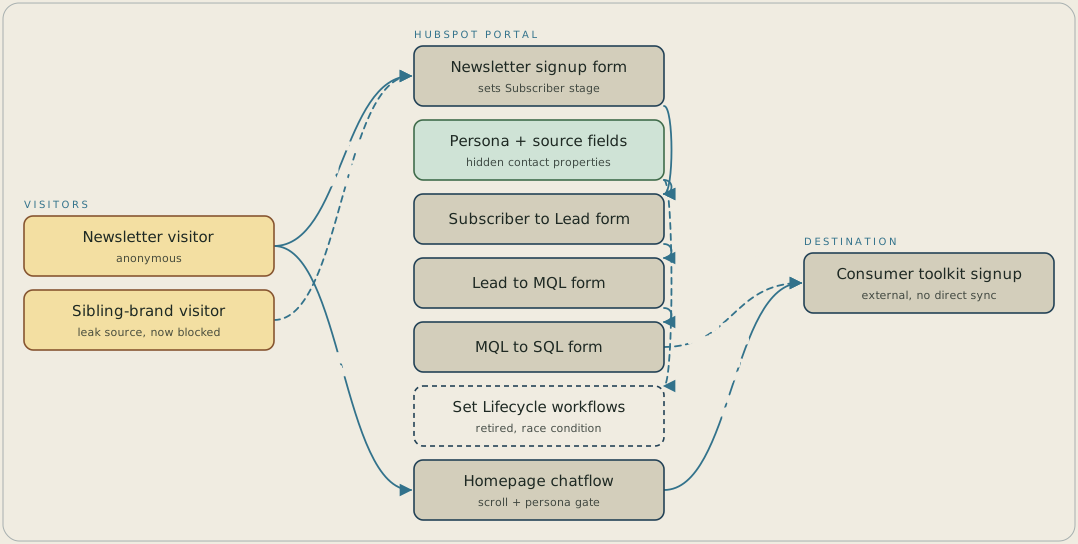
A visitor signs up through the newsletter form, which sets the Subscriber stage and carries hidden persona and source fields. Each later stage is now set by its own form, Subscriber to Lead, Lead to MQL and MQL to SQL, which replaced the Set Lifecycle workflows that raced each other and were retired. Sibling-brand visitors who used to leak into this signup are now blocked at the form's source check. A homepage chatflow, gated by persona and by scrolling past the halfway point, sends qualified visitors to the consumer toolkit signup, where creating a profile is what creates the opportunity.
FAQ
One shared instance holds every property, workflow and form, so a hidden field or an enrolment trigger built for one brand can catch a visitor from another brand unless the criteria are tight. A newsletter enrolment rule leaked a sibling brand's visitors into this nurture until we tightened the source check. That's why a Business Units upgrade gets proposed once a group operates enough brands through one subscription.
Two workflows watched the same lifecycle-stage property for the same event. When both fired close together, the property could land in an inconsistent state and strand a contact between stages. Moving that assignment onto the form removed the race, because only the submission now writes the stage.


