

Shifting Paid Search Budget Without a Conversion Pixel

A four-phase paid-media retainer was reading Google Ads conversions off HubSpot's own lead counts, with no conversion pixel wired directly into the platform. Every month still needed a defensible answer: which channel earned the next dollar of spend. A monthly conversion-rate comparison across Google Display and Search became that answer, driving one real reallocation after a June-to-July read.
Executive Summary

Context
A cloud-based estimating and project-management software company for service contractors ran a four-phase paid-media retainer across Google Search, Google Display, Facebook and LinkedIn. Weekly optimization and monthly reporting kept the account staffed through at least its fourth phase.

What We Built
We built a monthly conversion-rate comparison across Google Display and Search, cross-referenced against HubSpot's original-source lead counts, gating when budget moved between channels.

Tech Stack
- Google Ads (Search and Display), Facebook Ads, LinkedIn Ads, HubSpot, Google Analytics, Google Tag Manager
Not a fit if your team can't sustain a staffed weekly optimization cadence across three ad platforms, since the monthly reallocation call depends on consistent reporting, not an occasional check-in. Also not a fit if Google Ads conversions have to be judged against your CRM's lead counts with no conversion pixel in place: that gap makes every reallocation a read of proxy data, and an account that can't tolerate that uncertainty needs the pixel fixed first.

The Challenge
Google Ads conversions were judged against HubSpot's original-source lead counts, because no conversion pixel was wired directly into the ad platform. That meant every reallocation call rested on a proxy measurement. Google Display also kept drawing spend without a matching conversion story.
The branded search campaign's ad-strength rating sat at "poor," a sign that the responsive search ad copy needed work whatever the budget split. The account also still owed Google its own advertiser verification before that spend could keep running. All three problems had to clear before the team could move a dollar from Display to Search.

Our Approach
We first optimized within each channel on its own weekly cadence, adjusting Google Display creative and Facebook and LinkedIn targeting. That tuned performance inside a channel, but it couldn't tell us whether Display deserved its budget against Search.
The gate that did answer it was a monthly comparison. We tracked conversions, defined as "Request a Demo" form completions and ad-extension phone clicks, month over month against HubSpot's original-source lead counts.
When the June-to-July read showed the conversion rate climbing from 3.44% to 10.12%, we traced the gain to Search and moved Display's budget across. The trade-off is that the conversion pixel was still missing, so we named it as next quarter's fix.

Impact

Paid search conversion rate more than doubles in a month
The monthly read showed conversion rate climbing from 3.44% in June to 10.12% in July, a 194% increase, so the team could point to Search as the channel earning the incremental dollar. Because the comparison ran against the same HubSpot lead data each month, the gain was attributable to the reallocation, not a shift in how conversions were counted.
Search conversion volume climbs after the display budget shift
Reallocating Google Display's budget into Search produced a 118% month-over-month increase in SEM conversion volume, so the freed spend landed on a channel already proven to convert. The branded campaign's ad-strength rating moved from "poor" to "excellent" over the same period, so the extra spend reached ad copy rebuilt to earn it.
Google's advertiser verification clears the way to keep spending
The account completed Google's Advertiser verification, a compliance step Google requires to keep running ads, so the reallocated budget had platform clearance instead of an open compliance risk. Clearing it before the next quarterly review meant Google Ads eligibility was no longer a live variable.
A named keyword anchors the expanded search budget
"Project manager software" surfaced as the top-converting paid search keyword, converting at 32.85% across its clicks, giving the team a specific term to build the expanded search budget around instead of spreading it evenly. That gave the reallocation a defined place to land, not a general shift toward Search.
Each month, conversions, "Request a Demo" form completions plus ad-extension phone clicks, are tallied per channel and checked against the prior month's rate. A rate that moves enough signals a budget shift.
With no direct Google Ads conversion pixel, each platform's reported conversions get checked against HubSpot's original-source lead count for the same period. The cross-reference is a workaround, not a fix, and the team named that gap as next quarter's work.
Google Search, Display, Facebook and LinkedIn each get their own weekly pass, adjusting bids, creative and targeting inside the channel. That cadence runs independently of the monthly comparison that decides whether a channel keeps its budget.
Google's Advertiser verification sits alongside the reallocation logic as its own gate: continued eligibility to run ads, independent of which channel is winning that month. Completing it removed a compliance variable regardless of how well Search converted.
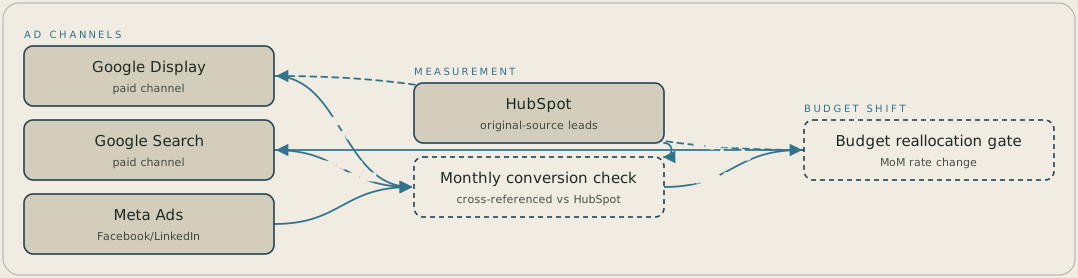
Google Display, Google Search and the Facebook and LinkedIn ads each report their conversions into a monthly check. Because no conversion pixel is wired directly into the ad platform, the check compares those counts against HubSpot's original-source lead counts. When the month-over-month conversion rate favors one channel, the budget step shifts spend to Search and pauses Display.
FAQ
You track the same conversion definition, "Request a Demo" form completions plus ad-extension phone clicks, across both channels every month and compare the rate change. When one channel's rate moves enough against the other, that is the signal to shift budget, the way a 3.44%-to-10.12% read moved this account's spend into Search.
You cross-reference each platform's reported conversions against your CRM's original-source lead count for the same period, so you still have a comparable number. It's a workaround, not a fix: the missing pixel stays on the list to install next.


