

A Compliance-Gated Deal Lifecycle for a Corporate Advisory Firm
An Australian corporate advisory firm ran deal origination across Outlook inboxes, an Excel forward-fee report and a cap-raise tool, with no shared pipeline view. We validated the firm's own staged-object brief against what HubSpot's Deal object could enforce: a pipeline moving Ideas through Pipeline to Mandated, gated by an MD-approved memorandum and a signed letter that a Compliance Director must clear first.
Executive Summary

Context
An Australian corporate advisory firm running M&A, equity capital markets and corporate broking mandates was tracking every deal by memory, email and a cap-raise tool. A director-authored CRM brief had sat unbuilt for roughly three years until one champion took ownership of building it.

What We Built
We validated a single staged Engagements pipeline running Ideas through Pipeline to Mandated on HubSpot's native Deal object. Two gates, a New Business Memorandum approval and a signed Engagement Letter, decide when a record moves between those stages.

Tech Stack
- HubSpot Sales Hub Enterprise, HubSpot Data Hub, PandaDoc, Microsoft Teams
Not a fit if no one at the firm owns the CRM decision end to end. This pipeline validated a model that sat unbuilt for three years until one director took responsibility for it, and a committee won't resolve a staged object with compliance gates. It also assumes a five-week discovery, with edited feedback returned within about a week.

The Challenge
Deal origination ran across personal Outlook inboxes, a monthly Excel forward-fee report and a cap-raise tool. Weekly meetings were the only shared view of the pipeline. A CRM rebuild had been proposed roughly three years earlier and had gone nowhere, because five stakeholders held different views and no one owned the decision until one director took responsibility.
That director wrote a four-object architecture brief covering Contacts, Companies, Engagements and Activities. It left one question for discovery to settle: where inside HubSpot the Engagements concept would actually live. The requirements documentation puts every new property on the Deal object rather than on a separate Engagements object. And client feedback describes a record moving "from Qualified to Proposal Requested," which reads as that concept landing on the Deal pipeline with an added stage.

Our Approach
We considered a separate Engagements object, as the client's brief proposed, and built the pipeline on the native Deal object instead. An idea enters as Ideas, then moves into Pipeline (Proposal Requested, Proposal Presented, Fridge or Lost), then Mandated (Live, On-Hold, Completed or Lost/Abandoned). Each stage is one property on the Deal. That choice keeps existing reports, permissions and workflows on one record type, and the cost is that the client's own Engagements name survives only as a label.
Gate 1 needs NBM Approved set to yes, with an AML/CTF Screening Complete and an ASIC Search Complete attachment. The client kept its own sequence even though HubSpot already enforces the required fields. The originating MD approves, a coordinator runs a completeness review, and then a second MD approval moves the stage to Proposal Requested.
Gate 2 needed a third checkpoint that the letter template already specified. A Compliance Director Approved property must read yes before the letter can be marked sent, and only then can Engagement Letter Signed move the record into Mandated. Each gate stamps its own audit trail onto the deal.

Impact

A single deal record instead of five places to check
A record now carries its own history from the moment an idea is logged, instead of living across an inbox, a spreadsheet row and a verbal update. The stage a deal sits in is one property, read off the deal rather than asked around for.
A compliance check the deal record can prove happened
An AML/CTF Screening Complete and an ASIC Search Complete attachment now sit on the memorandum before an MD can approve it, because Gate 1 won't pass without them. A completed screening can be proved from the record instead of being reconstructed from email.
A validated architecture the Board could act on
The staged pipeline, its gates and the property build list went to the Board as a validated Architecture Blueprint alongside an updated quote, not an unproven brief. That gave the Board a specific build to fund, checked against what HubSpot can do.
A third checkpoint the letter template itself called for
Reading the client's own letter template turned up a Compliance Director Approved checkpoint that the original brief hadn't accounted for, so the build added it between NBM approval and the signed letter. The letter can now only be marked sent once that approval is on the record.
A single staged pipeline runs Ideas through Pipeline (Proposal Requested, Proposal Presented, Fridge or Lost) into Mandated (Live, On-Hold, Completed or Lost/Abandoned), built on the native Deal object rather than a custom object. Each stage change updates the one property that shows where a deal stands.
The property NBM Approved gates the move to Proposal Requested, and it won't pass without an AML/CTF Screening Complete and an ASIC Search Complete attachment. PandaDoc generates the memorandum from Deal, Company and Contact merge fields.
A Compliance Director Approved property must read yes before Engagement Letter Signed can move a deal into Mandated, a checkpoint the client's own letter template specified. Clearing it notifies the deal owner, and signing the letter files the copy in Teams.
Contacts carry a many-to-many association with labels for Counterparty, Adviser or Decision Maker; Companies carry labels for Buyer, Seller, Target or Mandate Counterparty. Those labels let one record show every party's role.
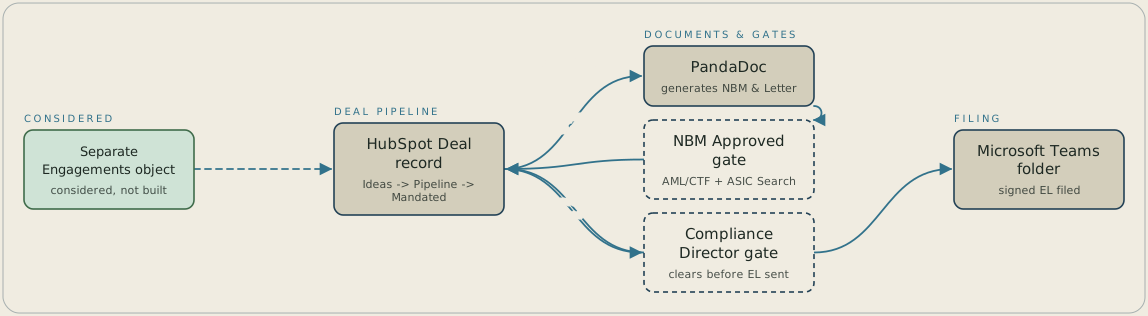
A deal starts as an idea on a HubSpot Deal record and moves through Pipeline to Mandated on a single property. When an MD is ready to issue a fee estimate, the deal's merge fields go to PandaDoc to draft the New Business Memorandum, and the move to Proposal Requested waits for NBM Approved, with the AML/CTF and ASIC Search attachments in place. PandaDoc then drafts the Engagement Letter, and signing it only moves the deal into Mandated once a Compliance Director has approved, after which the signed copy is filed in Microsoft Teams. A separate Engagements object was considered and not built.
FAQ
It can live on Deals if every property the pipeline needs already has a home there, which is what this build did. You keep existing reports, permissions and workflows on one record type, though the client's own pipeline name survives only as a label.
You let HubSpot enforce the required fields, and you still keep a human review where the client wants one. Here, an NBM can't be submitted without its screening attachments, and a coordinator still runs a completeness review before the final MD approval.


