

HubSpot Lead Management Rebuild for a National Aged-Care Provider

A Contact Centre answering aged-care enquiries by phone, email, and web form had no reliable way to route them: the HubSpot portal had sat effectively undeployed for two and a half years. We rebuilt enquiry intake, lead routing, and pipeline qualification for Residential Aged Care, Home Care, and Retirement Living, leaving AlayaCare and Epicor out of scope so Phase 1 stayed inside lead management alone.
Executive Summary

Context
The Contact Centre at a national aged-care provider running residential, home, and retirement-living services had held a HubSpot licence for years without a working lead-management process: enquiry forms went nowhere, and no deal pipeline was active.

What We Built
We rebuilt enquiry intake, team-based lead assignment, and playbook-gated deal pipelines for Residential Aged Care, Home Care, and Retirement Living inside a newly provisioned HubSpot portal, replacing a legacy configuration the client chose to abandon.

Tech Stack
- HubSpot Marketing Hub, Sales Hub (playbooks, sequences), Service Hub, Operations Hub, HubDB, custom object (Client Accommodation), same-object associations with association labels
Not a fit if your team needs individual, per-rep lead ownership and KPI tracking: this build routes leads to teams with a fallback default, matching shared, part-time staffing. Also not a fit for a first phase requiring your CRM already synced to a separate operations or finance system, since that integration was held out of scope by design here.

The Challenge
The client's HubSpot portal had sat undeployed for two and a half years, because its configuration and integration ambitions were too broad for the team running it. Enquiries reached the Contact Centre by phone, email, web and form, but nothing routed them, and no deal pipeline was active. The portal's own review scored it 55 out of 100, citing roughly 962 existing workflows against a licence allowance of only 20 new ones.
The Centre runs on shared, part-time staffing with no individual lead ownership. So HubSpot's default per-owner model would have sent enquiries to reps who had never been set up to receive them.

Our Approach
We ruled out repairing the legacy portal and moved to a newly provisioned instance instead. Forms and playbooks can't branch or relabel fields by business unit, so one dynamic enquiry flow wasn't buildable. We built three playbooks instead, one each for Residential Aged Care, Home Care and Retirement Living, each carrying its own eligibility questions.
For lead assignment we replaced the default per-owner model with team-based rotation and a fallback admin, because the Centre runs on shared, part-time staffing. Each playbook then applies its own gate, detailed below.

Impact

Enquiries reach the right pipeline without a rep guessing
The "Enquiry form submission workflow" hands each record straight to its matching playbook and question set, so a rep no longer has to work out which process applies before starting the call. Enquiry capture and assignment run live in production today.
Lead assignment keeps working without individual quota holders
Because the Contact Centre has no individual lead owners, the "Contact record rotation to teams" workflow assigns every new contact to a team, and falls back to a nominated admin when no rule matches. So assignment kept working without restructuring staffing.
Aged care and My Aged Care referrals route automatically
The "MAC Referral Code" property gates an automated email to the My Aged Care website whenever a Residential Aged Care enquiry logs a No. Retirement Living and Home Care carry their own gates, resident age and catchment postcode.
Marketing, sales, and service teams run the new portal themselves
Marketing, sales, and service staff received role-specific training backed by seven walkthrough videos across sixteen scenarios, and administrators received a handover pack, so the client's team can run the rebuilt portal without depending on the delivery team.
Every enquiry, by phone, email, web, or the "S2 | Enquiry Form," triggers the "Enquiry form submission workflow," which reads the business-unit field and routes the record via the "Set enquiry type to business unit workflow." Because playbooks cannot branch by business unit, routing lands on one of three separate playbooks rather than one dynamic flow.
The "Contact record rotation to teams" workflow fires on every new contact record and assigns ownership to a team rather than an individual, with a nominated fallback admin as the default. It replaces HubSpot's per-owner default with a model built for shared, part-time Contact Centre staffing.
Contacts sharing one email address, such as a Power of Attorney holder, a carer, a social worker, or a doctor, are modelled as separate records joined by same-object associations, each carrying a label naming the relationship to the primary emailable contact. The client rejected both a custom object and a dummy-email workaround as junk data.
The Residential Aged Care playbook's "MAC Referral Code" property records Yes, In progress, or No once logged, and a No triggers the My Aged Care referral email. Retirement Living checks resident age against the 55-plus rule before a deal reaches "Passed to ILU," and Home Care applies a postcode check as instructional wording only. Neither of those two checks runs as enforced logic.
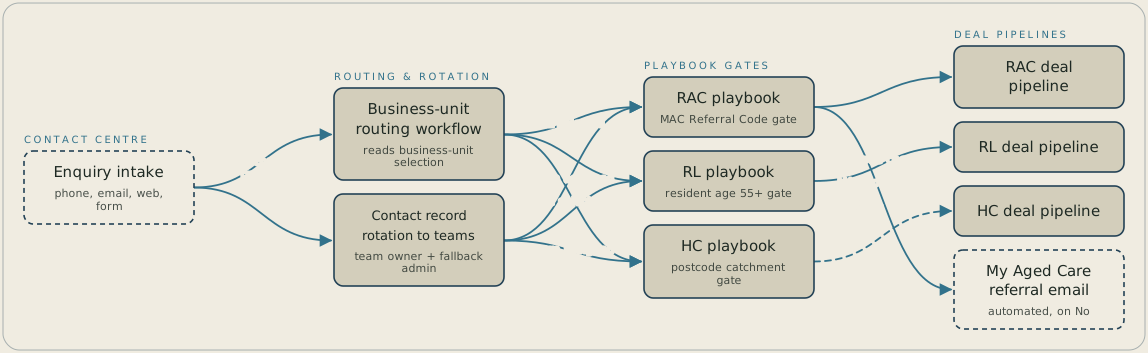
Enquiries arrive at the Contact Centre by phone, email, web or the enquiry form. A business-unit workflow reads the unit selected and sends the record to one of three playbooks, for Residential Aged Care, Home Care or Retirement Living, while a rotation workflow assigns each new contact to a team with a fallback admin. Each playbook applies its own gate before its deal pipeline: a No on the My Aged Care referral code triggers an automated referral email, Retirement Living checks resident age against the 55-plus rule, and Home Care's postcode check is instructional wording only.
FAQ
HubSpot forms and playbooks can't dynamically relabel fields or branch by business unit, so one flexible enquiry flow wasn't buildable. Three playbooks, one each for Residential Aged Care, Home Care and Retirement Living, let each business unit apply its own eligibility gate.
The Solution Plan scoped Phase 1 to lead management only, keeping AlayaCare (operations and rostering) and Epicor (finance and ERP) out of the integration boundary by design. That kept the rebuild focused on enquiry intake, lead assignment, and pipeline qualification first, not two additional integrations in the same sixteen-week phase.


