

Real-Time Deal Completeness Scoring for a Security Software Vendor

147 custom deal properties sat at 18% population, and roughly 600 deals scored 0% complete, so an all-properties completeness check told the sales team nothing useful. A four-section core of 35 properties replaced it, with a real-time workflow writing five scores back on every save.
Executive Summary

Context
A bot mitigation and account fraud security vendor selling into Fortune 500 e-commerce, financial services, airline, media and healthcare accounts had built an Enterprise HubSpot portal well ahead of what its sales team used: 224 workflows and 217 deal properties, most under 10% filled.

What We Built
We consolidated 147 custom deal properties into a governed core of 35 across four sections. We then built a real-time workflow that scores every deal and writes five completeness percentages back to the record, feeding a dashboard for stage, owner and section visibility.

Tech Stack
- HubSpot Sales Hub Enterprise, HubSpot Marketing Hub Enterprise, HubSpot workflows, Gong, Slack
Not a fit if your reps won't populate a shared set of deal fields: a completeness score only works when the sales team fills in what it measures. It also assumes an Enterprise-tier CRM already licensed, with enough property history to consolidate.

The Challenge
147 custom deal properties had built up on the deal record, and most were rarely maintained: they averaged 18% populated. Eight fields built to score deal quality averaged 3.3% fill, and only one cleared 40%, so managers couldn't tell which deals were ready to progress.
Scoring every property didn't help. The result came out near zero for most of the pipeline, because the score couldn't separate a field nobody needed from one a deal hadn't reached yet. Roughly 600 deals scored 0% complete.

Our Approach
We first tried scoring against all 147 properties, and it failed: the number couldn't tell a deal that was actually behind from one that had simply skipped fields outside its vertical. So we classified every property as core, optional or unused, and agreed 35 core properties across four sections. We didn't delete anything outside that set.
A real-time workflow, the Deal Completeness Scorer, fires whenever a deal field is saved. It writes five percentages back to the record, one overall and one for each section. A dashboard reads those scores and shows the score distribution, completeness by stage and owner, a manager alert list, and a section breakdown.
The 112 properties outside the core set stayed in the portal, so the score measures only what every deal is expected to carry, and the rest sit unscored.

Impact

A completeness score that updates the moment work happens
The Deal Completeness Scorer recalculates the moment a rep saves a deal, so the five percentages reflect the pipeline's current state, not a snapshot from the last audit. Sales leadership and RevOps read the same dashboard, which the handover names the highlight of the engagement.
A core property list confirmed by the business itself
The 35 core properties across four sections were confirmed complete by the client's own RevOps manager, not accepted on faith. That sign-off gave the sales team a fixed target to populate rather than an open-ended list of 147 fields.
Completeness broken down by stage, owner and section
Because the dashboard breaks completeness down by stage, owner and section, a manager can tell whether a low score belongs to a slow-moving deal, an under-filled section, or a specific rep. The section-level view points a rep at the exact fields to fix.
A consolidation that did not require deleting anything
The 112 properties outside the core set stayed in the portal rather than being removed, so anything a future workstream needed, from finance fields to product detail, remained available without a separate recovery effort. The core set carries the day-to-day scoring; the rest sits in reserve.
A real-time HubSpot workflow fires on any deal-property save and recalculates five completeness percentages: one overall and one for each of the four core sections. It runs on every save, not on a schedule, so the score is never more stale than the last edit.
The 35 properties kept for scoring are grouped into four sections: commercial deal basics, product and service detail, deal-quality scoring, and one further operational section. Scoring by section lets the dashboard show which part of a record is thin.
One dashboard surfaces five views: score distribution across the portfolio, completeness by stage, completeness by owner, a section-level breakdown per deal, and a manager alert list. Sales leadership and RevOps read the same dashboard, so a stage-level or owner-level pattern is visible to both.
Deals that are both in an active stage and critically incomplete surface on a standing alert list rather than waiting for a periodic review. That list turns the completeness score from a reporting metric into something a manager acts on inside the same sales cycle.
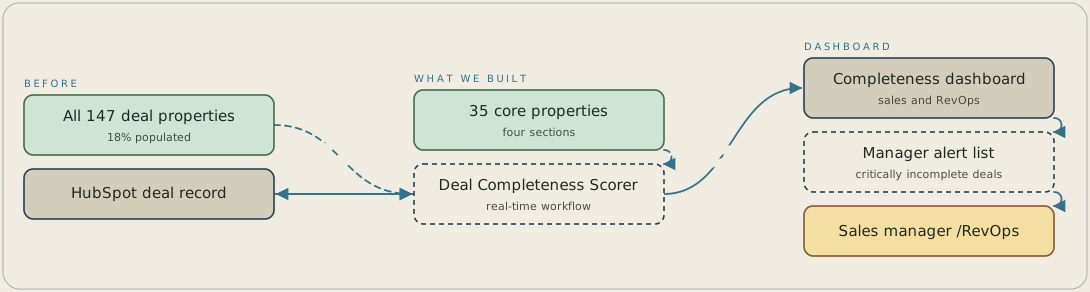
A rep saving any deal field in HubSpot triggers the Deal Completeness Scorer, a real-time workflow. It scores the deal against the 35 core properties rather than all 147, which were only 18% populated and too sparse to score. The workflow writes five completeness percentages back to the deal record, one overall and one for each section, and feeds the dashboard that sales leadership and RevOps both read. Deals that are in an active stage and critically incomplete show on a manager alert list.
FAQ
You separate core properties from optional and unused ones instead of scoring everything a portal has ever collected. Here, that meant taking 147 custom deal properties down to a governed set of 35 across four sections, so the score only measures fields every deal is expected to carry.
No. The properties outside the core set stayed in the portal rather than being removed, so historical data tied to them remained available. Only the scoring logic changed: it now runs against 35 core properties instead of all 147.


