Consolidating Four Winery Brands from Five Databases into One HubSpot Enterprise Platform

Four boutique winery brands ran separate storefronts on Shopify and WineDirect, four Mailchimp accounts, and a scatter of unintegrated point solutions for wine club, reservations, referrals, and service. Their loyal customers, the people buying allocation wines and visiting tasting rooms, got a different experience on every channel. We consolidated five databases into one HubSpot Enterprise platform structured as business units, migrated two databases off WineDirect, and integrated every storefront.
Executive Summary

Context
A wine-focused creative agency responsible for the marketing and hospitality systems of four boutique winery brands. Each brand had built its own commerce and email stack over the years, and none of them could see a customer whole: tasting room, wine club, online store, and support all held separate records.

What We Built
A multi-business-unit HubSpot Enterprise implementation: cleansed and consolidated customer data, two WineDirect-to-Shopify database migrations, Shopify integrations across four storefronts mapped to three business units, custom objects for wine-industry data, and the SOPs and training that let tasting-room and service staff work from one record.

Tech Stack
- HubSpot Enterprise (Marketing, Sales, Service)
- HubSpot Business Units
- Custom Objects
- Shopify
- WineDirect (legacy)
- Mailchimp (legacy)
Not a fit if you operate a single winery brand, or if your business sells entirely through three-tier distribution with no direct-to-consumer channel such as a wine club or tasting room. This build exists to unify customers who buy across multiple sister brands and interact through direct channels. Without more than one brand and a direct customer relationship to unify, there is no cross-brand identity problem here to solve.

The Challenge
Each winery brand had accumulated its own stack: a Shopify store, a Mailchimp list, and point solutions for wine club management, reservations, referrals, and customer service that talked to nothing else. Five separate databases described overlapping customers, because wine buyers rarely stay loyal to one label in a portfolio. A wine club member of one brand could stand in the tasting room of a sister brand and be treated as a stranger. Segmentation for allocation releases, the moments that drive most of a boutique winery's direct revenue, meant exporting lists and reconciling spreadsheets. And the brands still needed to stay distinct in every customer-facing touch, so a naive merge into one shared database was off the table.

Our Approach
We started with data, not tooling: cleansing and consolidating the five databases so a customer's identity survived across brands. Two brand databases were migrated off WineDirect into Shopify to standardize the commerce layer, then three business units were structured in HubSpot Enterprise and integrated with the four Shopify storefronts. Custom objects carried wine-industry data the standard model doesn't hold. Dynamic content and gated offers gave each brand its own voice inside a shared platform. The last phase was human: SOP documentation, training, and change management, so sales and service staff could deliver white-glove treatment to loyalty customers in the tasting room, on chat, by email, or on the phone, all working from the same record.
This engagement is part of our implementation + onboarding work for luxury goods organisations.

Impact

Five Databases Became One Reportable Platform
Loyalty Customers Recognized on Every Channel
Brand Separation Without Data Separation
Commerce, Marketing, and Service on One Record
SOP documentation, role-based training, and change management for sales and service teams came last. Consolidation only pays off if the person at the counter actually opens the record, so staff adoption was planned and delivered as part of the build.
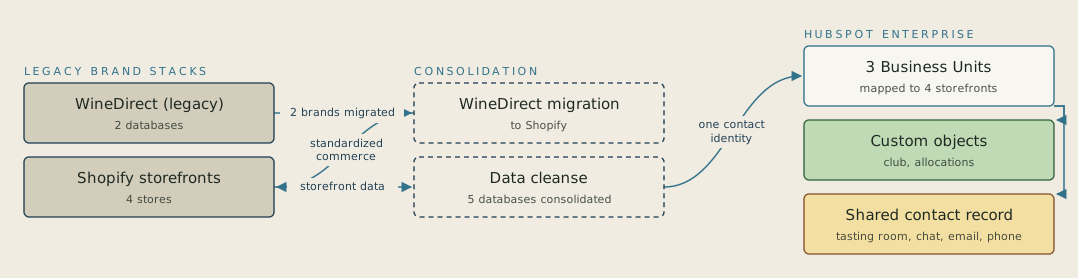
A wine club member of one brand used to be treated as a stranger in a sister brand's tasting room. One shared database would have blurred the brands, so a plain merge was off the table. Now business units let each brand keep its own subscription types, branding and campaign identity while sharing one contact database underneath. Marketing can segment a customer by brand relationship without keeping that customer in four places.
FAQ