

A HubSpot Portal Audit Reframes a Security Vendor's GTM Roadmap
A HubSpot Enterprise portal with 224 workflows, 217 deal properties and 109 forms looked, on paper, like a mature go-to-market system. A full audit, cross-referenced against a four-workshop discovery series, found infrastructure roughly 70 percent built against adoption under 10 percent, redirecting the next phase towards enforcing what the portal already ran.
Executive Summary

Context
A bot mitigation and account fraud security vendor selling into Fortune 500 e-commerce, financial services, airline, media and healthcare accounts had built a HubSpot Enterprise suite across six hubs, with over 70,000 contacts on file. Leadership needed to know whether the next phase should add automation or fix what already existed.

What We Built
A full audit inventoried every workflow, property, form, list, report and integration in the portal. A four-workshop discovery series covered sales qualification and personas, technical integrations, the systems map and data model, and validation. Together with the inventory, it produced a GTM roadmap built around enforcing existing automation rather than adding new construction.

Tech Stack
- HubSpot Marketing Hub Enterprise
- HubSpot Sales Hub Enterprise
- HubSpot Service Hub Enterprise
- HubSpot Content Hub Enterprise
- HubSpot Data Hub Enterprise
- HubSpot Commerce Hub Enterprise
- Gong
- Slack
Not a fit if the HubSpot portal is still early stage: this audit depends on a mature footprint of workflows, properties, forms and integrations to score against adoption, and a portal with only a handful of objects has nothing yet to diagnose at this scale. A newly onboarded instance needs an implementation engagement first, not a rationalisation audit.

The Challenge
Sales and RevOps leadership couldn't tell whether the portal's automation was running the business or sitting unused, because no report broke adoption down by object type. The eight MEDDPICC fields already built averaged 3.3 percent fill, and only competition was above 40 percent. Sequences converted into meetings at 0.06 percent.
Leadership had to decide where to spend the next phase of budget. Without knowing which numbers meant a broken workflow, adding more automation risked stacking it on a base that sales had stopped trusting.

Our Approach
We worked through the portal object by object: contacts, properties, forms, workflows, pipelines, reports and the Gong and Slack integration layer. We mapped every finding to one of seven pain points the client had stated, instead of giving a generic health score. That produced the headline ratio: roughly 70 percent of the intended infrastructure built, and under 10 percent adopted.
We then tested that ratio against how the business sold, in a four-workshop discovery series: sales qualification and MEDDPICC, technical integrations, the systems map and data model, and validation. Auto-populating MEDDPICC from Gong's transcripts came up and was deferred until the fields themselves were prioritised.
The output was a decision, not a build list: enforce what already existed before constructing anything further.

Impact

A single ratio replaces guesswork about portal health
The audit scored the full portal against actual usage rather than a licence count, producing the same roughly 70 percent built, under 10 percent adopted ratio different teams had been describing anecdotally. That single number moved the funding conversation from adding new workflows towards enforcing the ones already built.
Sales qualification data gets a baseline before it gets a mandate
The MEDDPICC review found eight fields averaging 3.3 percent fill, with only competition above 40 percent, telling the qualification workshop which fields reps already used. That evidence sequenced validation around fields with a real chance of adoption, not every field the object model happened to have.
Discovery workshops separate real gaps from unused capacity
A dedicated technical and integrations workshop, backed by a systems map and data model session, tested each of the portal's six licensed hubs against daily use. That separated objects worth extending, such as the workflow layer carrying live deal data, from hub-level licence spend the team wasn't yet using.
Seven pain points get one evidenced roadmap
Every finding was mapped to one of seven client-stated pain points instead of filed as a generic recommendation, so the roadmap from validation pointed at specific, named gaps rather than a general call for more automation. That gave the next phase a scoped starting point instead of a blank slate.
Every workflow, deal property, form, list and report in the Enterprise suite was counted and scored for use, not licensed capacity: 224 workflows, 135 active, 217 deal properties, 109 forms, 740 lists and 137 reports. That weighting produced the 70 percent built, under 10 percent adopted finding anchoring every workshop after it.
Rather than a single readiness score, each finding was tagged to one of seven pain points the client had stated directly, so a low-utilisation workflow and a near-zero fill property both pointed back to the same complaint. That let the workshops prioritise by business impact, not object count.
Four workshops ran in sequence, each testing the prior session's findings: sales and qualification, covering personas and the MEDDPICC framework; technical and integrations; systems map and data model; and validation. The MEDDPICC fill-rate finding fed directly into what validation chose to enforce first.
Validation's output was a decision, not a feature list: enforce and rationalise objects the audit had found under-adopted before any new automation was scoped. Auto-populating MEDDPICC from Gong's call transcripts was one item raised and deferred, held until the fields themselves were prioritised and populated by reps.
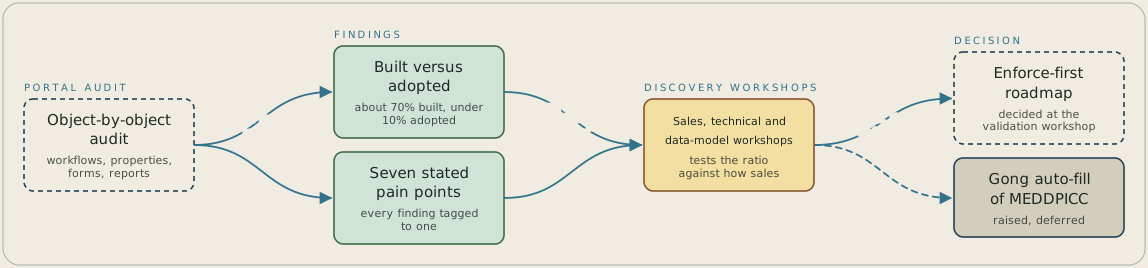
The audit starts with the HubSpot Enterprise portal itself, counting every workflow, property, form, list and report against how much of it is actually used. That scoring gives a ratio of roughly 70 percent built to under 10 percent adopted, and each finding is tagged to one of seven pain points the client stated. A four-workshop series then tests the ratio, moving from sales qualification through technical integrations and the data model to validation. Validation's decision is to enforce what already exists before building more, and auto-filling MEDDPICC from Gong's transcripts is deferred.
FAQ
A feature gap analysis asks what the platform can do that the portal does not use. This audit asked the opposite: of everything already built, how much was actually used. That produced the 70 percent built, under 10 percent adopted finding, and why the recommendation was enforcement rather than a new build list.
Sales qualification, technical integrations, the data model, and validation each surface different gaps, and in a single session the discussion tends to follow whichever topic is raised first. Splitting discovery into four workshops let each area produce its own evidence, such as the MEDDPICC finding, before validation combined them.


