

Hard negative gates in a two-tier lead scoring model

A HubSpot Marketing Hub setup was marking around 400 contacts a month as marketing qualified, but only about one in five was a lead that sales actually wanted to work. We rebuilt the scoring model across two iterations, and added a recalibrated MQL threshold and hard negative gates that remove a competitor or a bad-fit industry outright.
Executive Summary

Context
An offshore staffing and business-process-outsourcing provider ran its pipeline through a shared HubSpot Enterprise portal carrying more than 100,000 contacts. Its legacy scoring setup treated every inbound contact on one additive curve, so it couldn't separate an ideal-fit buyer from a job applicant filling in the same form.

What We Built
We rebuilt the lead scoring model in HubSpot Marketing Hub across two calibration passes. A single additive point curve gave way to weighted signals, a recalibrated threshold, and hard negative gates that disqualify competitor and bad-fit contacts outright.

Tech Stack
- HubSpot Marketing Hub contact and company properties, HubSpot workflow-based scoring logic, HubSpot Breeze smart properties (proposed)
Not a fit if you have less than a year of closed-deal history to calibrate against: the negative gates and the 80-point threshold came from reviewing the last 100 real customers, not an industry template. It also assumes you already have a HubSpot Marketing Hub licence and sales leadership willing to sit through that review.

The Challenge
The legacy model scored every signal as a straight positive, so a contact who filled in a form out of curiosity climbed the same ladder as a director at an ideal-fit account.
Reps spent time on job-seeker replies, support enquiries and accounts in industries that never converted, because nothing in the model treated those records any differently from a genuine prospect. Around 400 contacts a month were marked as marketing qualified, but only about one in five was a lead that sales wanted to work.

Our Approach
The first version scored profile and engagement signals on every property change. Email domain, job title, company size, revenue, lead source and page visits each added points, and 26 or more site visits added more. A bottom-of-funnel form filled within 60 days added 100 points, a mid-funnel form added 50, and booking a demo added 30. That version set the MQL line at 100.
We reviewed it against the last 100 real customers, and the line still let noise through, because nothing counted against a job-seeker enquiry or a competitor employee. So the second version lowered the threshold to 80 and weighted ideal industry and a LinkedIn source more heavily. It also added hard negative gates: 1,000 points off for a competitor or bad-fit industry, 100 off for a job-seeker or support enquiry, and smaller deductions for bounces and inactivity. We proposed a Breeze smart property to auto-zero job-seeker keywords as the next pass.

Impact

Competitor and bad-fit contacts drop out before a rep opens the record
A competitor company or a bad-fit industry now costs 1,000 points, and a job-seeker or support enquiry costs 100. Those records fall well below the 80-point line regardless of any positive signals they carry, so reps stopped losing time to accounts that were never going to close.
The 80-point MQL line was set against real closed customers, not a guess
Reviewing the last 100 customers against the original model showed which signals actually predicted a close, so the second version weighted ideal industry and a LinkedIn lead source more heavily. The qualifying line moved to 80 because the real customer data supported it, not because a lower number felt safer.
Recent bottom-funnel intent outranks a long browsing history
A bottom-of-funnel form filled in the last 60 days adds 100 points and a mid-funnel form adds 50, while booking a demo adds 30 on its own. A contact who took one of those actions recently now outranks one who has only visited the site repeatedly.
Qualified volume fell so the sales-aligned share could rise
By May 2026 the client reported qualified volume settling at roughly 210 to 230 a month, down from around 400, with better quality as the negative gates and recalibrated threshold took effect. Fewer records reached the queue, but more of them were people sales wanted to talk to.
Company size, revenue band, ideal industry, ideal country, ideal lead source, job title and email domain each carry their own point value. The formula treats a director at a mid-size company in an ideal industry as a stronger signal than a form fill from an unknown domain.
High-value page visits, 26 or more site visits, and booking a demo each add points on their own. A bottom-of-funnel or mid-funnel form filled within 60 days adds a further 100 or 50 points, so recent intent counts for more than an old visit history.
A competitor company or a bad-fit industry subtracts 1,000 points, and a job-seeker or support enquiry or a non-ideal persona subtracts 100, whatever the positive score. Smaller deductions apply for repeated bounces, an opt-out or inactivity.
We checked every point value and the threshold against the last 100 real customers instead of an assumed profile, which moved the line to 80 points, down from its original 100. We proposed a Breeze smart property to auto-zero job-seeker keywords next.
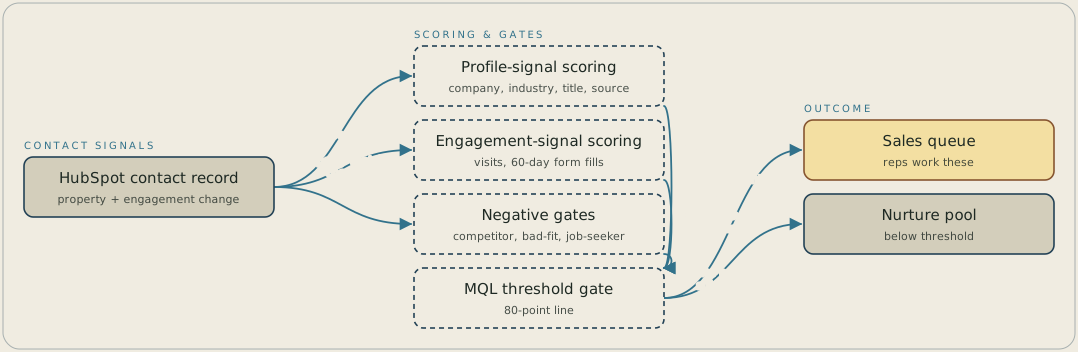
A HubSpot contact record is scored whenever one of its properties or its engagement changes. Profile signals such as company, industry, title and source add points, and engagement signals such as site visits and form fills in the last 60 days add more, while a separate check subtracts a large penalty if the contact is a competitor, a bad-fit industry or a job-seeker. A contact whose total reaches the 80-point line goes to the sales queue. Anyone below it stays in the nurture pool.
FAQ
Raising the threshold alone would still leave a competitor's employee or a job-seeker on the same curve as a real buyer, if they racked up enough positive signals. A hard negative value drops those contacts a thousand or a hundred points below the line regardless.
We reviewed the last 100 real customers and checked which signals actually showed up before a deal closed. The threshold moved to 80 because that review, not an industry benchmark, is what the recalibration was built on.


