

Registration Automation for an Invitation-Only Executive Program

Registration for an invitation-only executive program ran on spreadsheets and personal Outlook invitations, with no system check on whether a registrant actually held the seniority the program required. We built HubSpot forms with custom properties and conditional logic for both program tracks, a manual seniority-verification task ahead of any decline email, and a workflow that returns a cancelled or rescheduled registrant to the expression-of-interest list.
Executive Summary

Context
Both tracks of an invitation-only executive-education program admit only chief executives and chief financial officers, a positioning the operator protects deliberately rather than opening to a broader audience. Enforcing that rule had depended on whoever processed a spreadsheet entry catching an ineligible registration by eye.

What We Built
We built HubSpot registration forms with custom properties and track-specific form logic, gated by a manual seniority-verification task ahead of any decline email, and a workflow that automatically returns a cancelled or rescheduled registrant to the expression-of-interest list.

Tech Stack
- HubSpot Forms
- HubSpot Workflows
- HubSpot Landing Pages
Not a fit if your registration process has no eligibility rule to enforce, since the manual verification task this build depends on exists specifically to check registrants against one. Also not a fit if nobody on your team can action that task promptly, since a decline email waits on it.

The Challenge
Registration and event administration ran through spreadsheets and personal Outlook invitations sent by the executives running the program. No system recorded who had registered, been invited, or actually qualified. Both tracks admit only chief executives and chief financial officers, but a manual process couldn't enforce that once volume grew. A registrant could submit interest with no seniority check attached and take a seat meant for the target audience.
Cancellations and reschedules were tracked the same informal way. So a registrant who dropped out had no guaranteed path back into consideration.

Our Approach
We decided that screening registrants by seniority by hand wouldn't hold up once both program tracks ran registration together. A spreadsheet also gave no consistent way to tell a genuine chief-executive submission from anyone else who found the form. So we built HubSpot forms with custom properties for each track, with conditional form logic that routes a submission down that track's own path.
A submission then triggers a task that puts a person in front of it before any decline email goes out. That trades speed for a judgement call that an automated rule could get wrong.
Cancellations and reschedules run through their own workflow, which automatically re-adds a registrant who backs out to the expression-of-interest list.

Impact

A registration cannot reach a confirmed seat without a seniority check
Every submission on either program track runs through form logic built for that track, so a registration can't reach a confirmed seat without triggering the seniority-verification task first. The check holds on both tracks equally.
A person makes the final call on a borderline registration
The verification task puts a person in front of a registration before any decline email goes out, so an unusually titled but legitimate executive gets a judgement call instead of an automated rule turning them away.
A cancellation becomes a future invitation instead of a lost contact
A registrant who cancels or reschedules is returned to the expression-of-interest list automatically, keeping them in view for the program's next session rather than losing the relationship the moment a seat opens up.
Calendar invites run through the platform instead of an inbox
Calendar-invite automation replaced executives sending personal Outlook invitations by hand, so a confirmed registrant receives their invite from the same system that verified their eligibility.
Each program track carries its own custom properties and conditional form logic, so a submission on one track never runs the other track's rules, and the seniority check for one program can't leak into the other.
A registration submission triggers a task asking a person to confirm the registrant's seniority before any decline email is sent. The gate sits only between submission and decline, not ahead of an accepted registration.
A cancellation or reschedule triggers a workflow that automatically re-adds the registrant to the expression-of-interest list rather than closing out their record, whichever program track they came from.
Once a registration clears the seniority gate, calendar-invite automation sends the confirmation, replacing the personal Outlook invitations executives had been sending by hand.
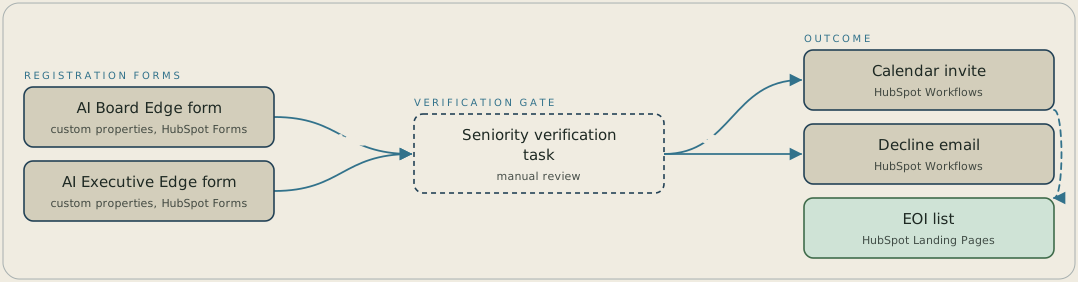
Registrants submit a HubSpot form for one of the two program tracks, and each submission creates a seniority-verification task for a person to review. If the seniority is confirmed, a workflow sends the calendar invite, and if the check fails, a decline email goes out only after that review. A registrant who cancels or reschedules is added back to the expression-of-interest list.
FAQ
The program is invitation-only and admits only chief executives and chief financial officers, a positioning the operator protects deliberately. Form logic narrows a submission to the right track, but confirming an unusually titled executive's actual seniority is a judgement call an automated rule could get wrong, so a person makes that call first.
A cancellation or reschedule triggers a workflow that automatically re-adds the registrant to the expression-of-interest list instead of closing out their record, keeping them in view for the program's next session.


