

A paid-media funnel that targets admissions prospects around a platform's audience restriction
An independent all-girls Catholic secondary school ran its first paid campaigns around a single Open House date in 2019. The ad platform refused the exact audience the school needed. It ruled out any category built around single-sex school interest or a household with daughters, so the team built a broader audience from parent status, income, and geography instead. Over the next two years that single-event push grew into a three-stage always-on funnel, with a rule that pulls spend from any stage producing zero conversions after two months.
Executive Summary

Context
The client is an independent all-girls Catholic secondary school running its own admissions funnel through Google Search, Google Display, and Facebook Ads. Its real audience sat outside what the ad platform would let it target directly.

What We Built
We built a three-stage always-on funnel across Google Search, Google Display, and Facebook Ads, with a standing rule that pauses any stage with zero conversions after two months and reallocates its spend.

Tech Stack
- Google Ads Search, Google Ads Display, Facebook Ads, Google Analytics.
Not a fit if your ideal audience maps to a category an ad platform disallows targeting on, such as a gender-specific school combined with parental status. The platform won't let you target that definition directly, so you end up with a broader, less precise audience instead.

The Challenge
In September 2019 the admissions team needed applicants and Open House attendees fast, ahead of a mid-November event. It was working from a new paid-media account, with a $2,000 Google budget and a $1,000 Facebook budget.
Two criteria actually described the school's prospective families: interest in single-sex schooling, and a household with daughters. The ad platform didn't let campaigns target either one. So the narrowest version of the audience the team wanted wasn't available at the platform level.

Our Approach
We tried the direct route first. That meant search ads keyed to explicit all-girls-school and private-school terms, plus a Facebook campaign meant to reach parents already interested in single-sex education. The platform's options stopped short of that definition, so we fell back to a wider audience built from geography, income, and parent status. Then we narrowed it again with a negative keyword list that excludes celebrity names and out-of-market competitor schools, and we updated it continuously. That trade held for two years: a broader audience, narrowed by exclusion rather than inclusion.
By Q4 2021 the funnel had grown to three stages. Display prospecting came first, then Display remarketing to visitors and abandoned form-fillers, then Search split across branded, non-branded, and competitor terms. The competitor terms named five other private schools within a 25-mile radius, and all three stages shared a $4,000 monthly budget.
We didn't want an underperforming stage to run indefinitely. So we set a standing rule: a stage with zero conversions for two months hands its budget to whichever stage is converting.

Impact

The 2019 Open House flight converts at a sub-$100 blended cost
The first flight ran from September through November 2019 against the $2,000 Google Search and $1,000 Facebook budget, producing 28 total conversions at a blended cost per acquisition of $98.14, with 20 of those conversions landing in October alone. The branded Google Search campaign carried the flight, averaging a 7.42% click-through rate and a 0.91% conversion rate in its first month.
A negative-keyword list keeps the broadened audience on topic
The broadened audience the platform forced still reached families who were searching for a school, not unrelated traffic. The negative-exact-match list kept excluding celebrity names and competitor-school terms as they surfaced. So the capped 2019 budget wasn't spent chasing the wrong searches.
An admissions-guide campaign lands signups under $57 a lead
The prior year's admissions-guide campaign, reported in the December 2020 proposal's retrospective, generated 31 signups at a $56.93 cost per lead. That was the evidence the team used to relaunch the same guide and retarget it toward applications rather than RSVPs once in-person Open House events stopped running.
A standing reallocation rule keeps a $4,000 monthly funnel self-correcting
By November 2021 the three-stage funnel generated 7 leads on $3,005.80 of spend, a $429.40 blended cost per lead, with the branded Google Search stage the strongest performer at a 13.27% click-through rate. The standing reallocation rule let that mix keep shifting toward whichever stage was converting, without waiting for the next planning cycle.
The ad platform doesn't offer an audience category for interest in single-sex schooling or for households with daughters. So the team built the audience from parent status, household income, and a geographic radius around the campus, standing in for the definition the platform wouldn't allow.
A negative-exact-match list excludes celebrity names and named competitor and out-of-market schools from Search campaigns, updated on an ongoing basis as new irrelevant queries surface.
The Q4 2021 funnel runs Display prospecting for awareness, Display remarketing to site visitors and abandoned form-fillers, and Search split across branded, non-branded, and competitor terms. Competitor-URL and interest targeting names five specific private schools within a 25-mile radius. All of it sits under one $4,000 monthly budget split across four sub-budgets.
We pause any stage that produces zero conversions across a two-month window and move its share of the monthly budget to whichever stage is converting. So the funnel's mix corrects itself between planning cycles, without waiting for the next monthly report.
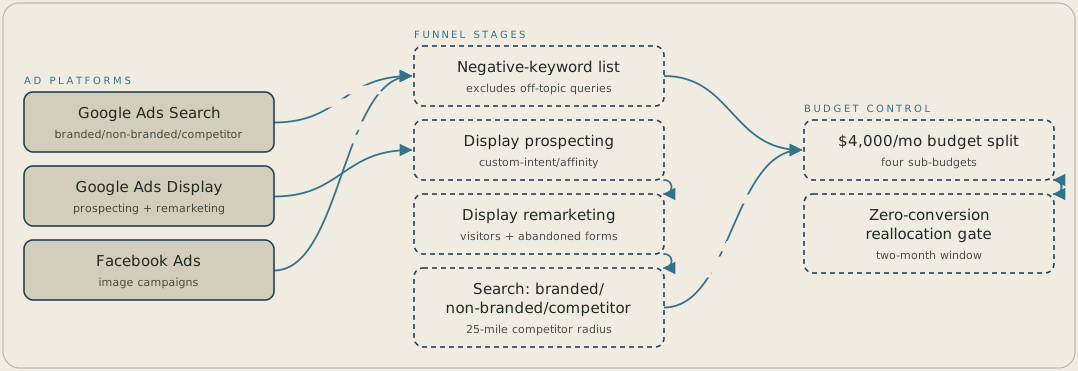
The campaigns run on Google Ads Search, Google Ads Display and Facebook Ads. Display prospecting feeds Display remarketing, which feeds Search split across branded, non-branded and competitor terms, and a negative-keyword list filters off-topic queries before spend is committed. All stages share one $4,000 monthly budget split into four sub-budgets. A stage with zero conversions after two months triggers a rule that moves its budget to whichever stage is converting.
FAQ
You rebuild the audience from what the platform will let you use: parent status, household income, and a geographic radius. Then you tighten it again with a negative-exact-match list that excludes the searches you know are off topic. It's a broader starting point, corrected by exclusion rather than inclusion.
A standing rule pauses any stage that produces zero conversions across a two-month window and reallocates its share of the monthly budget to whichever stage is converting. That keeps the mix correcting itself between planning cycles, instead of waiting for the next report to catch it.


