

Gated-content lead scoring for a professional services firm
Before this engagement, the solutions partner's HubSpot portal had no forms, no lead scoring and no kickback sequence, so every enquiry that reached the account looked the same to sales, regardless of who sent it.
We built two gated-content funnels, a thought-leadership guide and a return-on-investment guide, that share one job-role dropdown and route every submission through a single MQL scoring gate before it reaches a rep.
Executive Summary

Context
The client is an Atlassian solutions partner selling enterprise project- and service-management work to financial-services, government, and other compliance-driven organisations exploring the Atlassian stack. Its own portal had never carried a form built to separate a serious buyer from someone downloading a guide out of curiosity.

What We Built
We built a shared intake layer for two gated-content funnels: a job-role dropdown that tags every submission with one of four buyer roles and feeds a single MQL scoring gate ahead of sales handoff.

Tech Stack
- HubSpot Marketing Hub
- HubSpot Forms
- HubSpot Sales Hub
- HeyGen
Not a fit if your HubSpot subscription sits below Marketing Hub Professional, since the scoring gate depends on workflow and lead-scoring tooling that lower tiers don't carry. Also not a fit if no one on your team can own the qualification rules once they go live, since a director-level owner made every call here on which submissions counted as high-intent and which didn't.

The Challenge
The solutions partner already held a full Marketing, Content and Sales Hub subscription, but nothing in the portal separated a serious enquiry from a name captured out of curiosity. No forms, kickback emails or lead-scoring rules existed anywhere in the account before this build. A platform owner checking a feature and a budget holder ready to scope a longer engagement looked identical to sales, because no nurture sequence, landing-page template or connector setup existed to tell them apart.
The discovery workshop had already named four distinct buyer roles from its persona work, so the qualification logic had a real split to build against rather than a single generic form to improve.

Our Approach
We scoped two gated-content funnels rather than one, because the discovery workshop had surfaced four distinct buyer roles. A single generic form would have collapsed all four into the same undifferentiated submission the portal already produced.
Each funnel shares one job-role dropdown that asks a visitor to self-identify as a C-level executive, a platform owner, a portfolio or PMO executive, a project manager or IT leader, or another role. A workflow reads that answer on submission and maps it to one of the four buyer personas the discovery sessions defined, tagging the contact before any scoring runs.
The tagged record is then checked against MQL scoring thresholds before it reaches sales. This works as lifecycle stage gating, because a contact doesn't carry the marketing-qualified label until it clears the threshold. The gate runs on demand rather than on a batch schedule, so the dropdown carries the entire qualification signal, not a scored web-visit history or a third-party enrichment call.

Impact

Sales works from one qualification signal, not raw form fills
Every submission now clears MQL scoring thresholds keyed to the job-role dropdown before it reaches a rep, so a person picks up the phone already knowing whether the record is a platform owner or a budget holder ready to scope a longer engagement.
Two personas, two funnels, one shared intake
The thought-leadership guide and the return-on-investment guide were built as separate funnels because the discovery workshop had already mapped four distinct buyer roles, so each asset speaks to its own persona's questions. Both share the same dropdown and scoring gate, so a new asset can plug in later without rebuilding it.
A named MQL target now has a mechanism behind it
The roadmap's SMART goal set out to grow monthly qualified leads from a handful into the tens, and this build gave that target the only mechanism the account had to reach it: a working scoring gate where none existed. Engagement and MQL-to-SQL benchmarking were the roadmap's other two goals.
A kickback sequence keeps a qualified lead warm without a rep's time
The thought-leadership guide's kickback email follows the same job-role logic as the form, so a submission that scores below the MQL threshold still gets a follow-up built around its own role instead of a generic autoresponder.
A single required field on both landing pages asks the visitor to self-identify as a C-level executive, a platform owner, a portfolio or PMO executive, a project manager or IT leader, or another role.
A HubSpot workflow reads the dropdown value on submission and assigns the record to one of four buyer personas from the discovery workshop, tagging the contact before any scoring runs.
Each submission is checked against the scoring threshold before it reaches sales, so a record clears the gate on its own persona-tagged property rather than on form-fill volume alone. The gate fires on demand, not on a batch schedule.
The thought-leadership guide's kickback email is written to the same four-persona split as the form, so a submission that misses the MQL threshold still gets a follow-up addressed to its own role.
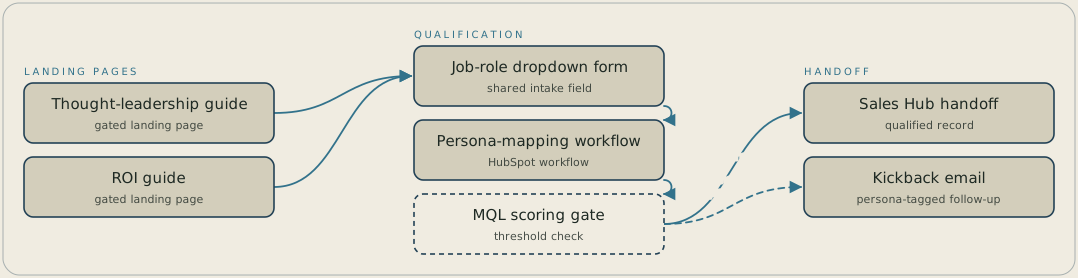
A visitor lands on one of two gated guides, a thought-leadership guide or a return-on-investment guide, and both landing pages use the same form with a job-role dropdown. A HubSpot workflow reads the dropdown answer and tags the contact with one of four buyer personas. The tagged record then goes through the MQL scoring gate, and a record that clears the threshold goes to Sales Hub as a qualified lead while one that falls below it gets a persona-tagged kickback email instead.
FAQ
It reads the job-role dropdown a visitor filled in and checks that persona-tagged record against the MQL scoring threshold before handoff. A submission that clears the threshold reaches sales with its role attached, and one that doesn't gets the kickback email instead.
No. Both funnels share one dropdown and one scoring gate, so a new gated asset plugs into the same qualification logic instead of duplicating it.


