

Grading a shared HubSpot Enterprise portal carrying two brands' data

A shared HubSpot Enterprise portal serving two related brands had never been reviewed end to end, so nobody could say with confidence which of its workflows, forms and lists were still doing useful work. We scored the portal across data health, ICPs and personas, lifecycle usage, forms, automation, email health, sales-tool adoption, pipelines and reporting, and returned a 70-out-of-100 grade with a ranked list of what to fix first.
Executive Summary

Context
An offshore staffing and business-process-outsourcing provider ran two related brands through one HubSpot Enterprise instance, with more than 100,000 contacts built up across both and no shared data standard between them. Nobody had graded the portal's health since the brands began sharing it, so early retainer priorities were being set by assumption instead of evidence.

What We Built
We delivered a scored audit of the shared portal. It graded the portal 70 out of 100 across data health, ICPs and personas, lifecycle usage, forms, automation, email health, sales-tool adoption, pipelines and reporting, and the prioritised list we handed over became the retainer's first month of work.

Tech Stack
- HubSpot contact and company property audit
- HubSpot workflow and list inventory
- HubSpot form and automation audit
- HubSpot native reporting review
Not a fit if the portal isn't already on HubSpot's Enterprise tier: the review's scope, which spans cross-hub automation, sales-tool adoption and reporting, assumes the licence depth that only Enterprise carries. It also assumes one team has the authority to act on the findings. A portal split across two brands with no agreed owner for the cleanup produces a ranked list that nobody is positioned to run.

The Challenge
Before the review, two related brands had been putting contacts, companies, forms and workflows into the same Enterprise-tier HubSpot instance for years, with no agreed data standard between them. Leadership could point to isolated problems, but nobody could say how deep the contamination ran.
Committing the retainer's first months to cleanup without that picture risked fixing the symptoms staff happened to notice while leaving the larger structural gaps untouched, such as tens of thousands of company records with no assigned owner. The portal needed one graded baseline before anyone could set priorities with confidence.

Our Approach
We didn't start from the workflow or form that nobody trusted. We scored the portal across data health, ICPs and personas, lifecycle-stage usage, forms, automation, email health, sales-tool adoption, and pipelines and reporting, in that order, and checked each area against what the portal actually held. That meant more than 800 workflows and over 500 forms, and roughly 1,200 saved lists with under a quarter of them active.
The inventory surfaced the sister-brand contamination directly. Tens of thousands of company records carried no owner, and a comparable number of contacts had no phone number, which showed that records from the second brand's earlier era had never been reconciled into one standard.
We rolled the area scores into one 70-out-of-100 grade and ordered the findings into a ranked list, with data-health and ownership gaps ahead of list consolidation. That ranking became the retainer's Month 1 work plan, five days after the review was issued.

Impact

A single, trusted grade replaces guesswork about portal health
The scored review gave marketing and sales one number, 70 out of 100, backed by named findings across every area, so conversations about the portal now argue from evidence instead of from whichever team last touched it.
The sister-brand contamination became a named, ranked problem
The review counted exactly how many company records had no owner. That turned a vague sense that the second brand's data was mixed into the first into a specific, quantified cleanup scope that the team could plan against.
Month 1 of the retainer had a validated starting point
The review's ranked list, not an assumption about what was probably broken, set the retainer's first-month priorities. So the client committed eighty hours of monthly work to the areas the audit showed mattered most.
Workflow, form and list sprawl is now a known quantity
The same inventory that found the ownership gaps also counted every workflow, form and saved list, so the client now knows which automation is still doing work and which is safe to retire.
The review scored the portal across data health, ICPs and personas, lifecycle usage, forms, automation, email health, sales-tool adoption, and pipelines and reporting, and checked each against what the portal actually held.
We checked company and contact records for two specific gaps, an assigned owner and a phone number on file. Tens of thousands of records were missing each, which was the clearest evidence of unreconciled sister-brand data inside one shared instance.
We counted every workflow, form and saved list and checked each for active use: more than 800 workflows, over 500 forms, and roughly 1,200 lists of which under a quarter were still active. That separated automation still doing work from automation nobody had retired.
The area scores rolled up into one 70-out-of-100 grade, and we ordered the findings into a ranked list instead of a flat report. The retainer's Month 1 plan adopted that ranking five days after the review was issued.
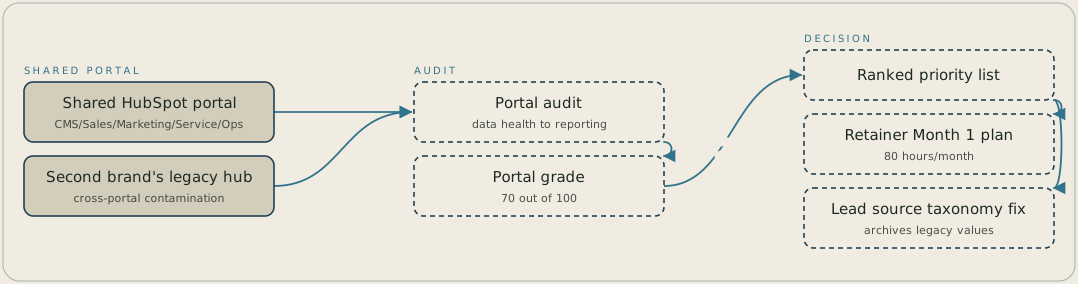
The audit covers a shared HubSpot portal that serves two brands, and it also examines the contamination from the second brand's legacy hub. The area scores roll up into one grade of 70 out of 100. We turned the findings into a ranked priority list, which set the first 80 hours of the retainer's Month 1 plan. One ranked fix, the lead source taxonomy cleanup, archived the legacy values inherited from the sister brands.
FAQ
You check the same areas you would on a single-brand portal, but you also look for records, workflows and lists that trace back to each brand separately. Here that surfaced tens of thousands of company records with no owner, the clearest sign of one brand's data sitting unreconciled inside the other's instance.
The findings get ranked, not just listed. Here, the ranked list became the first month of an eighty-hour-a-month retainer, which turned a one-time grade into a committed work plan.


