

Post-Trip Survey Migration to HubSpot Service Hub for a Passenger Ferry Operator
A booking made through the operator's own systems used to reach a passenger's inbox as a survey only after crossing three separate platforms. A daily export to CSV was pulled by FTP into Salesforce Service Cloud, then handed to Salesforce Marketing Cloud for the send, and a completed response travelled back into Service Cloud. We moved that whole chain into HubSpot Service Hub as the migration's first production phase. Survey handling now runs natively inside one platform instead of through daily batch handoffs.
Executive Summary

Context
Survey handling for a government-owned ferry operator's passengers used to run through a three-system batch chain. A daily CSV export and FTP pull fed Salesforce Service Cloud and Salesforce Marketing Cloud. We moved it into HubSpot Service Hub as Phase 1 of the wider migration, and it was confirmed functioning by November 2025. The survey's reporting format was left as a separate, later decision.

What We Built
We moved post-trip survey handling for a government-owned ferry operator off a daily batch chain that ran through the operator's own booking records, Salesforce Service Cloud and Salesforce Marketing Cloud, and rebuilt it natively inside HubSpot Service Hub. The new build went live as Phase 1 of the wider HubSpot migration and was confirmed functioning by November 2025. The survey's reporting format is a separate, later piece of work.

Tech Stack
- Salesforce Service Cloud
- Salesforce Marketing Cloud
- HubSpot Service Hub Enterprise
Not a fit if your post-trip survey process already sends and collects responses inside a single platform, since there is no multi-hop batch chain here to retire. Also not a fit if every reporting requirement has to be resolved before cutover. This migration went live with survey handling automated end to end while the reporting format itself was still being finalised separately.

The Challenge
A booking recorded in the operator's own system triggered a daily export to CSV, and a daily FTP pull then carried that file into Salesforce Service Cloud. From there the record passed to Salesforce Marketing Cloud, which sent the post-trip survey, and a completed response travelled back into Service Cloud for the service team to review. Three systems and a chain of scheduled file handoffs stood between a passenger finishing a sailing and a survey response someone at the operator could act on.
Each hop ran on its own schedule. So if one system's export format changed or an FTP window was missed, a batch of surveys could stall before anyone noticed. The daily-file design also meant a completed response could reach a usable view no faster than the next scheduled batch.

Our Approach
We retired the daily CSV export, the FTP pull into Salesforce and the handoff to Marketing Cloud, and rebuilt survey handling natively inside HubSpot Service Hub as the migration's first production phase. Collapsing three systems and their scheduled file handoffs into one platform means a completed survey no longer waits on the next scheduled batch to reach anyone.
The rebuild was confirmed functioning by November 2025, and it automates what had been a manual, multi-hop process from end to end. We left one piece for later on purpose. The reporting format the operator's team will use to read the results stayed an open item, because forcing it into this phase just to call it finished would have stalled the retirement of the manual data flow.

Impact

Batch hops collapsed into one platform
Post-trip surveys no longer travel through a daily CSV export, an FTP pull, and a handoff to a second platform before a response comes back. The full send-and-collect cycle now runs natively inside HubSpot Service Hub, removing two separate systems and their scheduled file handoffs from the path a survey takes.
A manual process automated end to end
The operator's service team went from a survey flow that depended on a daily batch file arriving and being processed correctly to one that runs automatically from send to completed response. That removed the batch-file failure point where a missed export or a stalled FTP transfer could delay an entire day's surveys.
Confirmed functioning ahead of later phases
Phase 1 of the survey migration was confirmed functioning by November 2025, giving the operator a working, automated survey process inside HubSpot Service Hub before later production work, including a second survey rebuild, began against it.
An open item named, not hidden
The reporting format the operator's team would use to read survey results was left open rather than folded into this phase's scope. Naming that gap kept Phase 1 focused on retiring the manual data flow instead of stalling on a second, unrelated decision.
Under the old design, a booking recorded in the operator's own system produced a CSV export once a day. That export was the only bridge between the booking record and the survey process; nothing left the operator's system until the next scheduled export ran.
A daily file transfer pulled that CSV export into Salesforce, where the record entered the CRM Salesforce Service Cloud held before any survey could be prepared. The pull ran on its own schedule, separate from the export that produced the file and separate from the Marketing Cloud send that followed it.
From Salesforce, the booking record passed to Salesforce Marketing Cloud, which generated and sent the post-trip survey. A completed response then travelled back into Service Cloud, the final hop in a chain that ran across three separate systems.
HubSpot Service Hub replaced all three systems in that chain for post-trip survey handling. A booking outcome and a survey response now sit inside the same platform instead of crossing a daily file export, an FTP pull, and a cross-platform send to get from one end of the process to the other.
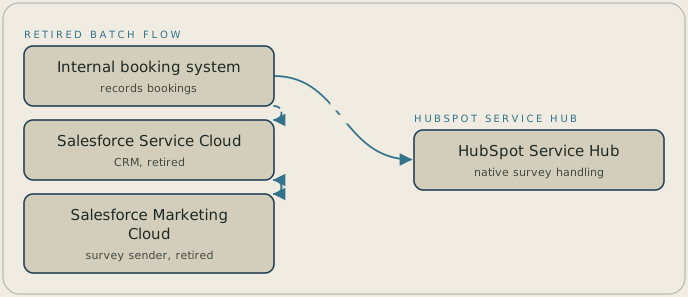
Before the migration, a booking in the operator's own system was exported to CSV each day and pulled by FTP into Salesforce Service Cloud. Service Cloud handed the record to Salesforce Marketing Cloud, which sent the survey, and the completed response came back to Service Cloud. In HubSpot Service Hub, the booking now reaches survey handling directly and automatically, and the whole batch chain is retired.
FAQ
The operator's booking record lived in one system, its service records lived in Salesforce Service Cloud, and its survey-sending tool was Salesforce Marketing Cloud. So a booking had to cross into each system in turn: a daily CSV export, a daily FTP pull into Salesforce, and a handoff to Marketing Cloud for the send. HubSpot Service Hub replaced all three for this workstream, so a survey no longer needs to leave one platform.
No. Phase 1 replaced the daily CSV export, FTP pull, and cross-platform send with survey handling run natively inside HubSpot Service Hub, and that was confirmed functioning by November 2025. The reporting format the operator's team would use to read the results was left as a separate, later piece of work rather than folded into this phase.


