

Buyer-journey mapping and campaign roadmap on HubSpot Marketing Hub
An Australian farmer-education course and community platform arrived at HubSpot Marketing Hub with its buyer journey living on a slide and not inside the platform. Lead, MQL, SQL and Opportunity were labels the team used in conversation, and Marketing Hub couldn't recognise or act on them as stages. A Foundation Phase mapped that journey onto Marketing Hub functionality. Then a Campaign Project Context and Roadmap session set the campaign's MVP scope, budget and priorities against it.
Executive Summary

Context
The client sold a Free, $25 and $50 tiered course and community product directly to individual farmers considering or practising regenerative and natural sequence farming, with no system translating that funnel into a HubSpot lifecycle stage.

What We Built
We mapped the client's Lead, MQL, SQL and Opportunity buyer journey onto HubSpot Marketing Hub. We then produced a campaign roadmap that fixed the project's MVP scope, budget and priorities ahead of any creative or development work.

Tech Stack
- HubSpot Marketing Hub
Not a fit if no founder or senior leader on the client side can give direct time to define positioning and audience early on: this Foundation Phase and roadmap depended on that input rather than existing brand documentation. It also assumes the client can commit to a fixed production allocation up front, since the roadmap sets priorities against a bounded hours budget.

The Challenge
Before the Foundation Phase, the client's buyer journey existed only as a named set of stages: Lead, MQL, SQL and Opportunity. Nothing inside HubSpot Marketing Hub recognised a contact's movement between them.
A campaign couldn't move into build until an MVP, a budget split and a priority order existed. The full creative, development, content and technical-marketing scope also had to fit inside one fixed 50-hour production bucket. Left unscoped, that bucket risked spreading branding, web-page and technical-marketing work thin across four disciplines.

Our Approach
The Foundation Phase started from the stage names that the client already used: Lead, MQL, SQL and Opportunity. We matched each one to the Marketing Hub functionality responsible for recognising or advancing it, so that we didn't introduce a stage model that would have to be translated back later.
That mapping fed directly into the Campaign Project Context and Roadmap session, where we set the campaign's MVP scope, budget and priorities before delivery began. Creative, development, content and technical-marketing work then drew against one shared 50-hour production bucket. The bucket covered branding, CMS work, blog and ebook content, and paid search and SEO, so the roadmap reflected what fifty hours could cover and not four separate wishlists.
We scheduled advocate outreach and the beta and alpha launches after that, sequenced behind the foundation and planning phases.

Impact

The buyer journey has an owner inside HubSpot, not just a slide
Each lifecycle stage, Lead, MQL, SQL and Opportunity, now maps to a specific piece of Marketing Hub functionality. A stage change is something the platform tracks, and not a label the team applies from memory in a sales conversation.
The campaign has an MVP, a budget and a priority order before build starts
The Campaign Project Context and Roadmap session fixed the campaign's MVP scope, budget split and priorities ahead of any creative or development work. The team built against an agreed scope and didn't discover the budget mid-project.
Fifty hours of production work carries a defined split across four disciplines
Creative, development, content and technical-marketing work each drew a bounded share of the fixed 50-hour production bucket. Branding, CMS work, blog and ebook content and paid-search support each had an agreed claim on the same budget, and they didn't compete for hours as work came in.
Advocate outreach and launch dates follow the foundation work rather than run beside it
We sequenced March advocate outreach and the June and July launch dates after the Foundation and Planning Phases closed. The buyer-journey mapping and roadmap decisions were therefore settled before either launch date arrived.
The Foundation Phase matches each of the funnel's four named stages, Lead, MQL, SQL and Opportunity, against the piece of Marketing Hub functionality that recognises or advances it. The team can build workflows straight from the mapping, and doesn't need a separate diagram that nobody in Marketing Hub ever reads.
This session sets the campaign's MVP scope, budget allocation and priority order in one sitting, and then produces the roadmap presentation that the rest of the engagement is measured against. It runs after the Foundation Phase, so scope decisions are made against a platform mapping that already exists.
Creative, development, content and technical-marketing work draw against one shared 50-hour allocation and not four separate budgets. The work covers branding and collateral, front-end, back-end and CMS work, blog, ebook and white-paper content, and platform support, paid search and SEO.
Delivery follows a five-day sprint cadence set out in the welcome pack. A discovery stage, a pre-audit discussion on content and a planning-phase review are each scheduled as their own sprint and aren't folded into one kickoff.
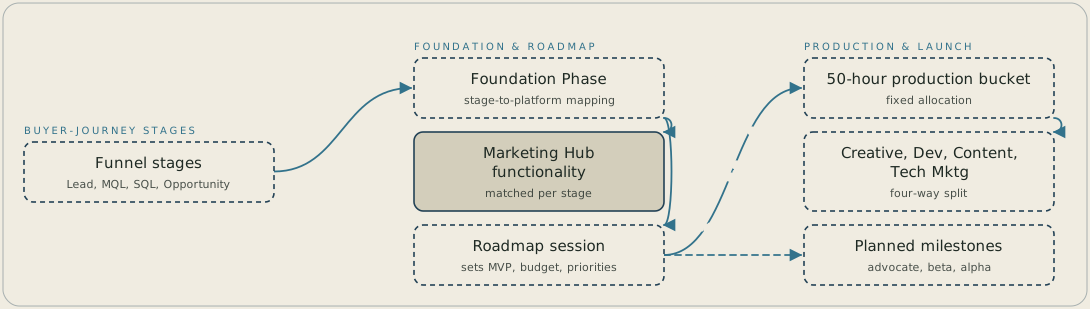
The client's four funnel stages, Lead, MQL, SQL and Opportunity, are matched in the Foundation Phase to the Marketing Hub functionality that recognises or advances each one. That mapping feeds the Campaign Project Context and Roadmap session, which sets the MVP, the budget and the priorities. The roadmap bounds a fixed 50-hour production bucket split across creative, development, content and technical marketing, and it schedules the advocate outreach and the beta and alpha launches after it.
FAQ
The roadmap's MVP, budget and priority decisions only mean something once the team knows which Marketing Hub functionality is responsible for each stage of the journey. Setting the roadmap first would have priced work against stages that nobody had mapped yet.
The engagement's production scope, covering creative, development, content and technical marketing, was fixed against one shared allocation and not four separate ones. The roadmap session set priorities across all four before any of them started drawing hours. You get one prioritised production plan, and the four disciplines don't compete for the same time.


