

Website Discovery and Roadmap for a Multi-Brand Aged Care Charity
An aged-care charity ran four sub-brands side by side: the organisation itself, a sibling dementia-care brand, a dementia-support organisation and a sibling palliative-care brand. Each carried its own pages, stakeholders and open questions, so no single rebuild brief could speak for all four at once. The charity commissioned a discovery phase before any design work started, then a roadmapping phase a year later, to test whether one plan could hold across every brand.
Executive Summary

Context
Each sub-brand carried its own content and its own unresolved stakeholder questions, with no shared plan connecting them. Rebuilding four brands at once carried real coordination risk if the work started from assumption instead of evidence. So the charity funded research first and held the build decision back until it had that evidence.

What We Built
We ran a discovery phase across the charity's four sub-brands, then a separate roadmapping phase that produced a sitemap for each brand, an SEO strategy and one merged question-and-answer log spanning every sub-brand. That log became the shared reference point that the later rebuild drew its structure decisions from, so each brand didn't have to answer the same questions again alone.

Tech Stack
Not a fit for a single-brand rebuild with one stakeholder group and one content library, since the coordination problem this phase solved, reconciling several sub-brands' questions into one plan, doesn't exist at that scale. It's also not a fit if the organisation is ready to build immediately, because this phase exists to hold the build until sitemaps, an SEO strategy and real evidence are in hand.

The Challenge
The charity's four sub-brands each ran their own site content and answered to their own stakeholders: the organisation itself, a sibling dementia-care brand, a dementia-support organisation and a sibling palliative-care brand. None had been planned together, so nobody could say whether one rebuild brief would serve all four, or whether it would quietly favour whichever brand had the loudest internal voice.
Rebuilding without that evidence risked the opposite failure too. Each brand could build its own sitemap and SEO approach alone, and the sites would contradict each other at launch. So the charity funded research first, instead of trying to resolve that risk inside the build itself.

Our Approach
The discovery phase ran on a budget in the tens of thousands of dollars. We scoped it to settle whether a single rebuild plan could hold across every sub-brand or whether the brands needed separate plans. A roadmapping phase followed a year later, split into hour buckets scaled to each brand's footprint, with two hundred hours for the organisation and one hundred and thirty for the dementia-support organisation.
Both phases fed one shared output instead of four separate ones: sitemaps, an SEO strategy and one merged question-and-answer log spanning all four brands. With one merged log, a stakeholder's answer for one brand was visible to whoever planned another. So contradictions surfaced during research, not after launch.

Impact

A merged decision record replaced four separate ones
The question-and-answer log spanning all four sub-brands gave the rebuild a single reference point. Without it, four brand teams would each have answered the same structural questions alone and could have reached four different answers.
Each sub-brand entered the rebuild with its own sitemap already approved
The roadmapping phase produced sitemaps, so the build phase started from an agreed site structure for every brand. It didn't have to resolve page architecture and stakeholder disagreement while the build was underway.
An SEO strategy set priorities before a single page was rebuilt
Setting SEO priorities during roadmapping, not after launch, gave the later migration a strategy to build against. The team didn't have to work one out from whatever the new site produced.
The rebuild decision itself waited on evidence, not assumption
Funding a discovery phase before the rebuild let the charity weigh real research, sitemaps, an SEO strategy and a merged stakeholder record against the cost of rebuilding four sub-brands at once. It didn't have to commit on assumption.
We ran a discovery phase on a budget in the tens of thousands of dollars, scoped to test the rebuild question before any design or development work began.
The roadmapping phase ran as separate hour buckets for each brand, two hundred hours for the organisation and one hundred and thirty for the dementia-support organisation. That kept each brand's planning accountable to its own scope instead of one pooled total.
Four sub-brands could each have run their own discovery conversation. Instead we built one merged question-and-answer log spanning all four, so one brand's answer was visible to whoever was planning the next.
Roadmapping closed with a sitemap for each sub-brand and a named SEO strategy. We handed both to the team that ran the later rebuild as a starting brief, not an open question.
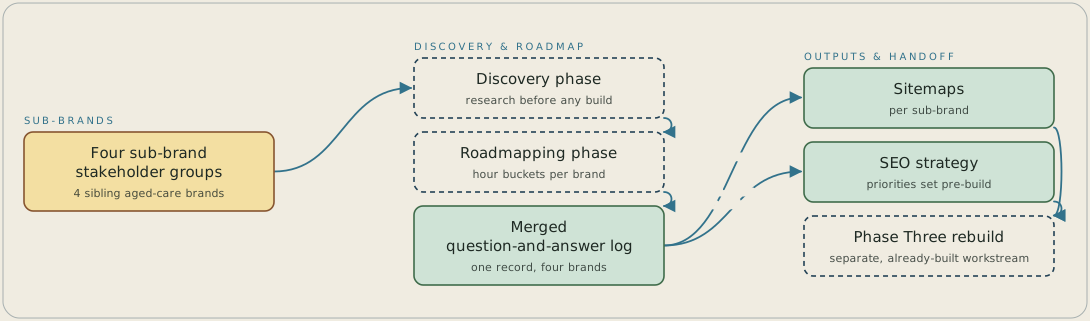
Four sub-brand stakeholder groups bring their own questions into one discovery phase. When the research is complete, a roadmapping phase splits the work into hour buckets scaled to each brand and records the answers in one merged question-and-answer log. That shared log feeds a sitemap for each sub-brand and an SEO strategy, and the approved structure and set priorities then pass to the separate Phase Three rebuild.
FAQ
The rebuild would touch four sub-brands at once, and nobody had evidence yet that one plan could serve all four. Splitting the work into discovery, then a separate roadmapping phase, let the charity test that assumption on a bounded budget before committing to the far larger cost of a full rebuild.
The roadmapping phase ran as hour buckets scoped to each brand, but it produced one shared question-and-answer log instead of four. A stakeholder's answer for one brand was visible to whoever was planning another, so the sitemaps and SEO strategy were reconciled across brands, not agreed four times over.


