

Three Deal Pipelines Gated by a Weighted Lead Score

One HubSpot portal tracked every lead the same way, whether it arrived through the marketing website, a self-service trial signup, or a franchise referral, so a single shared lifecycle stage set couldn't gate any of them correctly. A point-weighted lead-scoring model gated at 100 points, three separately named deal pipelines each with its own entrance and exit criteria, and list-based segmentation feeding nurture, re-engagement, and suppression lists replaced that undifferentiated handling.
Executive Summary

Context
A cloud-based estimating and project-management software company for service contractors ran three distinct lead paths through one HubSpot portal: website and referral, self-service trial signup, and franchise or partner-brand, each needing its own rules for advancing a record.

What We Built
We built a point-weighted lead-scoring model gated at 100 points, three named deal pipelines with stage-specific entrance and exit criteria, a mirrored Contact-to-Company status property, and list-based segmentation into nurture, re-engagement, or suppression tracks.

Tech Stack
- HubSpot
- Zapier
Not a fit if every lead in your portal follows one sales motion, since the value here came from giving three lead sources their own stage rules. Also not a fit if you need proof of production results: the workbook documents the design, and it doesn't confirm that the scoring model went live.

The Challenge
Before this build, the portal ran one generic lifecycle stage set and a shared Contact/Company Status property across every lead. A self-service signup and a franchise referral therefore advanced through identical stage logic, even though they had different sales motions. A stale "Opportunity" lifecycle value also sat unused in that set because Deals hadn't yet been adopted.
Nothing weighted a lead's fit before routing it forward. A qualified prospect and an unqualified inquiry entered sales queues through the same door.

Our Approach
The single shared stage set couldn't express that a self-service signup and a franchise referral needed different rules. So we split it into three pipelines: Website Lead/Referral, Self-Service, and Franchise/Job Rocket/Custom, each gated by stage criteria such as five proposals created and two accepted before a deal advances. A renamed Contact/Company Status property replaced the shared tracking and is mirrored from Contact to Company through automation.
Alongside the pipeline split, we added a point-weighted scoring model. Profile-fit signals are worth five to fifty points, bad-fit signals run from negative one hundred to negative one thousand, and one hundred points gives a contact marketing-qualified status. Segmentation then reads those records into nurture, re-engagement, or suppression lists.
The workbook doesn't state whether the model went live or stayed a documented design.

Impact

Lead quality becomes a number instead of a guess
The scoring model weighs profile-fit signals from five to fifty points and bad-fit signals from negative one hundred to negative one thousand, recalculating continuously as properties change, gated at one hundred points. That gives sales a single number to check, though the source material doesn't confirm whether the model was ever turned on in the production portal.
Three sales motions get their own advancement rules
Website Lead/Referral, Self-Service, and Franchise/Job Rocket/Custom each run their own pipeline, so a record must clear stage-specific criteria, such as five proposals created and two accepted, before advancing in that pipeline alone. That let each sales motion set the bar matching how it actually closes, instead of forcing a franchise referral through a self-service gate.
Contact and company status stay in sync automatically
The renamed Contact/Company Status property mirrors from Contact to Company automatically, so a status change on one side doesn't go stale on the other. That gave reporting and workflows one property to read instead of two that could disagree.
Stalled and cold leads get routed instead of stranded
List-based segmentation reads the scored, staged records into nurture, re-engagement, or suppression lists, so a stalled lead lands in nurture and one gone cold after qualifying drops into re-engagement instead of sitting untouched in a pipeline. The rebuild also flagged the unused Opportunity value for deletion.
Profile-fit signals, firmographic and engagement indicators, add five to fifty points each; clearly bad-fit signals subtract one hundred to one thousand. The score recalculates on every relevant property update or engagement event, and a total of one hundred points marks a contact marketing-qualified.
Website Lead/Referral, Self-Service, and Franchise/Job Rocket/Custom each define their own stage progression, with rules like five proposals created and two accepted required before a deal advances. Each pipeline tracks its own sales motion instead of sharing one stage set.
A renamed Contact/Company Status property mirrors from the Contact record onto its associated Company through automation, so both records carry the same current status. Any workflow or report reading Company-level status sees what a rep sees on the Contact.
Lists built on the scoring and status properties route contacts stalled below the MQL threshold into nurture, route contacts gone cold after qualifying into re-engagement, and suppress records that should not receive further outreach.
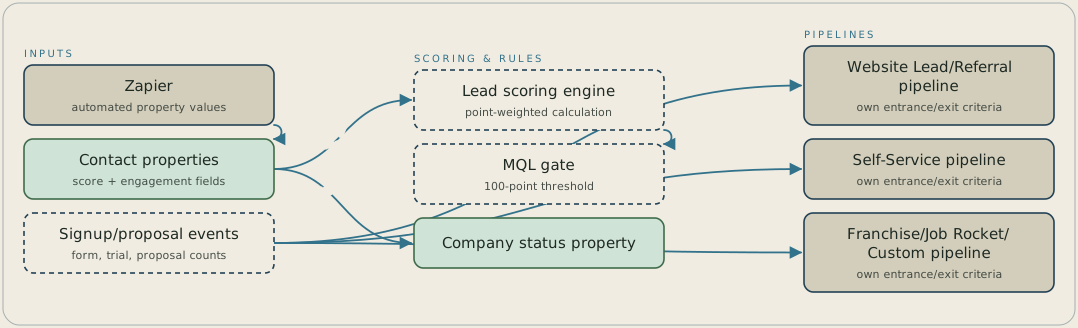
Zapier writes automated property values onto the contact record, and each change recalculates a point-weighted lead score that marks the contact marketing-qualified once it reaches 100 points. The contact's status is mirrored onto its company record. Signup, trial and proposal events then route a record by lead source into one of three pipelines, Website Lead/Referral, Self-Service, or Franchise/Job Rocket/Custom, each with its own entrance and exit criteria.
FAQ
It adds points for profile-fit and engagement signals, typically five to fifty points each, and subtracts one hundred to one thousand for a clearly bad fit. The score recalculates as properties change, and a contact crosses into marketing-qualified at the defined gate, one hundred points here.
Different lead sources close differently: a website or referral lead, a self-service signup, and a franchise lead don't pass through the same qualification steps. A dedicated pipeline lets the entrance and exit criteria, such as a proposal count before advancing, match how that lead type closes.


