

Admissions marketing migrates off tooling that could not separate a minor applicant from a guardian
Pre-college and undergraduate program marketing at a private university ran through Salesforce Marketing Cloud and Target X, tooling built for admissions transactions rather than nurture marketing. Target X couldn't carry a minor applicant and a guardian as two addressable contacts inside one marketing-usable segment, so a household's two real recipients collapsed into whichever record the form happened to capture.
We're moving that marketing layer onto HubSpot Marketing Hub, while a native Salesforce connector keeps standard CRM objects syncing bidirectionally against the existing Sales Cloud org.
Executive Summary

Context
The client is a private university's pre-college and undergraduate-programs division, migrating program marketing off Salesforce Marketing Cloud and Target X onto HubSpot Marketing Hub. Salesforce Sales Cloud stays the system of record for standard CRM objects, kept current through HubSpot's native connector and a bidirectional sync governance rule table.

What We Built
We rebuilt program forms, email templates, and lead-nurture automation natively in HubSpot Marketing Hub, replacing Salesforce Marketing Cloud as the sending platform. HubSpot's native Salesforce connector stayed in place underneath it, syncing standard Contact, Account, Lead, and Deal objects bidirectionally against the existing Sales Cloud org under a per-field rule table.
IP warming and a nurture-journey build are in progress.

Tech Stack
- Salesforce Sales Cloud
- Salesforce Marketing Cloud
- Target X (Base package)
- HubSpot Marketing Hub
- HubSpot's native Salesforce connector
- a per-field sync-direction rule table
- a paid transactional-email add-on
Not a fit if your Salesforce org is itself the CRM you intend to replace. This migration keeps Sales Cloud as the system of record and moves only the marketing layer. It also assumes transactional email is either already licensed or budgeted separately, since Marketing Hub doesn't include it by default.

The Challenge
Target X, the Base package's admissions and course-offering layer, flattened contact data. A minor applicant and their guardian couldn't exist as two distinct, addressable people inside one sendable list. The program's first technical discovery call flagged that gap as the central pain point.
Salesforce Marketing Cloud carried the same limitation into every send. Program marketing could reach a household's inbox, but it couldn't target the parent or the student separately within one campaign.

Our Approach
We ruled out moving the CRM itself. Salesforce Sales Cloud remains the system of record for standard Contact, Account, Lead, and Deal objects, and re-platforming it alongside a marketing migration would have doubled the risk in one project. Instead we kept HubSpot's native Salesforce connector running underneath the new marketing layer. It syncs those objects bidirectionally under a per-field rule table that assigns each field its own authoritative system and direction.
Transactional email surfaced a separate limit, because Marketing Hub doesn't include it by default. We flagged the paid add-on as a hard requirement before launch. The rest of the build covers form rebuilds, template builds, and IP warming toward roughly 350,000 contacts.

Impact

Parent and student reach the same program as two distinct contacts
HubSpot Marketing Hub can hold a minor applicant and their guardian as two separate, addressable contacts on their own tracks, closing the gap Target X left open. Program marketing can message each household member on their own track instead of guessing which inbox a shared form submission belongs to.
The Sales Cloud org keeps its own data without a second migration
Standard Contact, Account, Lead, and Deal objects keep syncing bidirectionally against the existing Salesforce org through HubSpot's native connector, governed field by field so admissions and marketing never silently overwrite each other's version of the same record. The university avoided running two simultaneous CRM migrations on the same team.
Transactional send is licensed before the nurture journey needs it
Flagging the paid transactional-email add-on as a hard requirement ahead of launch means the nurture build won't stall waiting on a licensing gap once IP warming clears. The team can sequence template builds and automation against a send capability that is already provisioned.
A combined list of roughly 350,000 contacts is ready to warm into
Form rebuilds and template builds are proceeding against a target outbound audience of about 350,000 contacts, the program's current lead volume plus contacts still to be pulled and uploaded. IP warming against that scale is sequenced ahead of launch rather than attempted cold.
Rather than treat the native Salesforce connector as one bidirectional switch, we assigned each synced field its own authoritative system and direction, recorded in a rule table enforced through the connector's own API. A field Salesforce owns flows one way; a field HubSpot owns flows the other.
Salesforce Marketing Cloud and Target X's marketing functions moved to HubSpot Marketing Hub, while Salesforce Sales Cloud stayed the system of record for standard objects. Splitting the migration this way kept the CRM's own data model untouched while the marketing layer changed underneath it.
HubSpot Marketing Hub doesn't ship transactional email by default, so we flagged the paid add-on to the university as a hard requirement ahead of the nurture-journey launch, rather than discovering the gap at send time.
The build sequences warm-up capacity ahead of the nurture-journey launch, current leads plus contacts still to be pulled and uploaded, so the send doesn't open onto an unwarmed list at scale.
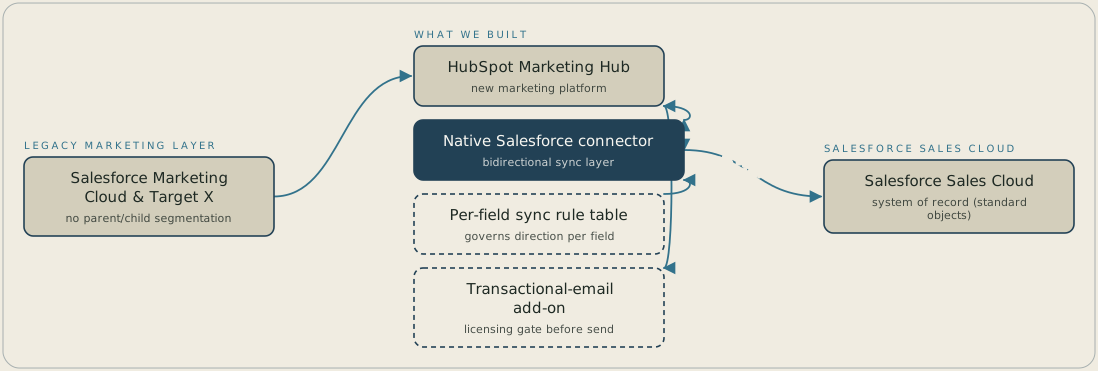
Program marketing moves from Salesforce Marketing Cloud and Target X, which couldn't segment parents and students separately, onto HubSpot Marketing Hub. HubSpot's native Salesforce connector keeps syncing standard objects with Salesforce Sales Cloud, the system of record, and a per-field rule table sets the direction each field flows. Marketing Hub also needs a paid transactional-email add-on before it can send transactional messages.
FAQ
Salesforce Sales Cloud stays the system of record for standard Contact, Account, Lead, and Deal objects, so re-platforming it alongside the marketing migration would have doubled the risk in one project. HubSpot's native connector keeps those objects synced bidirectionally under a per-field rule table instead.
Target X couldn't carry a minor applicant and their guardian as two separately addressable contacts inside one marketing-usable segment, collapsing a household's two real recipients into a single record. HubSpot Marketing Hub can hold both as distinct contacts on their own tracks.


