

Sales to service handoff pages started at verbal for a professional services company

Scope disputes surfaced months into the company's projects and traced back to caveats that never left the sales thread. We replaced the post-signature handoff meeting with a page that starts at verbal agreement, because after signature a scope disagreement becomes a change order. Delivery leads now review what they are signing up for while the SOW can still change.
Executive Summary

Context
The North America team of a professional services company on HubSpot, where a small sales group sells into a delivery organization of account managers, solutions architects, and developers.

What We Built
A handoff page per deal that collects the client's own success criteria, the SOW's biggest assumptions, known risks, a stakeholder map, and the verbatim record, plus a checklist of HubSpot properties a deal needs before it moves to Closed Won.

Tech Stack
- Claude Projects
- Fathom
- Gmail
- Slack
- HubSpot Sales Hub
- password-protected internal pages
Not a fit if the same person sells and delivers every engagement, because no context is lost between sale and kickoff. Also not a fit for deals small enough that a kickoff call covers the whole context.

The Challenge
Sales notes were scattered across chat threads and inboxes, and the SOW captured obligations without the reasoning or the warnings behind them. On one engagement, a technical risk was raised in Slack weeks before signature and only partly validated in a proof of concept, and the caveat the architect asked for never reached the client.
Deals also moved to Closed Won without milestones, estimated hours, or project duration, which broke the forecast the delivery team relied on.

Our Approach
We moved the handoff earlier and made it a page rather than a meeting. When a deal reaches verbal, Claude assembles the handoff from the deal room and the record: what the client said success looks like, the SOW's riskiest assumptions, open risks with their source, the stakeholder map, and links to the calls.
We also made the CRM part of the handoff. A closed-won prep checklist lists exactly which HubSpot properties and milestones must be set before the stage changes, so the forecast and the handoff agree. The trade-off is extra work for the sales team at verbal, before the deal is won.

Impact

A handoff for every signed deal since August
Handoff pages were created for eight deals between August and October 2026, including platform migrations, a strategic growth engagement, and a website roadmapping project, with the first published the same day its deal signed.
Delivery sees the deal before it closes
Starting at verbal gives the delivery lead time to challenge an assumption or a timeline before the SOW is signed, rather than after.
Cleaner records at Closed Won
The closed-won checklist was tested on two October deals and lists the milestones, estimated hours, and duration each one needed before it could move.
Lessons from hard projects carried forward
The pattern that preceded two of the company's hardest overruns, a required Change of Scope that was never executed, is now named in the handoff's risk section.
The handoff draws on the same deal room that tracked the sale, so calls, proposals, and decisions arrive with their dates and links instead of being reconstructed from memory.
Success criteria are quoted from the client's own statements on calls and in email, then mapped to SOW deliverables, so delivery works toward what the buyer said rather than a paraphrase.
Before a stage change, a checklist confirms milestones, estimated hours, project duration, and other required properties against the signed SOW.
Each known risk links to where it was first raised and by whom, so a caveat raised in a sales thread can't silently disappear.
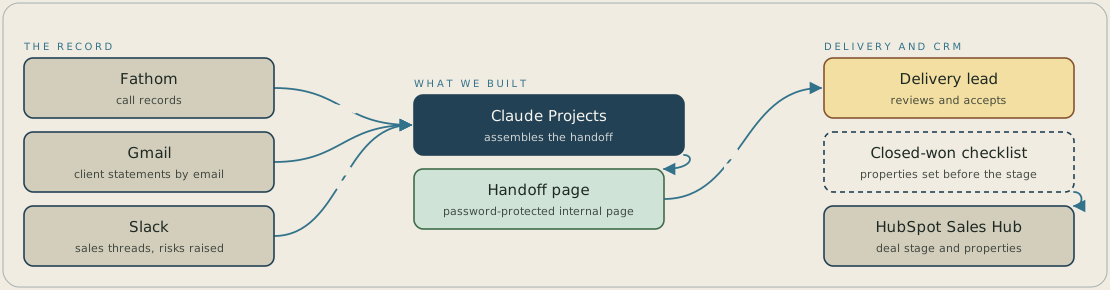
Systems: a deal room (the record of calls, email and Slack threads for the sale); Claude Projects (assembles the handoff page); the handoff page (success criteria, SOW assumptions, risk register, stakeholder map, links to calls); the delivery lead (reviews and accepts the page before kickoff); HubSpot Sales Hub (deal properties, milestones, Closed Won stage); the closed-won checklist (a gate inside the deal stage change). Flows: a deal reaching verbal agreement triggers Claude Projects to read the deal room and write the handoff page. The page goes to the delivery lead for review and acceptance before kickoff, ahead of signature while the SOW can still change. Before the deal stage changes to Closed Won, the closed-won checklist checks milestones, estimated hours and project duration in HubSpot against the signed SOW; the stage changes only when they are set. The evidence is silent on any automated sync between the page and HubSpot, so none is drawn. Layout: left to right in one row, from the deal room to Claude Projects, the handoff page, the delivery lead, then the checklist and HubSpot Sales Hub, with the verbal agreement trigger marked above the first arrow and the Closed Won gate marked above the last.
FAQ
At verbal agreement, before signature, because that is the last point where delivery can still change the SOW. After signature, a disagreement about scope becomes a change order or a dispute. Here, a handoff page assembled at verbal gives the delivery lead the client's success criteria and the riskiest assumptions while there is time to act on them.
Sales drafts it with Claude from the deal record, and the delivery lead reviews and accepts it before kickoff. Once accepted, the account team maintains it. A first conversation would look at who on your team currently brings context from the sale into kickoff, and which HubSpot properties your deals carry when they reach Closed Won.


