

Interactive proposal pages with tiered scope and pricing math for a systems integrator

The integrator's proposals were static documents that a champion forwarded to a buying committee, and the questions that came back took another round of calls. We replaced the PDF with a password-protected page that has tiers, a scope configurator, and a labor sheet behind every price. Seven of the eight proposals that reached a decision after mid-July 2026 closed won.
Executive Summary

Context
The North America sales team of a marketing technology systems integrator, selling platform migrations, CRM implementations, and website builds to mid-market and enterprise buyers, often alongside HubSpot co-sell reps.

What We Built
A proposal system that turns deal notes into a hosted, password-protected page with tiered options, a scope configurator, a timeline, a time savings planner, and a labor sheet behind every price.

Tech Stack
- Claude Projects
- Supabase
- Google Sheets
- HubSpot Sales Hub
Not a fit if procurement accepts only a fixed document format, because the tiers and configurator have nowhere to go. Also not a fit for small transactional deals, where a one-page quote already answers what the buyer needs to know.

The Challenge
The people who read the integrator's proposals were rarely the people who signed. A champion would take a PDF into a meeting the sales team wasn't in, and the questions that came back (what if we do more of the migration ourselves, what does this save us, why does it cost this much) took another round of calls to answer.
Prices were defensible, but only one person could reconstruct the math behind them, so a teammate couldn't check a number before it went out.

Our Approach
We moved the proposal from a document to a page, built in the same Claude thread that held the deal notes. The page opens with the recommendation, then lets the buyer explore tiered options such as Guided DIY, Co-Build, and White Glove, a timeline, and on larger deals a time savings planner that shows hours returned to the client's team.
On a Salesforce Marketing Cloud migration for a vertical software company, the proposal opened with a fixed baseline for discovery and the core architecture and put everything else into a configurator. The deal signed at more than three and a half times that baseline, 43 days after it was created. Scope also grew through conversation, so we give the configurator partial credit: it made a larger scope easy to see, price, and approve.
Behind every price, a labor sheet breaks the fee down by task, role, hours, and rate, so anyone on the team can check how the number was reached.

Impact

Most decided proposals closed won
Of the proposals tracked on the publishing platform that reached a decision after mid-July 2026, seven of eight closed won, for about $390k. The sample is small, and deals that reach a proposal are already qualified.
A proposal page for every live deal
The North America team published 84 proposal, assessment, and planner pages between July 3 and October 27, 2026, including earlier proposals moved onto the platform in July. Each page keeps its URL through every revision, so a champion who forwards it always sends the current version.
Migration deals closing more often
Platform migration deals, the heaviest users of these pages, won 60% of decided deals in 2026, up from 35% in 2024, with more than $800k won.
Pricing anyone can check
Labor sheets and a written rate card with an hourly floor made every price reviewable by a teammate before it went out, so a number no longer depended on one person's judgment.
The proposal is drafted in the same Claude Project thread as the deal notes and call transcripts, so the recommendation reflects what the buyer actually said. The black and white draft comes first, and the interactive version is built from it.
Each tier lists what the client's team does, what the integrator does, and hard caps such as the number of templates, forms, or nurtures. The buyer chooses scope against bandwidth instead of negotiating a discount.
An interactive planner estimates hours returned each week after the migration, using numbers the client supplies on the call. It was first written for one enterprise proposal and is now a reusable skill.
Each proposal is a hosted page with a password and a client record, and every round of changes publishes as a new version at the same URL, so the buyer always sees the current one.
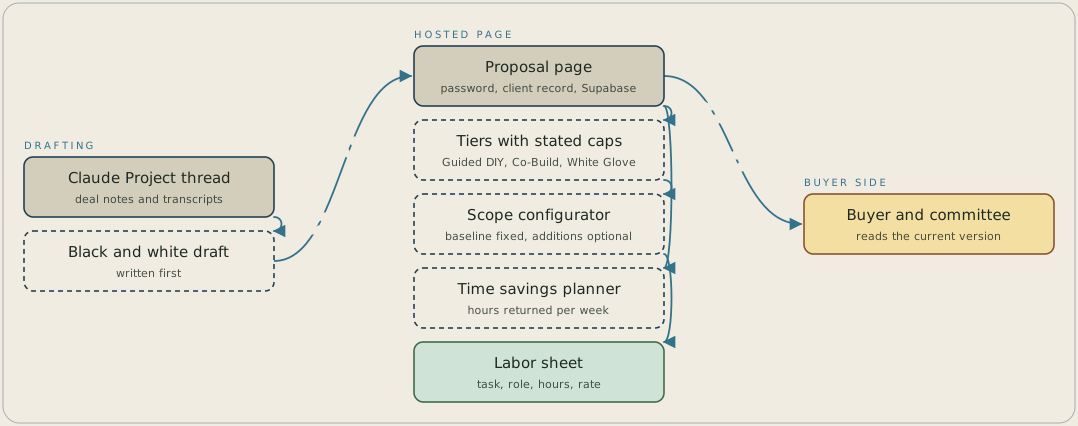
Systems: a Claude Project thread (holds the deal notes and call transcripts and drafts the proposal); the black and white draft (the first version, which the interactive page is built from); the hosted proposal page (password-protected, with a client record, on Supabase); the page's parts, which are tiered options (Guided DIY, Co-Build, White Glove, each with stated caps), a fixed baseline plus scope configurator, a timeline, a time savings planner and a labor sheet by task, role, hours and rate; the buyer (the champion who forwards the page to a buying committee); the formal SOW (the contract document, kept separate); and HubSpot Sales Hub (where deal outcomes are recorded). Flows: deal notes and transcripts flow into the Claude Project thread, which produces the black and white draft (trigger: a deal reaches the proposal stage). The draft is turned into the hosted page. The buyer opens the page with the password and chooses tiers and additive scope in the configurator, and the planner takes numbers the client supplies on the call (trigger: a larger deal). Every round of changes publishes as a new version at the same URL (trigger: each revision). The chosen scope moves to the formal SOW, which does the contracting. Deal outcomes are recorded in HubSpot Sales Hub. The evidence is silent on what Google Sheets holds, so it is not drawn. Gates: the baseline of discovery, strategy and core architecture sits outside the configurator and cannot be removed; only additive scope is configurable. A teammate checks the labor sheet before a price goes out. Layout: left to right in one row from the Claude Project thread to the draft, the hosted page and the buyer, then the SOW. The page's parts stack inside the hosted page box, with the labor sheet beneath the price. HubSpot Sales Hub sits below the SOW.

FAQ
Not in this integrator's experience, because the SOW is still a formal document. The page does the persuading and answers what-if questions, and the SOW does the contracting.
The baseline that protects the architecture, meaning discovery, strategy, and core architecture work, priced as a starting point the buyer can't remove. Only additive scope belongs in the configurator, so the buyer chooses scope against bandwidth instead of negotiating a discount. A first conversation would look at which parts of your current proposals are safe to make optional.


