

Escalated account recovery with an AI evidence timeline for a digital marketing agency

An executive sponsor at the agency's client emailed on go-live day to say a marketing automation migration had missed expectations, and the champion who signed the SOW had left. We used Claude to rebuild the engagement history as a dated, cited timeline before the next call, because without one that call becomes a memory contest. The agency reached a clean, agreed close and has reused the method on later escalations.
Executive Summary

Context
A digital marketing agency on HubSpot managing an escalated fixed-fee migration from a legacy marketing automation platform. The client's original champion had left weeks after kickoff, and the delivery team had absorbed adjacent questions outside the SOW along the way.

What We Built
A repeatable recovery workflow that sweeps every source for one account, builds a dated evidence timeline, and produces separate internal and client-facing outputs from the same facts.

Tech Stack
- HubSpot Marketing Hub
- Fathom
- Gmail
- Slack
- SOW and change history
- Claude
- password-protected pages
Not a fit if the escalation is already a legal dispute in counsel's hands, since counsel then decides what the record is used for. Also not a fit if the engagement history was never recorded in calls, email, or a shared workspace, because the timeline can only cite what exists.

The Challenge
The agency's scope position depended on what had been agreed with a champion who was no longer at the client, plus months of small decisions spread across call recordings and side threads. The people who remembered those decisions were busy delivering the go-live, and nobody had assembled them.
The client also asked the team to bulk-subscribe contacts for sends during IP warming. Subscription and opt-in decisions belong to the account owner under HubSpot's terms, so the team declined to act on them from its own user credentials, even under deadline pressure, and then had to explain that refusal without sounding defensive.

Our Approach
We used Claude to sweep Fathom, Gmail, and Slack for the account and produce a dated timeline in which every claim cites its source. The timeline went through three versions as new threads surfaced. It became an internal evidence file and, separately, a client-facing outcomes sheet listing each SOW deliverable with its evidence in an expandable panel, with budget burn, team strain, and escalation history removed from everything the client saw.
The tone rule came from a second account. During a delivery escalation at a university department, the draft Phase 2 SOW included contractual backstops that were accurate but wrong for the relationship at that moment, so we removed them and recorded the tone choice as a deliberate one.
For the migration client, the last step was an exit playbook: a talk track with explicit do-not-say guardrails, objection handling, and a post-call email confirming completion and the one remaining session.

Impact

A clean, agreed close
The wrap-up call with the executive sponsor ended without friction. The client confirmed it was ready to self-manage HubSpot and offered to support a private case study.
A university phase signed after the escalation
The university department escalated on a delivery call, and its Phase 2 integration build signed twelve days later, with the contractual backstops left out of the SOW.
An independent partner reached the same reading
The agency's HubSpot partner manager reviewed the same record and reached the same reading of scope, which counted for more with the client than the agency's word alone.
Post-mortem findings feed account monitoring
The post-mortem scored the engagement across eight lenses, from commercial motion to case study candidacy. Its findings on multi-threading, pricing for risk, and change-order discipline became inputs to the agency's client health monitor, which already flags a champion going quiet and has change-order detection on its roadmap.
Fathom meetings are filtered by date window, then pulled by recording ID. Slack is searched on the account name and sorted by time, and Gmail threads are matched on the client domain. Every item is cited in the timeline with a link back to its source.
When a client has two engagements, such as two departments at one university, the context brief names which records belong to which. It also explains why calls labeled with the institution's name may belong to only one of them.
The internal file keeps commercial detail. The client version removes burn, strain, and escalation history by rule rather than by memory, so nothing in it has to be walked back.
The post-mortem scores commercial and sales motion, scope fidelity, profitability, delivery execution, relationship and sentiment trajectory, process adherence against a guardrail rubric, expansion and retainer potential, and case study candidacy.
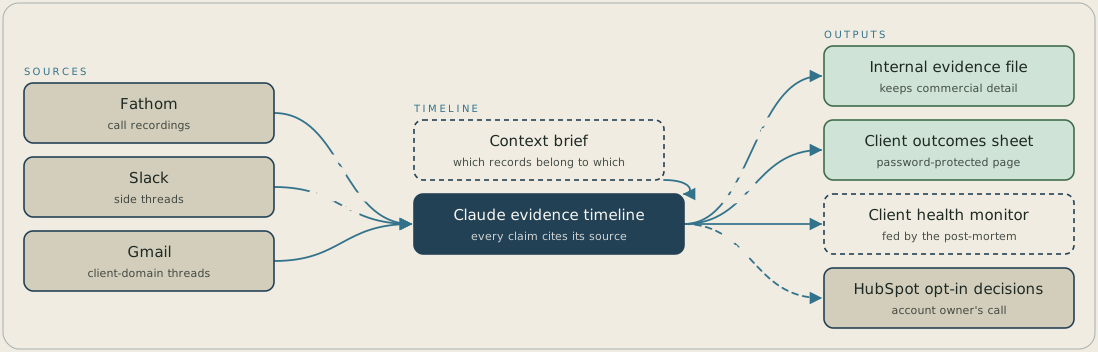
Systems: Fathom (call recordings); Slack (side threads); Gmail (email threads on the client domain); Claude (sweeps the three sources and builds the timeline); the dated evidence timeline (every claim cites its source); an internal evidence file (keeps commercial detail); a client outcomes sheet on a password-protected page (each SOW deliverable with its evidence in an expandable panel); a context brief (names which records belong to which engagement); and the post-mortem feeding the client health monitor. Flows: Fathom meetings are filtered by date window and pulled by recording ID, Slack is searched on the account name and sorted by time, and Gmail threads are matched on the client domain; all three go to Claude on demand, with the context brief steering records to the right engagement when a client has two. Claude writes the timeline, which is revised as new threads surface. The timeline splits into the internal file and the client sheet; a stripping rule removes burn, strain and escalation history from the client sheet. After close, a post-mortem scoring eight lenses sends its findings to the client health monitor. Boundaries: the stripping rule is the gate between internal and client views; the source evidence stops at what was captured. Subscription and opt-in changes in HubSpot sit outside the flow, because they belong to the account owner. Layout: left to right, three sources into Claude, then the timeline, then a fork into the two outputs, with the post-mortem and health monitor below.
FAQ
A dated timeline in which every claim about scope cites its source, especially when the person who agreed the scope has left the client. Without it the call turns into a memory contest, which an agency tends to lose even when it is right. Here, Claude swept calls, email, and Slack for one account, and the timeline produced both an internal evidence file and a calmer client-facing outcomes sheet.
Recorded calls, email on the company domain, and a shared workspace such as Slack, plus the signed SOW and any change history. The timeline can only cite what was captured, so gaps in recording become gaps in the record, and when one client has two engagements someone has to say which calls belong to which. A first conversation would look at which of those sources exist for the account in question.


