

AI sales operating model in Claude with shared skills for a digital marketing agency

Every discovery call needed notes, every proposal needed solutions input, and every SOW needed the right rates, so sales capacity depended on two or three people. We replaced individual prompting, which sped up drafts without moving the close rate, with one Claude Project holding role rules, rate files, and shared skills. Deal notes, proposals, and SOWs now use the agency's rates and voice, and a person reviews each one.
Executive Summary

Context
The North America region of a multi-region digital marketing agency on HubSpot, with a small sales group, heavy HubSpot co-sell involvement, and senior solutions staff whose time limits how many complex deals the region can pursue.

What We Built
A Claude Project with role definitions, lifecycle rules, rate and nomenclature references, and brand voice training, plus a library of shared skills for proposals, pricing, pre-call briefs, deal summaries, handoffs, and post-mortems.

Tech Stack
- Claude Projects and skills
- Fathom
- Gmail
- Slack
- HubSpot
- Google Workspace
Not a fit if the team won't record calls, because deal notes and proposals are drafted from transcripts. Also not a fit for leadership that wants AI output used without review, since every deliverable here is checked by a person before it reaches a client.

The Challenge
The agency's sales capacity was tied to two or three people, because they were the ones who knew which rates applied, which milestones and exclusions belonged in an SOW, and how a solution should be scoped. A draft written by anyone else went back to one of them for rates and scope.
Individual AI use made single drafts faster, but the region's close rate in 2025 was no better than in 2024. Instructions kept in long chat threads also drifted, so the same request could come back with different rates or structure from one week to the next.

Our Approach
The region chose Claude after a side-by-side test against ChatGPT in late 2024, then spent the next year turning individual use into a shared system. We built one Claude Project that holds role definitions for sales, solutions, account management, design, and marketing, plus rules for each stage of the sales and service lifecycle. Deal Notes follow one format on every new call: an opportunity table, then SPICED, Sandler, and Slingshot analysis, with coaching at the end.
Recurring work then moved from prompts to skills, each with its own checks: a labor sheet for pricing, a voice scan that blocks em dashes and banned phrases, a deal room builder, and a closed-won checklist. A shared skill library proposal in October 2026 extended the same brand guardrails to the agency's EMEA and APAC teams.
AI office hours, a Claude Project 101 session, and a quarterly business review spotlight spread the method beyond the person who built it. The trade-off is that the rate and voice files need an owner, because every skill inherits whatever they say.

Impact

Close rate rose from a third to half
Counting only deals whose company had a logged meeting, so that stale CRM stages can't inflate the result, the North America close rate was 33% in 2024 and 34% in 2025, then 50% in 2026 through late October. On new clients the team met, it rose from 23% to 34%. The operating model is one of several changes in that period.
A steady rate on a larger book
The region's lead seller closed about 56% of met deals in both 2025 and 2026 while handling more of them, from 32 decided deals in 2025 to 43 by late October 2026.
A higher median deal
The median won deal rose 35%, from $20.2k in 2025 to $27.4k in 2026 through late October. Larger scopes were priced from the same rate files and labor sheets, so a teammate could check a bigger number before it went out.
One standard across regions
Rates, engagement nomenclature, and brand voice are encoded once and used by every skill, and the shared library extends the same guardrails to the agency's other regions.
The project tells Claude which role to work from based on the request and where the deal is in the lifecycle, from first discovery to retainer renewal, so the same tool writes discovery coaching early and scope protection late.
Rate cards, billing policy, engagement types, and voice guidance are project files generated from one context layer, so a rate change is made once and every skill picks it up.
Each recurring deliverable is a skill that includes its own validation, such as a voice scanner, a schema column count, or a required-properties checklist, rather than relying on the prompt alone.
The project asks which account a question is about before tailoring an answer, which prevents details from one client's deal leaking into another's.
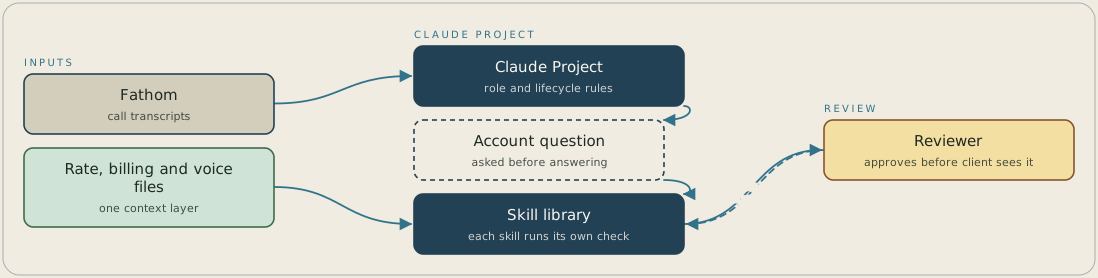
Systems: a call recording tool (Fathom; captures each call as a transcript); a Claude Project (holds role definitions for sales, solutions, account management, design and marketing, plus lifecycle rules from first discovery to retainer renewal); project knowledge files (rate cards, billing policy, engagement types, nomenclature and voice guidance, generated from one context layer); a skill library (proposals, pricing, pre-call briefs, deal summaries, handoffs, post-mortems, each with its own check); HubSpot Sales Hub (deals and win and loss data); Gmail, Slack and Google Workspace (where the people work); and a seller or solutions lead who reviews every deliverable. Flows: a call transcript goes from the recording tool into the project on every new call, and the project returns Deal Notes in one format (opportunity table, then SPICED, Sandler and Slingshot analysis, coaching at the end). A request about a deal goes into the project, which first asks which account it concerns (gate: no tailoring before the account is known), then works from the role that matches the lifecycle stage. Knowledge files feed every skill, so a rate change is made once. Each skill runs its own check (a labor sheet for pricing, a voice scan that blocks em dashes and banned phrases, a closed-won checklist) before output goes to the reviewer, who approves it before it reaches a client. Layout: left to right in one row from the recording tool to the project, to the skills, to the reviewer and then the client, with the knowledge files as a band beneath the project and skills that every skill reads. HubSpot data feeds the close-rate measurement only; the evidence names no automated sync between HubSpot and the project, so none is drawn.
FAQ
Yes, if the rates, engagement types, and voice rules are written down as files the project reads rather than repeated in prompts. Here, rate cards, billing policy, and nomenclature are project files, and each recurring deliverable is a skill with its own checks, such as a labor sheet for pricing. A person still reviews every client-facing piece before it goes out.
A current rate card, the engagement types and structural terms your SOWs use, and voice guidance with examples, because those are what a shared project applies on every draft. Recorded discovery calls matter as much, since deal notes and proposals are drafted from them. A first conversation would look at which of those exist today and who owns keeping them current.


