

AI deal desk and self-updating deal rooms on HubSpot for a CRM systems integrator

In June 2026 the integrator's North America team had 40 to 45 active opportunities in HubSpot, and only about $1.1M of that pipeline carried a recorded value. We ruled out another HubSpot dashboard, which could not easily show call content or proposal versions, and built a deal desk that rebuilds the pipeline twice a day. Every live deal also has a deal room that updates itself after major calls.
Executive Summary

Context
The North America sales team of a CRM systems integrator and HubSpot partner, running roughly 10 to 40 live deals at a time across solutions, website, and strategy work, with HubSpot co-sell reps involved on many of them.

What We Built
A pipeline hub that refreshes at 6:00am and 4:30pm Eastern and ranks deals by near-term close likelihood and activity, plus a per-deal room template that updates itself after major calls and conversations.

Tech Stack
- HubSpot Sales Hub
- Fathom
- Gmail
- Slack
- Google Calendar
- Claude
- Supabase
Not a fit if sales calls aren't recorded, because the rooms summarize what was said and have nothing to read without transcripts. Also not a fit for a team running a handful of deals a quarter, where a CRM view and a weekly meeting already cover each deal.

The Challenge
HubSpot held the deal records, but the context that decides a deal was spread across other tools: what the economic buyer said on the last call, which proposal version went out and when, who at HubSpot was involved, and whether anyone had booked the next meeting. Reps rebuilt that context by hand before every meeting, and deals without recent attention quietly lost their values and dates.
Large deals got attention whether or not they could close that quarter, while smaller deals that were ready to sign waited.

Our Approach
We split the work between a desk, which is the single pipeline view, and a deal room for each deal, which is the working page for that deal. The desk ranks deals by how likely they are to close in the next 30 to 45 days and then by activity, which matched how the team already talked about priority better than ranking by size.
Refreshing every room on every pass would have been expensive and noisy, so rooms run in three modes: hyper for deals with calls this week, active for deals with a call on the calendar or one being booked, and dormant for deals with no activity. A room's first poll always holds everything known, so a quiet room is still a complete one. The trade-off is that a dormant room can lag until something new arrives.
Each room links its proposals with sent dates, a duplicable inventory sheet, and, at verbal, the sales to service handoff.

Impact

Pipeline values on record
Open, valued pipeline outside the team's parked-deals stage stood at about $3.6M across 41 deals in late October, compared with about $1.1M recorded in June across a similar number of opportunities. Part of that gap is larger deals and part is better record keeping, which was one of the goals.
A room for every live deal within a week
Forty-nine deal rooms were created in the week after the desk launched in mid-October 2026, each from the same template, so a fix to the base reaches every room.
Faster cycles on the deals that matter
Median time from deal creation to close fell from 34.5 days in 2025 to 28 days in 2026 through late October. The desk and rooms arrived late in that period, so they are one of several contributors.
Partners see the same picture
Each room has its own URL, so a deal can be shared with a HubSpot co-sell team to compare notes without exposing the rest of the pipeline.
The desk refreshes at 6:00am and 4:30pm Eastern from HubSpot deals, recorded calls, email, and Slack. Offhand remarks in internal meetings are not accepted as timeline evidence; dates come from the client, signed documents, or proposals.
Hyper, active, and dormant modes control how often a room re-reads its sources. A calendar event or an open scheduling thread with the client promotes a room to active automatically, and dormant rooms are summarized only when something new arrives, which keeps AI costs down.
All rooms render from a single template, so features and styling change in one place. A per-room toggle can pin an older version when needed, with the current version as the default.
Every tool, process, and logic change is written to a changelog page alongside a future improvements list, so the team can see why the desk behaves the way it does.
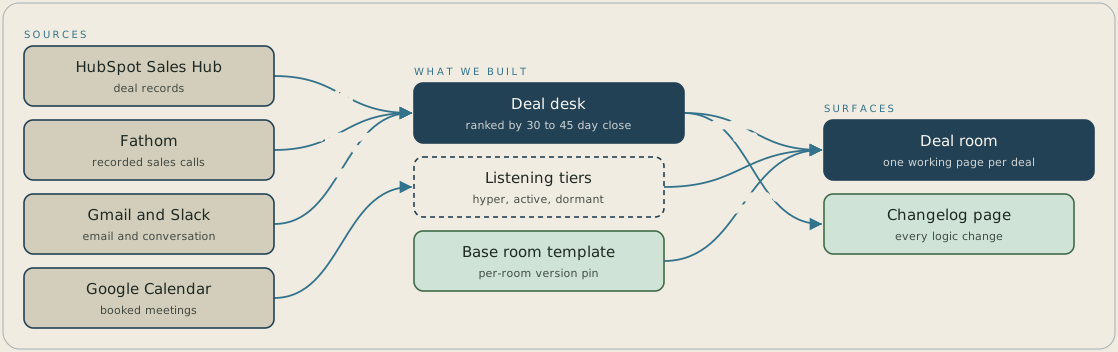
Systems: HubSpot Sales Hub (system of record for deals); Fathom (recorded sales call transcripts); Gmail (email); Slack (conversation); Google Calendar (booked meetings); Claude (writes the per-deal summaries); Supabase (listed in the stack, its role is not described in the evidence); the pipeline desk (a single ranked pipeline view); the deal rooms (one working page per deal, all rendered from one base template); a changelog page. Flows: on a schedule, 6:00am and 4:30pm Eastern, HubSpot deals, Fathom calls, Gmail and Slack feed the desk, which ranks deals by close likelihood in the next 30 to 45 days and then by activity (mechanism 1). Each deal room re-reads its sources by mode: hyper for calls this week, active for a call on the calendar or being booked, dormant for no activity. A Google Calendar event or an open scheduling thread with the client promotes a room to active; a dormant room is summarized only when something new arrives (mechanism 2). The base template feeds every room, and a per-room toggle can pin an older version (mechanism 3). Every tool, process or logic change goes to the changelog page (mechanism 4). Changes still return to HubSpot through the team. Boundaries: dates are accepted only from the client, signed documents or proposals, never offhand remarks in internal meetings; each room has its own URL, so a deal can be shared with a HubSpot co-sell team without exposing the rest of the pipeline. Layout: left to right, source systems in a column, then the desk, then the rooms beneath it in three mode lanes, with the base template above the rooms and the changelog as a band underneath.

FAQ
Not easily, because dashboards report on deal properties and logged activities rather than what was said on a call or which proposal version went out when. Here HubSpot stayed the system of record, the desk added a written summary per deal from calls, email, and Slack, and changes still went back into HubSpot through the team.
Recorded sales calls and deal records that carry a close date, because the rooms read transcripts and the desk ranks on near-term close. Calendar access matters too, since a booked meeting is what moves a room from dormant to active. A first conversation would look at how many of your live deals have a recorded call and a dated next step.


